
Built to provide research that’s more actionable and strategically valuable, The Business Research Company’s 2026 market reports include market attractiveness analysis, total addressable market sizing, company benchmarking matrices, interactive Excel dashboards, broader supply chain intelligence, emerging startup tracking, and in-depth product insights.
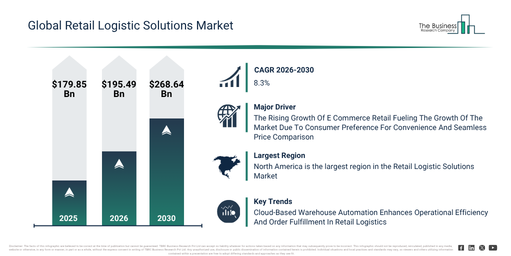
Retail Logistic Solutions Market Forecast: Value Set To Climb From $195.49 Billion To $268.64 Billion
The retail logistic solutions market has demonstrated robust growth in recent years. It is projected to expand from $179.85 billion in 2025 to $195.49 billion in 2026, achieving a compound annual growth rate (CAGR) of 8.7%. This historic growth can be attributed to the increasing expansion of retail networks and distribution channels, rising demand for efficient product movement and storage, growing adoption of organized retail operations, increasing need for improved inventory management, and the expansion of e-commerce and omnichannel retail activities.
The retail logistic solutions market is projected to experience substantial expansion over the upcoming years. This market is set to reach $268.64 billion by 2030, progressing at a compound annual growth rate (CAGR) of 8.3%. This projected growth during the forecast period is driven by several factors, including the escalating demand for expedited order fulfillment, the greater need for resilient supply chains, the expanding reach of online retail platforms, the increasing imperative for cost efficiency in logistics, and the intensified focus on sustainable transportation and delivery methods. Key trends anticipated within this period encompass the wider adoption of integrated retail supply chain management systems, the escalating requirement for real-time inventory tracking and order transparency, a heightened emphasis on optimizing last-mile delivery, the ongoing creation of adaptable and scalable retail logistics infrastructures, and the expanding use of sophisticated warehouse management techniques.
Get A Free Sample Report With In-Depth Market Insights:
Retail Logistic Solutions Market Demand Drivers Opening New Revenue Streams
The expansion of e-commerce retail is anticipated to fuel the market for retail logistics solutions. E-commerce retail growth signifies a continuous rise in the overall value and quantity of products consumers purchase via online channels. This surge is primarily due to consumers’ growing preference for convenience, as online shopping allows for quick, efficient purchases without requiring visits to physical stores, thereby saving time and effort. Retail logistics solutions facilitate e-commerce by optimizing inventory management, order fulfillment, and last-mile delivery, which leads to quicker product distribution and enhanced customer satisfaction. For example, in January 2026, data from the Australian Bureau of Statistics indicated that Australian online retail turnover hit AUD 4,182.6 million (USD 2,927.8 million) in November 2024, marking an 8.7 percent year-over-year increase from November 2023. Consequently, the expanding e-commerce retail sector is a key impetus for the retail logistics solutions market’s development.
Retail Logistic Solutions Market Segment Analysis And Revenue Potential
The retail logistic solutions market covered in this report is segmented –
1) By Solution Type: Transportation Management, Warehousing And Storage, Inventory Control And Management, Order Fulfillment, Value Added Services
2) By Mode Of Transport: Roadways, Railways, Airways, Waterways
3) By Technology Integration: Automation And Robotics Enabled Logistics, Artificial Intelligence And Predictive Analytics Solutions, Cloud Based Logistics Platforms, Internet Of Things Enabled Tracking Systems, Warehouse Management Systems, Real Time Tracking And Visibility Tools
4) By End User Industry: Grocery, Food And Beverage, Fashion, Apparel And Lifestyle, Consumer Electronics And Appliances, Personal And Household Care, Pharmaceuticals And Healthcare Retail, Home And Furniture Retail
Subsegments:
1) By Transportation Management: Freight Optimization And Routing, Fleet Management And Tracking, Carrier Selection And Management, Load Planning And Consolidation, Route Planning And Scheduling
2) By Warehousing And Storage: Storage Space Optimization, Warehouse Layout Planning, Goods Receiving And Dispatch Handling, Cross Docking Operations, Storage Condition Management
3) By Inventory Control And Management: Stock Level Monitoring, Demand Forecast Based Replenishment, Inventory Tracking And Visibility, Safety Stock Management, Multi Location Inventory Coordination
4) By Order Fulfillment: Order Processing And Validation, Pick Pack And Ship Operations, Last Mile Delivery Coordination, Order Tracking And Status Updates, Returns And Reverse Logistics Handling
5) By Value Added Services: Product Labeling And Packaging, Kitting And Assembly Services, Customization And Personalization Services, Quality Inspection And Assurance, After Sales Support Services
Retail Logistic Solutions Market Trends Redefining Industry Growth
Leading companies within the retail logistics solutions market are concentrating on creating sophisticated cloud-based warehouse automation. This initiative aims to enhance warehouse processes, streamline order fulfillment, boost operational transparency, and facilitate scalable logistics activities. Cloud-based warehouse automation is defined as a digital system leveraging cloud platforms to automate tasks such as inventory tracking, order processing, and general warehouse workflows, thereby offering real-time insights, increased efficiency, and adaptable operations. As an illustration, in March 2025, Honeywell International Inc., an industrial automation firm based in the US, unveiled its warehouse execution software (WES) platform. This cloud-centric solution empowers distribution and fulfillment centers to handle picking, routing, order processing, staff allocation, and capacity planning via a scalable cloud infrastructure. Furthermore, the platform delivers real-time operational data, supports analytics driven by AI, lowers IT infrastructure expenses, and boosts warehouse flexibility by consolidating information from robots, scanners, and other automated systems to elevate overall supply chain performance.
Retail Logistic Solutions Market Key Players Shaping Industry Direction
Major companies operating in the retail logistic solutions market are United Parcel Service Inc., FedEx Corporation, DHL Supply Chain, A.P. Møller – Mærsk A/S, Kuehne + Nagel International AG, DSV A/S, C.H. Robinson Worldwide Inc., CEVA Logistics, Nippon Express Holdings Inc., GEODIS SA, J.B. Hunt Transport Services Inc., Ryder System Inc., GXO Logistics Inc., Expeditors International of Washington Inc., XPO Inc., TFI International Inc., DP World, Penske Logistics LLC, FM Logistic Group, Röhlig Logistics GmbH & Co. KG, Fracht Group, USPack Logistics LLC, DCL Logistics Inc., Bergen Logistics LLC, CKB Logistics Group, AmerTrans Logistics Inc.
View The Full Retail Logistic Solutions Market Report:
Retail Logistic Solutions Market Regional Breakdown: Where Is Demand Concentrated?
North America was the largest region in the retail logistic solutions market in 2025. Asia-Pacific is expected to be the fastest-growing region in the forecast period. The regions covered in the retail logistic solutions market report are Asia-Pacific, South East Asia, Western Europe, Eastern Europe, North America, South America, Middle East, Africa.
Reach Out To Our Team:
The Business Research Company: https://www.thebusinessresearchcompany.com/
Americas: +1 310-496-7795
Asia: +44 7882 955267 & +91 8897263534
Europe: +44 7882 955267
Email us at: marketing@tbrc.info
Follow us on:
LinkedIn: https://in.linkedin.com/company/the-business-research-company
YouTube: https://www.youtube.com/channel/UC24_fI0rV8cR5DxlCpgmyFQ
Global Market Model: https://www.thebusinessresearchcompany.com/global-market-model

Wasay has over a decade of experience in market research, data modelling, and analytics, with prior experience at GlobalData and Decision Tree Consulting Services. At The Business Research Company , he leads research operations across syndicated studies, customized consulting engagements, and the Global Market Model platform. His professional experience includes supporting organizations such as Boston Consulting Group, KPMG, and Ernst & Young. Wasay holds a degree in Electronics and Communications Engineering, postgraduate management qualifications from International Management Institute Belgium and Indian School of Business and Entrepreneurship, and completed the Integrated Program in Business Analytics from Indian Institute of Management Indore.