
Featuring market attractiveness scoring, total addressable market sizing, company benchmarking matrices, interactive Excel dashboards, deeper supply chain intelligence, emerging startup tracking, and granular product-level insights, The Business Research Company’s 2026 market reports are built to deliver research that is both more actionable and more strategically valuable.
Ride-On Combine Harvester Market CAGR Outlook And Future Development
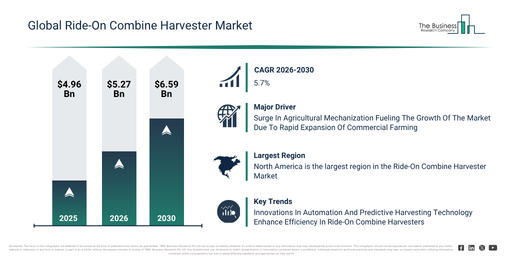
The ride-on combine harvester market size has shown robust expansion in recent years. It is forecast to rise from $4.96 billion in 2025 to $5.27 billion in 2026, achieving a compound annual growth rate (CAGR) of 6.2%. The past growth in this market can be attributed to factors such as increasing agricultural mechanization across farming regions, a growing demand for improved harvesting efficiency, rising labor shortages in agricultural operations, expanding large-scale farming activities, and an increasing need for reduced crop harvesting losses.
The ride-on combine harvester market is projected to experience substantial growth in the upcoming years. It is forecast to expand to $6.59 billion by 2030, exhibiting a compound annual growth rate (CAGR) of 5.7%. This anticipated growth can be attributed to several factors such as the increasing adoption of smart harvesting equipment, greater investment in precision farming technologies, a rising demand for automated agricultural machinery, the expansion of commercial farming operations, and a growing preference for high productivity harvesting solutions. During this forecast period, key trends include the increasing utilization of high-capacity ride-on combine harvesters, an escalating demand for precision crop harvesting solutions, a developing preference for fuel-efficient agricultural machinery, the broader application of multi-crop harvesting equipment, and an enhanced focus on minimizing grain loss during harvesting operations.
Get A Free Sample Report With In-Depth Market Insights:
Ride-On Combine Harvester Market Expansion Drivers: What’s Shaping Future Growth?
The increasing mechanization in agriculture is projected to fuel the expansion of the ride-on combine harvester market in the coming years. Agricultural mechanization refers to the deployment of sophisticated machinery and equipment to enhance the efficiency, output, and overall scale of farming operations. The rise in mechanization within agriculture stems from labor shortages, as machines assist farmers in completing tasks efficiently while lessening their dependence on human workers. Ride-on combine harvesters contribute to agricultural mechanization by efficiently performing harvesting in a single pass, thereby reducing labor requirements, cutting down crop losses, and improving productivity on large farms. For instance, according to Gov.UK, a government agency based in the UK, the total amount spent by farms in England on machinery reached $2.66 billion (£2.3 billion) in 2023–2024, as reported in March 2026. Therefore, the growing mechanization in agriculture is a key driver for the ride-on combine harvester market.
Ride-On Combine Harvester Market Segmentation: How Does The Market Break Down By Category?
The ride-on combine harvester market covered in this report is segmented –
1) By Type Of Harvesting: Grain Harvesters, Corn Harvesters, Forage Harvesters, Vegetable Harvesters, Pulse Harvesters
2) By Fuel Type: Diesel, Gasoline, Electric, Biofuel
3) By Technology Integration: Conventional, Autonomous, Precision Farming Technology, Smart Technology (Internet Of Things Enabled)
4) By Power Output: Below 100 Horsepower, 100 To 200 Horsepower, 200 To 300 Horsepower, Above 300 Horsepower
5) By End User: Individual Farmers, Agricultural Cooperatives, Commercial Farming Enterprises, Custom Harvesting Service Providers
Subsegments:
1) By Grain Harvesters: Wheat Harvesters, Rice Harvesters, Barley Harvesters, Oat Harvesters
2) By Corn Harvesters: Single Row Corn Harvesters, Multi Row Corn Harvesters, Self Propelled Corn Harvesters, Mounted Corn Harvesters
3) By Forage Harvesters: Grass Forage Harvesters, Silage Forage Harvesters, Whole Crop Forage Harvesters, Precision Chop Forage Harvesters
4) By Vegetable Harvesters: Root Vegetable Harvesters, Leafy Vegetable Harvesters, Tuber Crop Harvesters, Specialty Vegetable Harvesters
5) By Pulse Harvesters: Soybean Harvesters, Pea Harvesters, Lentil Harvesters, Chickpea Harvesters
Ride-On Combine Harvester Market Industry Trends Fueling Future Revenue Growth
Leading firms within the ride-on combine harvester market are prioritizing the creation of sophisticated automation technologies, like predictive ground speed automation, with the goal of enhancing harvesting effectiveness, minimizing grain wastage, and maximizing operator output. This predictive ground speed automation is a technology that leverages cameras, satellite imagery, and live crop sensing data to autonomously modify the harvester’s speed according to crop conditions, even before the machine enters the specific crop zone. An example of this trend occurred in February 2024, when John Deere, an agricultural machinery company based in the US, introduced its S7 Series combines. This new range of ride-on combine harvesters incorporates cutting-edge harvesting automation. These S7 Series combines are equipped with Predictive Ground Speed Automation and Harvest Settings Automation, which employ front-mounted cameras, satellite biomass mapping, and current crop information to automatically fine-tune the machine’s speed and harvesting parameters, leading to enhanced operational efficiency. Furthermore, the S7 Series offers upgraded grain loss monitoring capabilities, advanced connectivity options, and improved operator comfort features. These enhancements assist farmers in achieving greater productivity, better grain quality, and lower fuel usage throughout harvest operations.
Ride-On Combine Harvester Market Competitive Overview And Top Companies
Major companies operating in the ride-on combine harvester market are Deere & Company, CNH Industrial N.V., AGCO Corporation, CLAAS KGaA mbH, Kubota Corporation, Mahindra & Mahindra Limited, Yanmar Holdings Co. Ltd., Zoomlion Heavy Industry Science and Technology Co. Ltd., SDF S.p.A., Tractors and Farm Equipment Limited, Shandong Shifeng Group Co. Ltd., YTO Group Corporation, Jiangsu World Agricultural Machinery Co. Ltd., Preet Agro Industries Pvt. Ltd., Rostselmash, Gomselmash, Balkar Combines Pvt. Ltd., Dasmesh Mechanical Works Pvt. Ltd., Malkit Agro Tech Pvt. Ltd., Standard Combine Pvt. Ltd., ISEKI & Co. Ltd., Sampo Rosenlew Oy
View The Full Ride-On Combine Harvester Market Report:
Ride-On Combine Harvester Market Regional Analysis: Which Geography Leads On Revenue?
North America was the largest region in the ride-on combine harvester market in 2025. Asia-Pacific is expected to be the fastest-growing region in the forecast period. The regions covered in the ride-on combine harvester market report are Asia-Pacific, South East Asia, Western Europe, Eastern Europe, North America, South America, Middle East, Africa.
Reach Out To Our Team:
The Business Research Company: https://www.thebusinessresearchcompany.com/
Americas: +1 310-496-7795
Asia: +44 7882 955267 & +91 8897263534
Europe: +44 7882 955267
Email us at: marketing@tbrc.info
Follow us on:
LinkedIn: https://in.linkedin.com/company/the-business-research-company
YouTube: https://www.youtube.com/channel/UC24_fI0rV8cR5DxlCpgmyFQ
Global Market Model: https://www.thebusinessresearchcompany.com/global-market-model

Wasay has over a decade of experience in market research, data modelling, and analytics, with prior experience at GlobalData and Decision Tree Consulting Services. At The Business Research Company , he leads research operations across syndicated studies, customized consulting engagements, and the Global Market Model platform. His professional experience includes supporting organizations such as Boston Consulting Group, KPMG, and Ernst & Young. Wasay holds a degree in Electronics and Communications Engineering, postgraduate management qualifications from International Management Institute Belgium and Indian School of Business and Entrepreneurship, and completed the Integrated Program in Business Analytics from Indian Institute of Management Indore.