
Backed by market attractiveness analysis, total addressable market sizing, company benchmarking matrices, interactive Excel dashboards, wider supply chain intelligence, emerging startup coverage, and detailed product-level insights, The Business Research Company’s 2026 market reports are designed to offer research that is more actionable and strategically valuable than ever.
Space Logistics Market Size And Revenue Outlook Through 2030
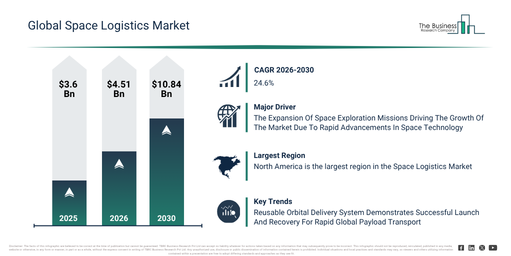
The space logistics market has seen substantial expansion in recent years. It is anticipated to expand from $3.6 billion in 2025 to $4.51 billion in 2026, achieving a compound annual growth rate (CAGR) of 25.0%. This historical growth can be ascribed to a number of elements, including government spending on space initiatives, an increase in satellite deployments, a greater need for satellite lifecycle management, innovations in spacecraft servicing capabilities, and the rising deployment of orbital assets.
The space logistics market is poised for significant expansion in the upcoming years. Its valuation is projected to reach $10.84 billion by 2030, exhibiting a compound annual growth rate (CAGR) of 24.6%. This anticipated growth during the forecast period is primarily attributed to expanding commercial space activities, an increasing demand for satellite servicing missions, the rising development of orbital logistics networks, a growing imperative for space asset sustainability, and increased investment in reusable space transportation systems. Key trends expected over this period include the increasing adoption of autonomous space logistics systems, the growing development of in-orbit servicing and maintenance solutions, the rising deployment of space transportation and cargo delivery services, an increasing demand for space debris management and removal services, and the growing expansion of commercial space infrastructure support services.
Get A Free Sample Report With In-Depth Market Insights:
Space Logistics Market Growth Backed By Core Demand Fundamentals
The anticipated expansion of space exploration missions is projected to boost the space logistics market in the future. These missions encompass organized scientific and technological activities undertaken by spacecraft to examine outer space, celestial bodies, and the environment beyond Earth. The increasing scope of space exploration missions stems from swift technological progress in space, making missions more dependable, economical, and able to venture further into space. Space logistics supports these missions by facilitating the effective movement, provision, maintenance, and synchronization of spacecraft, payloads, and essential resources between Earth and space, thus enhancing mission longevity and capabilities. For example, the Space Foundation, a US-based nonprofit space advocacy group, reported in January 2024 that over 2,800 satellites were launched into orbit in 2023, marking a 23% increase compared to 2022. Consequently, the growing number of space exploration missions is a key factor propelling the space logistics market’s expansion. The growth of the space logistics market is also expected to be propelled by expanding government space programs and their funding, driven by increasing national security and strategic interests. These government initiatives and financial backing represent public-sector efforts and investments aimed at fostering space exploration, satellite development, scientific inquiry, national security endeavors, and the progression of space-related technologies and infrastructure. The rise in government space programs and funding is attributed to heightened national security and strategic concerns, prompting nations to invest in satellites, space-based surveillance, communication networks, and advanced space technologies to bolster defense capabilities and uphold geopolitical standing. Such government support fuels space logistics by generating greater demand for various services, including launch operations, cargo transport, orbital transfers, satellite deployment, and in-orbit maintenance, all essential for the effective execution of government-led space missions. For example, the Space Foundation, a US-based nonprofit, reported in July 2025 that government spending on space programs rose by 6.7% in 2024, reaching a total of $132 billion, with the United States dedicating $77 billion to both national security and civilian space activities. Therefore, the expansion of government space programs and funding significantly drives the growth of the space logistics market.
Space Logistics Market Segment Analysis: What Are The Core Market Categories?
The space logistics market covered in this report is segmented –
1) By Service Type: Launch Logistics Services, In Orbit Servicing, Space Transportation And Cargo Delivery, Orbital Transfer Services, Space Debris Removal Services, Satellite Deployment And Relocation Services, End Of Life Deorbiting Services
2) By Platform Type: Satellites, Spacecraft And Space Tugs, Space Stations, Orbital Depots And Fuel Stations, Reusable Launch Vehicles, Autonomous Servicing Vehicles
3) By Orbit Type: Near Earth Orbit, Low Earth Orbit, Geostationary Orbit
4) By End User Type: Government Space Agencies, Commercial Space Companies, Defense Organizations, Research Institutions, Private Satellite Operators, Space Infrastructure Providers
Subsegments:
1) By Launch Logistics Services: Payload Integration Services, Launch Scheduling And Coordination Services, Pre Launch Processing Services, Launch Insurance Support Services, Mission Planning Support Services
2) By In Orbit Servicing: On Orbit Inspection Services, Robotic Repair Services, Satellite Refueling Services, Hardware Upgrade Services, Software Update Services, Life Extension Services
3) By Space Transportation And Cargo Delivery: Orbital Cargo Transport Services, Interplanetary Cargo Transport Services, Crew And Cargo Resupply Services, Last Mile Space Delivery Services, Space Station Logistics Services
4) By Orbital Transfer Services: Orbit Raising Services, Orbit Lowering Services, Plane Change Maneuvers Services, Satellite Relocation Services, Payload Deployment Assistance Services
5) By Space Debris Removal Services: Active Debris Removal Services, Debris Capture And Deorbit Services, Space Debris Tracking Services, Collision Avoidance Services, Debris Mitigation Consulting Services
6) By Satellite Deployment And Relocation Services: Constellation Deployment Services, Satellite Orbit Relocation Services, Multi Satellite Deployment Services, Geostationary Positioning Services, Orbital Slot Management Services
7) By End Of Life Deorbiting Services: Controlled Reentry Services, Graveyard Orbit Relocation Services, Passivation Services, Deorbit Planning Services, Compliance And Disposal Reporting Services
Space Logistics Market Growth Trends Reshaping The Competitive Landscape
Leading companies in the space logistics market are focused on developing innovative solutions, including reusable space-enabled delivery vehicles, to enable rapid, cost-efficient, and on-demand transportation of cargo and payloads across space and Earth. These reusable space-enabled delivery vehicles are spacecraft designed to move cargo or payloads between space and Earth (or between orbital locations) and then return for multiple flights, which reduces launch costs and enhances mission efficiency. For instance, in May 2026, LEAP Space Logistic Technologies, a US-based logistics company specializing in Earth-to-orbit mobility solutions, successfully launched and recovered its Bullfrog space vehicle, marking the transition of its space logistics platform from conceptual development to operational capability. The vehicle is engineered to demonstrate quick, space-supported delivery of payloads for humanitarian, commercial, and defense applications, allowing goods to be transported and delivered within minutes across global and orbital distances. It incorporates a reusable architecture that facilitates launch, delivery, and recovery within a single operational cycle, thus improving cost efficiency and turnaround time for repeated missions. The demonstration highlighted the significant potential of integrating space systems into mainstream logistics networks, offering high-speed, on-demand mobility beyond traditional aviation and maritime supply chains.
Space Logistics Market Top Companies Driving Competitive Growth
Major companies operating in the space logistics market are The Boeing Company, Airbus Defence and Space SAS, Lockheed Martin Corporation, Northrop Grumman Corporation, Space Exploration Technologies Corp., Blue Origin LLC, OHB SE, Rocket Lab USA Inc., Sierra Space Corporation, Axiom Space Inc., Voyager Technologies Inc., Redwire Corporation, Astroscale Holdings Inc., D-Orbit S.p.A., Impulse Space Inc., ClearSpace SA, Exotrail SA, Starfish Space Inc., Orbit Fab Inc.
View The Full Space Logistics Market Report:
Space Logistics Market Global Footprint: Which Region Leads The Market?
North America was the largest region in the space logistics market in 2025. Asia-Pacific is expected to be the fastest-growing region in the forecast period. The regions covered in the space logistics market report are Asia-Pacific, South East Asia, Western Europe, Eastern Europe, North America, South America, Middle East, Africa.
Reach Out To Our Team:
The Business Research Company: https://www.thebusinessresearchcompany.com/
Americas: +1 310-496-7795
Asia: +44 7882 955267 & +91 8897263534
Europe: +44 7882 955267
Email us at: marketing@tbrc.info
Follow us on:
LinkedIn: https://in.linkedin.com/company/the-business-research-company
YouTube: https://www.youtube.com/channel/UC24_fI0rV8cR5DxlCpgmyFQ
Global Market Model: https://www.thebusinessresearchcompany.com/global-market-model

Wasay has over a decade of experience in market research, data modelling, and analytics, with prior experience at GlobalData and Decision Tree Consulting Services. At The Business Research Company , he leads research operations across syndicated studies, customized consulting engagements, and the Global Market Model platform. His professional experience includes supporting organizations such as Boston Consulting Group, KPMG, and Ernst & Young. Wasay holds a degree in Electronics and Communications Engineering, postgraduate management qualifications from International Management Institute Belgium and Indian School of Business and Entrepreneurship, and completed the Integrated Program in Business Analytics from Indian Institute of Management Indore.