
Featuring market attractiveness scoring, total addressable market sizing, company benchmarking matrices, interactive Excel dashboards, deeper supply chain intelligence, emerging startup tracking, and granular product-level insights, The Business Research Company’s 2026 market reports are built to deliver research that is both more actionable and more strategically valuable.
Synthetic Surfactants Market Revenue Outlook: What CAGR Lies Ahead Through 2030?
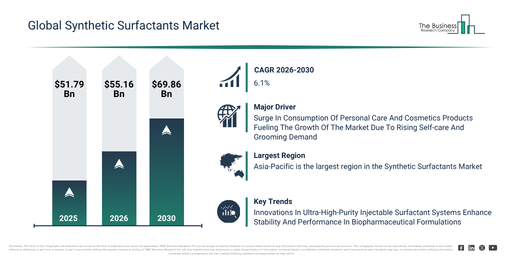
The synthetic surfactants market size has experienced strong growth in recent years. It is projected to expand from $51.79 billion in 2025 to $55.16 billion in 2026, at a compound annual growth rate (CAGR) of 6.5%. This historical growth can be attributed to several factors including an increasing demand for cleaning and personal care products, the expansion of household and industrial cleaning applications, a rising adoption of surfactants in consumer product formulations, expanding chemical manufacturing activities, and a growing demand for effective emulsification and dispersion solutions.
The synthetic surfactants market is projected to experience substantial expansion over the coming years. It is anticipated to reach $69.86 billion by 2030, demonstrating a compound annual growth rate (CAGR) of 6.1%. This projected increase can be linked to the rising need for sustainable and eco-friendly surfactant options, the greater integration of specialty surfactants into sophisticated formulations, the ongoing development of highly efficient cleaning agents, the broader application across personal care and industrial segments, and the increasing demand for surfactants derived from renewable sources. Key trends expected during this period include the wider adoption of bio-based and sustainable surfactant alternatives, the continuous innovation in high-performance surfactant formulations, the escalating requirement for mild and skin-friendly surfactant solutions, a heightened focus on specialty surfactants for industrial purposes, and the increasing use of advanced surfactant blends to enhance formulation effectiveness.
Get A Free Sample Report With In-Depth Market Insights:
Synthetic Surfactants Market Growth Catalysts And Demand Drivers
The expanding use of personal care and cosmetic products is projected to fuel the growth of the synthetic surfactants market moving forward. Personal care and cosmetics products refer to items utilized for personal hygiene, grooming, skin care, and enhancing physical appearance. This increasing consumption of personal care and cosmetic products is driven by consumers’ heightened focus on self-care and appearance enhancement, as these items support daily hygiene, grooming, and aesthetic improvements. Synthetic surfactants aid personal care and cosmetic products by functioning as effective cleansing and foaming agents that remove dirt and oil, simultaneously enhancing texture, spreadability, and product performance. For instance, in September 2024, according to the U.S. Bureau of Labor Statistics, a US-based government agency that collects and analyzes data on labor economics and price changes, consumer spending on personal care products and services increased from $866 in 2022 to $950 in 2023, reflecting a rise of $84. Therefore, the growing consumption of personal care and cosmetic products is a primary driver for the synthetic surfactants market’s expansion.
Synthetic Surfactants Market Segmentation: How Does The Market Break Down By Category?
The synthetic surfactants market covered in this report is segmented –
1) By Type: Anionic Surfactants, Non Ionic Surfactants, Cationic Surfactants, Amphoteric Surfactants
2) By Source: Petroleum Based, Oleochemical Based, Other Sources
3) By Form: Liquid, Powder, Paste Or Gel
4) By Distribution Channel: Direct Sales, Distributors And Wholesalers, Online Channels
5) By Application: Personal Care And Cosmetics, Household Cleaning, Laundry Detergents, Industrial Cleaning, Agriculture, Food Processing, Oil And Gas Enhanced Oil Recovery, Textiles, Paper And Pulp
Subsegments:
1) By Anionic Surfactants: Sodium Alkyl Sulfates, Alkyl Ether Sulfates, Linear Alkylbenzene Sulfonates, Alkyl Ether Carboxylates, Fatty Acid Soaps, Alkyl Phosphate Esters
2) By Non Ionic Surfactants: Fatty Alcohol Ethoxylate, Alkylphenol Ethoxylates, Alkyl Polyglucosides, Sorbitan Esters, Polyoxyethylene Esters, Amine Oxides
3) By Cationic Surfactants: Quaternary Ammonium Compounds, Alkyl Amines, Esterquats, Imidazolinium Compounds, Alkyl Pyridinium Salts
4) By Amphoteric Surfactants: Betaines, Amphoacetates, Amphopropionates, Imidazoline Derivatives, Amino Acid Based Surfactants
Synthetic Surfactants Market Trends Shaping Long-Term Demand
Leading companies operating in the synthetic surfactants market are concentrating on developing innovations in high-performance, low-dose surfactant formulations, including ultra-high-purity injectable surfactant systems. These advancements aim to enhance protein stability, decrease interfacial stress, and improve the solubilization efficiency of hydrophobic active pharmaceutical ingredients, all while maintaining effectiveness at lower concentration levels. Ultra-high-purity injectable surfactant systems are highly refined, pharmaceutical-grade synthetic surfactants crafted with meticulously controlled molecular composition and exceptionally low impurity levels, ensuring safety, stability, and predictable interfacial performance in sensitive drug formulations such as injectables and biologics within the synthetic surfactant context. For instance, in September 2025, Evonik Industries AG, a Germany-based specialty chemicals company, introduced MaxiPure Polysorbate 80. This product was launched to boost the performance and sustainability of household and laundry cleaning formulations by supplying a high-purity, bio-based emulsifier for detergents and cleaning products. The product contains more than 98 percent oleic acid content, guaranteeing high compositional consistency, supports protein stability and viral inactivation in injectable biologics, and adheres to Ph. Eur., USP, JP, and CP monographs to satisfy global regulatory standards for parenteral drug manufacturing.
Synthetic Surfactants Market Competitive Overview And Top Companies
Major companies operating in the synthetic surfactants market are BASF SE, Dow Inc., SABIC, LyondellBasell Industries N.V., Evonik Industries AG, Huntsman Corporation, Arkema S.A., Solvay S.A., Nouryon Chemicals B.V., Wilmar International Limited, Croda International Plc, Clariant AG, Kao Corporation, Stepan Company, Innospec Inc., Zanyu Technology Group Co. Ltd., Galaxy Surfactants Limited, Lion Corporation, India Glycols Limited, Pilot Chemical Company, Colonial Chemical Inc., Procter & Gamble, Unilever
View The Full Synthetic Surfactants Market Report:
Synthetic Surfactants Market Global Footprint: Which Region Leads The Market?
Asia-Pacific was the largest region in the synthetic surfactants market in 2025. Asia-Pacific is expected to be the fastest-growing region in the forecast period. The regions covered in the synthetic surfactants market report are Asia-Pacific, South East Asia, Western Europe, Eastern Europe, North America, South America, Middle East, Africa.
Reach Out To Our Team:
The Business Research Company: https://www.thebusinessresearchcompany.com/
Americas: +1 310-496-7795
Asia: +44 7882 955267 & +91 8897263534
Europe: +44 7882 955267
Email us at: marketing@tbrc.info
Follow us on:
LinkedIn: https://in.linkedin.com/company/the-business-research-company
YouTube: https://www.youtube.com/channel/UC24_fI0rV8cR5DxlCpgmyFQ
Global Market Model: https://www.thebusinessresearchcompany.com/global-market-model

Wasay has over a decade of experience in market research, data modelling, and analytics, with prior experience at GlobalData and Decision Tree Consulting Services. At The Business Research Company , he leads research operations across syndicated studies, customized consulting engagements, and the Global Market Model platform. His professional experience includes supporting organizations such as Boston Consulting Group, KPMG, and Ernst & Young. Wasay holds a degree in Electronics and Communications Engineering, postgraduate management qualifications from International Management Institute Belgium and Indian School of Business and Entrepreneurship, and completed the Integrated Program in Business Analytics from Indian Institute of Management Indore.