
Enhanced with market attractiveness analysis, total addressable market evaluation, company benchmarking matrices, interactive Excel dashboards, expanded supply chain intelligence, emerging startup coverage, and detailed product insights, The Business Research Company’s 2026 market reports deliver more actionable and strategically valuable research.
Drone Lithium Battery Market Forecast: What Market Value Is Expected By 2030?
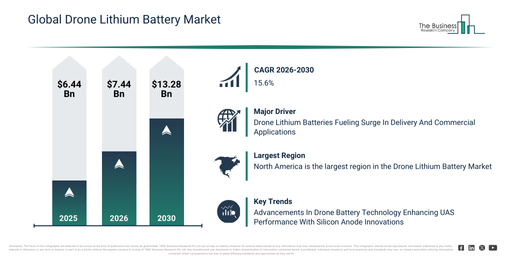
The drone lithium battery market has seen substantial expansion in recent years. This market is projected to grow from $6.44 billion in 2025 to $7.44 billion in 2026, achieving a compound annual growth rate (CAGR) of 15.4%. The historical increase in demand can be ascribed to several factors: the expanded deployment of drones across both commercial and recreational uses, fueling the need for lithium-based batteries; the prompt adoption of lithium-ion and lithium-polymer technologies owing to their high energy density and lightweight nature; the rising prevalence of high-performance racing drone batteries within enthusiast and competitive drone sectors; the creation of custom battery packs to meet various drone design and performance specifications; and the introduction of LiFePO4 batteries, which provide enhanced safety and extended cycle life for particular drone applications.
The drone lithium battery market size is set to experience substantial expansion in the coming years, projected to reach $13.28 billion by 2030, growing at a compound annual growth rate (CAGR) of 15.6%. This growth during the forecast period is driven by increasing demand for batteries that enable longer flight times for expanding commercial UAV missions, progress in fast-charging and high-efficiency lithium technologies that improve operational uptime, and greater customization of battery packs for enterprise-grade and industrial drones. Furthermore, the rising adoption of safer and highly durable chemistries such as LiFePO4 in professional drone fleets, coupled with the expanding use of drones in delivery, inspection, and agriculture, is continuously boosting battery energy density. Significant trends anticipated for this period include a rising need for high-capacity drone batteries for extended flight duration, increased utilization of lightweight battery materials to enhance drone efficiency, and the growing integration of fast-charging lithium batteries for commercial drone applications. Additionally, there will be expanding customization of drone battery packs for specialized uses and an increase in the production of high-discharge batteries designed for racing and performance drones.
Download A Free Sample Report For Comprehensive Market Insights:
#Drone Lithium Battery Market Growth Drivers And Industry Catalysts
The expanding deployment of drones for commercial purposes is anticipated to fuel the expansion of the drone lithium battery market in the future. This commercial deployment involves the utilization of unmanned aerial vehicles (UAVs) across various industries and sectors, capitalizing on their ability to execute tasks more efficiently, safely, and economically than conventional approaches. Lithium batteries are preferred for drones because of their superior energy density, light weight, and capacity to deliver essential flight power. A notable example illustrating this trend is the forecast made in May 2024 by VUL (Association of Unmanned Aviation), as cited by the US government’s International Trade Administration, which predicts a 40% surge in the worldwide count of commercially operated drones from 2022 to 2030. Consequently, the escalating adoption of drones for commercial applications is a key factor propelling the development of the drone lithium battery market.
Drone Lithium Battery Market Segmentation And Category Breakdown
The drone lithium battery market covered in this report is segmented –
1) By Battery Type: Lithium-Ion, Lithium-Polymer, Lithium–Sulfur
2) By Battery Capacity: Below 3,000 mAh, 3,000–5,000 mAh, Above 5,000 mAh
3) By Wing Type: Fixed Wing, Rotary Wing
4) By Drone Maximum Takeoff Weight (MTOW): Below 100 Kgs, 100–200 Kgs, Above 200 Kgs
5) By End Use: Military, Commercial
Subsegments:
1) By Lithium-Ion (Li-ion): Standard Li-ion Batteries, High-Capacity Li-ion Batteries, Li-ion Batteries With Fast Charging Capabilities
2) By Lithium-Polymer (LiPo): Flexible LiPo Batteries, High-Energy Density LiPo Batteries, Light-Weight LiPo Batteries
3) By Lithium-Sulfur (Li-S): High-Capacity Li-S Batteries, Ultra-Light Li-S Batteries, Advanced Li-S Batteries For Longer Flight Time
Drone Lithium Battery Market Strategic Trends: What Is Defining The Next Phase Of Growth?
Leading firms within the drone lithium battery sector are concentrating on creating superior drone battery packs, incorporating Amprius’s innovative silicon anode technology. This technology aims to substantially boost energy density, prolong flight time, and extend overall battery lifespan, thereby making drones more effective and suitable for extended operations. Amprius’s advanced silicon anode technology represents a high-energy battery architecture where silicon replaces conventional graphite in the anodes, leading to a considerable increase in energy density. This breakthrough facilitates longer battery life and enhanced performance, particularly beneficial for drone applications. As an illustration, in September 2023, Amprius Technologies Inc, a US-based battery manufacturing company, partnered with Tenergy Corp, also a US-based company, to launch a novel high-performance drone battery pack. This new battery pack is 31% lighter compared to current industry alternatives, considerably enhancing flight efficiency and increasing payload capacity. Furthermore, it provides a 6% greater energy capacity, enabling drones to operate for extended periods without needing a recharge, a critical advantage for diverse applications from commercial deliveries to surveillance.
Drone Lithium Battery Market Leading Companies Driving Competitive Growth
Major companies operating in the drone lithium battery market are Sony Corporation, Panasonic Corporation, LG Chem Ltd., China Aviation Lithium Battery Co. Ltd. (CNHL), Samsung SDI Co. Ltd., HES Energy Systems Pte Ltd, Team Orion, SZ DJI Technology Co. Ltd., Max Amps Inc, Plug Power Inc., RRC Power Solutions GmbH, Horizon Hobby LLC, CTECHi Technology Co Ltd, Kokam Co. Ltd., Grepow Battery Co. Ltd., EnerDel Inc., Thunder Tiger Corp, Solid State PLC, Dualsky Motors, Hextronik Limited, Venom Group International, Tattu and Gens Ace, Thunder Power RC Corporation
Access The Complete Drone Lithium Battery Market Report:
Drone Lithium Battery Market Geographic Distribution And Regional Opportunities
North America was the largest region in the drone lithium battery market in 2025. The regions covered in the drone lithium battery market report are Asia-Pacific, South East Asia, Western Europe, Eastern Europe, North America, South America, Middle East, Africa.
Access a Customized Drone Lithium Battery Market Report for Deeper Competitive Insights
https://www.thebusinessresearchcompany.com/customise?id=14335&type=smp
The Business Research Company: https://www.thebusinessresearchcompany.com/
Americas: +1 310-496-7795
Asia: +44 7882 955267 & +91 8897263534
Europe: +44 7882 955267
Email us at: marketing@tbrc.info
Follow us on:
LinkedIn: https://in.linkedin.com/company/the-business-research-company
YouTube: https://www.youtube.com/channel/UC24_fI0rV8cR5DxlCpgmyFQ
Global Market Model: https://www.thebusinessresearchcompany.com/global-market-model

Wasay has over a decade of experience in market research, data modelling, and analytics, with prior experience at GlobalData and Decision Tree Consulting Services. At The Business Research Company , he leads research operations across syndicated studies, customized consulting engagements, and the Global Market Model platform. His professional experience includes supporting organizations such as Boston Consulting Group, KPMG, and Ernst & Young. Wasay holds a degree in Electronics and Communications Engineering, postgraduate management qualifications from International Management Institute Belgium and Indian School of Business and Entrepreneurship, and completed the Integrated Program in Business Analytics from Indian Institute of Management Indore.