Built to provide research that’s more actionable and strategically valuable, The Business Research Company’s 2026 market reports include market attractiveness analysis, total addressable market sizing, company benchmarking matrices, interactive Excel dashboards, broader supply chain intelligence, emerging startup tracking, and in-depth product insights.
Application Transformation Market Size Forecast: How Big Could The Market Get By 2030?
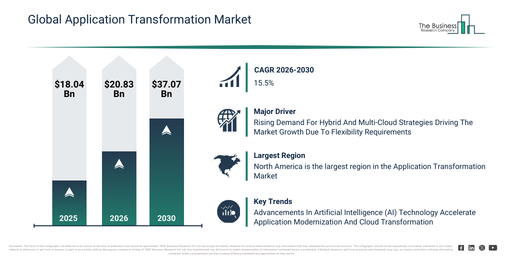
The application transformation market size has witnessed rapid expansion in recent years. It is projected to increase from $18.04 billion in 2025 to $20.83 billion in 2026, registering a compound annual growth rate (CAGR) of 15.5%. The historical growth of this market can be ascribed to a surge in enterprise digital transformation initiatives, the escalating complexity of legacy application environments, the broadening of multi-application ecosystems, a greater demand for business continuity, and an increase in cloud service adoption.
The application transformation market size is poised for substantial growth over the next few years. It is anticipated to expand to $37.07 billion by 2030, achieving a compound annual growth rate (CAGR) of 15.5%. This forecasted growth can be linked to several factors, such as increased investments in containerized application platforms, the rising adoption of low-code modernization tools, the expansion of hybrid and multi-cloud environments, a growing emphasis on application security hardening, and an increasing demand for scalable digital platforms. Prominent trends for the forecast period include the increasing adoption of cloud-based application transformation, a rising demand for application replatforming services, a heightened focus on UI and UX enhancements, the expansion of API-led integration frameworks, and an enhanced emphasis on application resilience.
Get A Free Sample Report With In-Depth Market Insights:
Application Transformation Market Opportunity Drivers: What’s Unlocking New Revenue Potential?
The increasing need for hybrid and multi-cloud strategies is anticipated to fuel the expansion of the application transformation market in the future. These strategies involve an approach where private clouds, public clouds, and on-premises infrastructure are combined to deploy and manage applications across various cloud environments. The heightened demand for hybrid and multi-cloud approaches stems from a requirement for enhanced flexibility and reduced risk, as businesses aim to prevent vendor dependency and refine workload distribution across diverse cloud platforms according to performance, cost, and compliance needs. The increasing adoption of hybrid and multi-cloud methodologies facilitates application transformation by requiring the modernization and re-architecture of older applications, enabling their smooth operation across various cloud environments and infrastructure platforms. For example, data from Flexera, a US-based computer software company, revealed in March 2024 that multi-cloud usage experienced a minor increase, growing from 87% in the previous year to 89% currently. Consequently, the growing demand for hybrid and multi-cloud strategies is a key driver for the application transformation market’s expansion.
Application Transformation Market Segmentation: How Does The Market Break Down By Category?
The application transformation market covered in this report is segmented –
1) By Service Type: Cloud Application Migration, Application Integration, Application Replatforming, Application Portfolio Assessment, UI Or UX Modernizations, Other Service Types
2) By Enterprise Size: Large Enterprises, Small And Medium Enterprises
3) By End Use: Banking, Financial Services And Insurance (BFSI), Retail, Healthcare, IT And Telecom, Government, Manufacturing, Other End Users
Subsegments:
1) By Cloud Application Migration: Infrastructure Migration, Data Migration, Application Re-Hosting
2) By Application Integration: API Integration, Middleware Solutions, Data Integration Services
3) By Application Replatforming: Platform Migration, Containerization Services
4) By Application Portfolio Assessment: Application Inventory Analysis, Cost-Benefit Analysis, Performance Assessment
5) By UI Or UX Modernizations: User Interface Redesign, User Experience Enhancement, Responsive Design Implementation
6) By Other Service Types: Legacy System Modernization, Security Enhancements, Performance Optimization Services
Application Transformation Market Innovation Trends Shaping Future Development
Leading firms within the application transformation market are concentrating on utilizing cutting-edge technologies, specifically artificial intelligence (AI)-powered database automation, to address the growing need for quicker, more adaptable, and smarter application modernization. This AI-driven database automation incorporates machine learning algorithms into database management systems, facilitating automatic optimization, predictive analysis, and smart query performance adjustments, resulting in considerably improved efficiency over conventional manual database administration. As an illustration, in September 2025, MongoDB Inc., a US-based software company, introduced its AI-powered platform for application transformation, aimed at streamlining and speeding up application modernization. The platform integrates MongoDB’s NoSQL database functionalities with generative AI to automate data modeling, optimize queries, and deliver intelligent insights for developing applications. Key features of this offering encompass natural language-based query generation, proactive performance adjustments, and effortless integration with existing cloud infrastructures, rendering it especially valuable for businesses seeking to shorten development cycles and enhance operational effectiveness. This platform finds application across various sectors including e-commerce, finance, and healthcare, areas where swift adaptation and decisions informed by data are crucial.
Application Transformation Market Competitive Overview And Top Companies
Major companies operating in the application transformation market are Accenture PLC; Atos SA; Cognizant; Fujitsu Ltd.; HCL Technologies Ltd.; International Business Machines Corporation; Microsoft Corporation; Micro Focus International PLC; Asysco Software B.V; Capgemini SE; Infosys Limited; Dell Technologies; Hexaware Technologies; Pivotal Software; CleverIS Technologies; TRIANZ Holdings Pvt. Ltd.; Bell Integrator; Oracle Corporation; Happiest Minds Technologies Limited; Tech Mahindra; Unisys Corporation; Wipro Limited; DXC Technology Company; Mindtree Limited; Virtusa Corporation; Tata Consultancy Services Limited; Larsen & Toubro Infotech Limited; NTT DATA Corporation; Mphasis Limited
View The Full Application Transformation Market Report:
Application Transformation Market Geographic Landscape: Which Region Leads Industry Growth?
North America was the largest region in the application transformation market in 2025. The regions covered in the application transformation market report are Asia-Pacific, South East Asia, Western Europe, Eastern Europe, North America, South America, Middle East, Africa.
Reach Out To Our Team:
The Business Research Company: https://www.thebusinessresearchcompany.com/
Americas: +1 310-496-7795
Asia: +44 7882 955267 & +91 8897263534
Europe: +44 7882 955267
Email us at: marketing@tbrc.info
Follow us on:
LinkedIn: https://in.linkedin.com/company/the-business-research-company
YouTube: https://www.youtube.com/channel/UC24_fI0rV8cR5DxlCpgmyFQ
Global Market Model: https://www.thebusinessresearchcompany.com/global-market-model

Wasay has over a decade of experience in market research, data modelling, and analytics, with prior experience at GlobalData and Decision Tree Consulting Services. At The Business Research Company , he leads research operations across syndicated studies, customized consulting engagements, and the Global Market Model platform. His professional experience includes supporting organizations such as Boston Consulting Group, KPMG, and Ernst & Young. Wasay holds a degree in Electronics and Communications Engineering, postgraduate management qualifications from International Management Institute Belgium and Indian School of Business and Entrepreneurship, and completed the Integrated Program in Business Analytics from Indian Institute of Management Indore.