Built to provide research that’s more actionable and strategically valuable, The Business Research Company’s 2026 market reports include market attractiveness analysis, total addressable market sizing, company benchmarking matrices, interactive Excel dashboards, broader supply chain intelligence, emerging startup tracking, and in-depth product insights.
Artificial Intelligence In Emotion Recognition Market Revenue Growth On Track For A 17.8% CAGR Through 2030
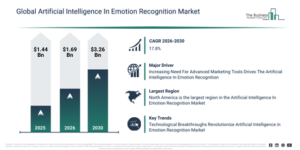
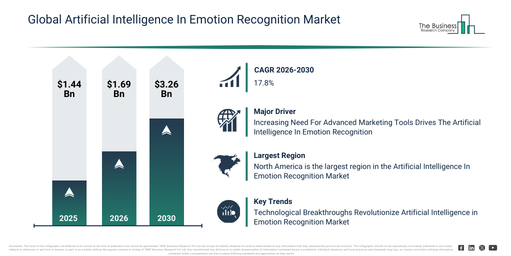
The market size for artificial intelligence in emotion recognition has experienced swift expansion over recent years. This market is projected to expand from $1.44 billion in 2025 to $1.69 billion in 2026, demonstrating a compound annual growth rate (CAGR) of 17.7%. Historical growth has been fueled by factors such as an increasing demand for personalized marketing, greater integration of AI in customer service, an expansion in healthcare and life sciences applications, the progress of advanced bio-sensor technologies, and the proliferation of digital media and entertainment.
The market for artificial intelligence in emotion recognition is projected to experience substantial expansion over the coming years. This market is set to reach a value of $3.26 billion by 2030, exhibiting a compound annual growth rate (CAGR) of 17.8%. Factors contributing to this anticipated growth include the fusion of AI with natural language processing (NLP) and pattern recognition, the rise of emotion-aware robotics and e-learning platforms, the proliferation of voice and speech recognition technologies, the implementation of AI-powered surveillance and monitoring systems, and increased financial commitment to emotion recognition tools within the BFSI and retail industries. Key trends anticipated during this period encompass the analysis of facial expressions, identification of emotions through voice, recognition of gestures and postures, sentiment analysis and emotional detection from text, and AI-powered analytics for customer interactions.
Get A Free Sample Report With In-Depth Market Insights:
Artificial Intelligence In Emotion Recognition Market Demand Drivers: What’s Powering Industry Growth?
The anticipated expansion of artificial intelligence within the emotion recognition market is fueled by the growing requirement for sophisticated marketing instruments. These advanced marketing tools encompass highly developed and technologically forward-thinking solutions intended to improve different facets of marketing approaches, campaigns, and general effectiveness. Emotion recognition technology provides marketers with the capability to craft personalized campaigns through grasping individual emotional reactions, thereby permitting customized content and advertising that align with the emotional characteristics of particular audience segments for communication that is both more impactful and resonant. A relevant example comes from January 2024, where a report from Influencer Marketing Hub, a media firm based in Denmark concentrating on social media and influencer marketing, indicated that over 60% of businesses utilize AI in their marketing efforts, with 44% specifically applying AI for content creation. Projections further indicate that by the year 2030, approximately 70% of enterprises are expected to have embraced diverse forms of AI technology. Consequently, the escalating demand for sophisticated marketing tools is set to propel the adoption of artificial intelligence in the emotion recognition market.
Artificial Intelligence In Emotion Recognition Market Segments: Where Is Growth Concentrated?
The artificial intelligence in emotion recognition market covered in this report is segmented –
1) By Offerings: Software, Services
2) By Tools: Facial Expression Recognition, Speech And Voice Recognition, Gesture And Posture Recognition
3) By Technology: Machine Learning, Bio Sensors Technology, Natural Language Processing, Feature Extraction, Pattern Recognition
4) By Application: Marketing And Advertising, Surveillance And Monitoring, Medical Emergency, Robotics And eLearning, Other Applications
5) By End-Use Verticals: Banking, Financial Services, And Insurance (BFSI), Healthcare And Life Sciences, IT And Telecommunication, Retail And eCommerce, Education, Media And Entertainment, Automotive, Other End-Users
Subsegments:
1) By Software: Emotion Recognition Software, Facial Recognition Software, Voice And Speech Emotion Recognition Software, Text Analysis And Sentiment Analysis Software
2) By Services: Consulting Services, Integration Services, Support And Maintenance Services, Custom Development Services
Artificial Intelligence In Emotion Recognition Market Innovation Trends: What Developments Are Reshaping The Industry?
Major companies operating in artificial intelligence within the emotion recognition market are developing technical breakthroughs in AI, such as AI-powered audience segmentation, to boost the accuracy and personalization of emotion recognition, enabling the creation of more effective and tailored emotion recognition products. AI-driven audience segmentation involves using artificial intelligence algorithms and technologies to classify a target audience into distinct and meaningful groups based on various criteria. For example, in September 2023, AB Tasty, a France-based customer experience optimization company, launched EmotionsAI, a technology that allows customers to implement AI-driven audience segmentation considering emotional needs. This innovative product empowers brands to personalize interactions with customers on an emotional level, marking AB Tasty’s initial foray into leveraging AI for improved digital experiences. EmotionsAI facilitates enhanced win rates and the development of more effective strategies for customizing customer experiences, a proven method for generating revenue. This technology fundamentally transforms brands’ ability to tailor customer experiences by prioritizing emotional requirements.
Artificial Intelligence In Emotion Recognition Market Key Participants And Competitive Landscape
Major companies operating in the artificial intelligence in emotion recognition market are Apple Inc; Google LLC; Microsoft Corporation; Intel Corporation; NEC Corporation; SoftBank Robotics Group Corp; Tobii AB; Entropik Technologies Pvt Ltd; Kairos Inc; Affectiva Inc; GestureTek Inc; Ayonix Corporation; iMotions Inc; Sony Depthsense Solutions; Elliptic Labs AS; Realeyes; Beyond Verbal; Nviso; Eyeris Technologies Inc; Sightcorp BV; Visage Technologies AB
View The Full Artificial Intelligence In Emotion Recognition Market Report:
Artificial Intelligence In Emotion Recognition Market Regional Analysis: Which Geography Leads On Revenue?
North America was the largest region in the artificial intelligence in emotion recognition market in 2025. Asia-Pacific is expected to be the fastest-growing region in the forecast period. The regions covered in the artificial intelligence in emotion recognition market report are Asia-Pacific, South East Asia, Western Europe, Eastern Europe, North America, South America, Middle East, Africa.
Reach Out To Our Team:
The Business Research Company: https://www.thebusinessresearchcompany.com/
Americas: +1 310-496-7795
Asia: +44 7882 955267 & +91 8897263534
Europe: +44 7882 955267
Email us at: marketing@tbrc.info
Follow us on:
LinkedIn: https://in.linkedin.com/company/the-business-research-company
YouTube: https://www.youtube.com/channel/UC24_fI0rV8cR5DxlCpgmyFQ
Global Market Model: https://www.thebusinessresearchcompany.com/global-market-model

Wasay has over a decade of experience in market research, data modelling, and analytics, with prior experience at GlobalData and Decision Tree Consulting Services. At The Business Research Company , he leads research operations across syndicated studies, customized consulting engagements, and the Global Market Model platform. His professional experience includes supporting organizations such as Boston Consulting Group, KPMG, and Ernst & Young. Wasay holds a degree in Electronics and Communications Engineering, postgraduate management qualifications from International Management Institute Belgium and Indian School of Business and Entrepreneurship, and completed the Integrated Program in Business Analytics from Indian Institute of Management Indore.