
Enhanced with market attractiveness analysis, total addressable market evaluation, company benchmarking matrices, interactive Excel dashboards, expanded supply chain intelligence, emerging startup coverage, and detailed product insights, The Business Research Company’s 2026 market reports deliver more actionable and strategically valuable research.
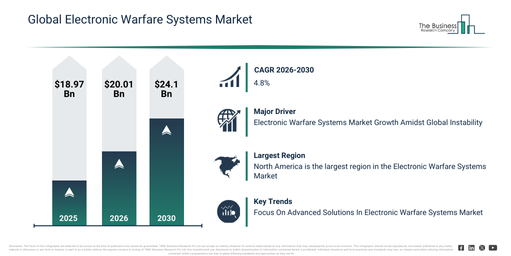
Electronic Warfare Systems Market Growth From $20.01 Billion In 2026 To $24.1 Billion By 2030 At A CAGR Of 4.76%
The electronic warfare systems market has experienced robust expansion in recent years. This market is projected to expand from $18.97 billion in 2025 to $20.01 billion in 2026, exhibiting a compound annual growth rate (CAGR) of 5.5%. Historically, this expansion has been driven by several factors, including the increased deployment of radar warning receivers for improved threat detection on military platforms, the early incorporation of electronic countermeasure suites to boost aircraft survivability, and the heightened use of chaff dispensers and self-protection systems to counter advanced radar-guided threats. Additionally, the growing demand for signal intelligence has spurred the acquisition of specialized EW systems, alongside modernization initiatives that have broadened the integration of EW capabilities across air, land, and naval forces.
The electronic warfare systems market is anticipated to experience consistent expansion over the upcoming years. This market is projected to reach $24.1 billion by 2030, exhibiting a compound annual growth rate (CAGR) of 4.8%. The expansion during this period can be attributed to the rising need for advanced EW systems to combat changing electromagnetic dangers, the greater incorporation of AI-powered signal processing to improve electronic attack and defense capabilities, the spread of multi-domain operations driving the uptake of compatible EW systems, increased funding for small, modular EW options suitable for both crewed and uncrewed platforms, and rapid progress in sophisticated electronic deception and jamming technologies to meet future conflict demands. Key trends expected in the forecast period encompass combining EW systems with various platforms across air, land, sea, and space; making EW payloads smaller for unmanned aerial vehicles and tactical uses; the creation of smart, flexible jammers for complex spectrum combat; more widespread adoption of simulation and virtual testing for EW personnel instruction; and the expansion of EW solutions designed to combat drones and unmanned aerial vehicles.
Download A Free Sample Report For Comprehensive Market Insights:
#Electronic Warfare Systems Market Demand Drivers Creating New Revenue Opportunities
The electronic warfare systems market is projected for future growth, driven by territorial disputes and geopolitical instability. Territorial disputes involve disagreements between two or more states over the control or ownership of a particular geographical area, while geopolitical instability describes the unpredictable and volatile conditions within and among nations, frequently resulting from shifts in power dynamics, regional conflicts, or geopolitical rivalries. These systems provide capabilities to influence battlespace information, manage the electromagnetic spectrum, and deny adversaries access to specific areas or airspace during such disputes and instability. For instance, in 2023, Vision of Humanity, an Australia-based non-government organization, indicated that the US accounted for 76% of terrorism-related deaths among Western democracies, coinciding with incident rates reaching a 15-year low. Additionally, in 2022, the Islamic State (IS) and its affiliates were identified as the world’s deadliest terrorist group for the eighth consecutive year, executing attacks in 21 countries. Therefore, the expansion of the electronic warfare systems market is being propelled by territorial disputes and geopolitical instability.
Electronic Warfare Systems Market Categorization By Product Type And Application
The electronic warfare systems market covered in this report is segmented –
1) By Product: Jammer, Countermeasure System, Decoy, Directed-Energy Weapon, Other Products
2) By Capability: Electronic Support, Electronic Attack, Electronic Protection
3) By Application: Airborne, Naval, Land
Subsegments:
1) By Jammer: Radio Frequency (Rf) Jammers, Communication Jammers, Radar Jammers, Gps Jammers, Missile Jammers, Drone And Uav Jammers, Cognitive And Adaptive Jammers, Pulsed And Continuous Wave Jammers
2) By Countermeasure System: Electronic Countermeasure (Ecm) Systems, Anti-Radiation Missiles (Arm), Electronic Counter-Countermeasure (Eccm) Systems, Active And Passive Countermeasure Systems, Signal Disruptor Systems, Radar Evasion And Deception Systems, Frequency Hopping Systems, Counter-Drone Electronic Systems
3) By Decoy: Infrared Decoys, Radar And Radio Frequency Decoys, Acoustic Decoys, Towed And Airborne Decoys, Missile And Rocket Propelled Decoys, Multispectral Decoys, Laser And Optical Decoys
4) By Directed-Energy Weapon: High-Powered Microwave (Hpm) Weapons, Laser Weapons (E.G., Solid-State Lasers), Electromagnetic Pulses (Emp), Anti-Missile Directed-Energy Weapons, Non-Lethal Directed-Energy Systems, Directed-Energy Systems For Counter-Drone Operations
5) By Other Products: Signal Intelligence (Sigint) Systems, Cyber Warfare Systems, Electronic Surveillance Systems, Anti-Uav And Anti-Drone Systems, Noise And Signal Disruptor Systems, Electromagnetic Field Generators
Electronic Warfare Systems Market Strategic Trends: What Is Defining The Next Phase Of Growth?
Leading corporations within the electronic warfare systems market are intensifying their efforts to develop advanced technological solutions, such as the airborne self-protection EW suite, aiming to enhance warfare components and offer improved combat capabilities. This suite consists of electronic countermeasure systems designed to safeguard aircraft from various threats, including radar-guided and infrared-guided missiles, as well as other hostile electronic emissions. For instance, in June 2023, Elbit Systems Ltd., an Israel-based defense contractor and military technology company, unveiled a new and unique electronic warfare (EW) capability, integrated into their proven Airborne self-protection EW suite, at the Paris airshow. This new functionality, delivered through digital radar warning receivers (RWR), enables drone detection, identification, and the location of personal location beacons (PLB) for ground forces and pilots. The EW suite, which operates on numerous rotary-wing and fixed-wing aircraft, comprises various components such as an EW controller, an IR missile warning system (MWS), laser warning systems (LWS), and a countermeasure dispenser system (CMDS), all intended to boost platform protection and aircrew survivability against sophisticated threats.
Electronic Warfare Systems Market Competitive Landscape And Leading Companies
Major companies operating in the electronic warfare systems market are Raytheon Technologies Corporation, Lockheed Martin Corporation, General Dynamics Corporation, Northrop Grumman Corporation, BAE Systems PLC, Thales Group, L3Harris Technologies Inc, Textron Inc, Leonardo S.p.A, Rheinmetall AG, CACI International Inc, Elbit Systems Ltd, Israel Aerospace Industries, SAAB AB, General Atomics, Viasat Inc, Leonardo DRS, Curtiss-Wright Corporation, Cobham PLC, ASELSAN AS, Hensoldt Group, QinetiQ Group, Exelis Inc, Mercury Systems Inc, Ultra Electronics Holdings plc, Kratos Defense & Security Solutions, Aeroflex Inc, Chemring Group plc
Access The Complete Electronic Warfare Systems Market Report:
Electronic Warfare Systems Market Regional Analysis And Leading Geography
North America was the largest region in the electronic warfare systems market in 2025. The regions covered in the electronic warfare systems market report are Asia-Pacific, South East Asia, Western Europe, Eastern Europe, North America, South America, Middle East, Africa.
Access a Customized Electronic Warfare Systems Market Report for Deeper Competitive Insights
https://www.thebusinessresearchcompany.com/customise?id=14701&type=smp
The Business Research Company: https://www.thebusinessresearchcompany.com/
Americas: +1 310-496-7795
Asia: +44 7882 955267 & +91 8897263534
Europe: +44 7882 955267
Email us at: marketing@tbrc.info
Follow us on:
LinkedIn: https://in.linkedin.com/company/the-business-research-company
YouTube: https://www.youtube.com/channel/UC24_fI0rV8cR5DxlCpgmyFQ
Global Market Model: https://www.thebusinessresearchcompany.com/global-market-model

Wasay has over a decade of experience in market research, data modelling, and analytics, with prior experience at GlobalData and Decision Tree Consulting Services. At The Business Research Company , he leads research operations across syndicated studies, customized consulting engagements, and the Global Market Model platform. His professional experience includes supporting organizations such as Boston Consulting Group, KPMG, and Ernst & Young. Wasay holds a degree in Electronics and Communications Engineering, postgraduate management qualifications from International Management Institute Belgium and Indian School of Business and Entrepreneurship, and completed the Integrated Program in Business Analytics from Indian Institute of Management Indore.