Built to provide research that’s more actionable and strategically valuable, The Business Research Company’s 2026 market reports include market attractiveness analysis, total addressable market sizing, company benchmarking matrices, interactive Excel dashboards, broader supply chain intelligence, emerging startup tracking, and in-depth product insights.
5G System Integration Market Revenue Growth On Track For A 24% CAGR Through 2030
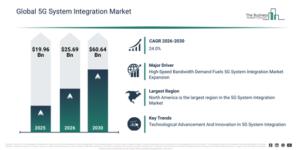
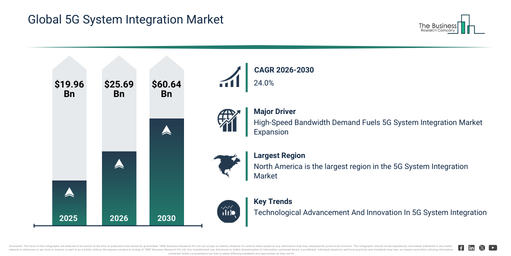
The 5G system integration market has experienced substantial expansion in recent years. It is projected to increase from $19.96 billion in 2025 to $25.69 billion in 2026, demonstrating a compound annual growth rate (CAGR) of 28.7%. The growth observed in the preceding period can be attributed to the rising adoption of 4G and early 5G networks, increasing enterprise digitalization, an uptick in telecom infrastructure projects, a rise in industrial automation, and a growing demand for smart city applications.
The 5G system integration market is anticipated to experience substantial growth over the coming years. This market is projected to reach $60.64 billion in 2030, expanding at a compound annual growth rate (CAGR) of 24.0%. The expansion during the forecast period is primarily driven by wider 5G network rollouts, the increasing use of cloud-native and edge computing solutions, a greater need for integrated IoT applications, advancements in industrial and logistics automation, and a surge in digital transformation efforts by enterprises and governments. Key trends anticipated in this period encompass comprehensive end-to-end network integration, cloud-native deployment approaches, the integration of edge computing, IoT-driven industrial automation, and capabilities for real-time data monitoring and analytics.
Get A Free Sample Report With In-Depth Market Insights:
5G System Integration Market Development Factors: What’s Supporting Demand?
The increasing need for high-speed bandwidth capacity is anticipated to drive the future expansion of the 5G system integration market. High-speed bandwidth refers to the capability of a communication network or channel to transmit substantial amounts of data quickly and efficiently. This demand is escalating due to the growing adoption of data-intensive applications such as high-definition (HD) and ultra-high-definition (UHD) video streaming, remote collaboration tools, and the proliferation of IoT and cloud-based services. The 5G system integration market supports this requirement by enabling seamless connectivity, efficient data flow, and high-speed network performance across various devices and applications, leveraging 5G’s advanced architecture and ultra-low latency capabilities. For instance, in April 2023, according to 5G Americas, a US-based wireless industry trade organization, global 5G wireless connections reached 1.05 billion in 2022 and are projected to grow to 1.9 billion by the end of 2023 and further to 5.9 billion by 2027, reflecting a sharp multi-year expansion in bandwidth consumption. Therefore, the rising demand for high-speed bandwidth capacity is driving the growth of the 5G system integration market.
5G System Integration Market Segmentation And Category Overview
The 5G system integration market covered in this report is segmented –
1) By Services: Consulting, Infrastructure Integration, Application Integration
2) By Application: Smart City, Collaborate Robot And Cloud Robot, Industrial Sensors, Logistics And Inventory Monitoring, Wireless Industry Camera, Drone, Home And Office Broadband, Vehicle-To-Everything (V2X), Gaming And Mobile Media, Other Applications
3) By Vertical: Banking, Financial Services And Insurance (BFSI), Healthcare, Information Technology (IT) And Telecommunications, Retail, Manufacturing, Energy And Utilities, Media And Entertainment, Other Verticals
Subsegments:
1) By Consulting: Network Planning And Design, Strategy And Roadmap Development, Technical Feasibility And Analysis
2) By Infrastructure Integration: Hardware Integration, Network Deployment And Optimization, Cloud Infrastructure Integration
3) By Application Integration: IoT Application Integration, Cloud Application Integration, Network Function Virtualization (NFV) Integration, Edge Computing Integration
5G System Integration Market Transformation Trends: What Innovations Are Driving Change?
Leading companies within the 5G system integration market are concentrating on creating sophisticated technological solutions, such as HCLTech’s 5G SF integration frameworks, with the aim of streamlining deployment, optimizing network performance, and improving scalability for smooth 5G system integration. HCLTech’s 5G SF integration frameworks represent a complete collection of tools, protocols, and methodologies designed to facilitate the effective integration of components from multiple vendors and domains within a 5G network environment. For example, in February 2023, HCL Technologies Limited, an India-based information technology and consulting firm, introduced HCLTech’s 5G SF, a set of technology solutions intended to hasten 5G readiness and system integration for communication service providers (CSPs) and enterprises. This initiative’s system integration framework offers a unified architecture enabling CSPs, enterprises, hyperscalers, and equipment manufacturers to effortlessly integrate network functions, automate processes, and boost operational efficiency, thereby supporting more rapid, dependable, and scalable 5G deployments.
5G System Integration Market Competitive Analysis Of Leading Industry Participants
Major companies operating in the 5G system integration market are Samsung Electronics Co. Ltd; Dell Technologies Inc; Huawei Technologies Co. Ltd; Accenture Inc; International Business Machines Corporation (IBM); Cisco Systems Inc; Oracle Corporation; Fujitsu Limited; Hewlett Packard Enterprise (HPE); Tata Consultancy Services Limited (TCS); Telefonaktiebolaget LM Ericsson (Ericsson); Nokia Corporation; NEC Corporation; Cognizant Technology Solutions Corporation; ZTE Corporation; Infosys Limited; DXC Technology Company; HCL Technologies Limited; Atos SE; Wipro Limited; Tech Mahindra Limited; Amdocs Limited; Ciena Corporation; Altran Technologies SA; Mavenir Systems Inc; Ribbon Communications Inc; Keysight Technologies Inc
View The Full 5G System Integration Market Report:
5G System Integration Market Largest Region: Which Geography Holds The Biggest Share?
North America was the largest region in the 5G system integration market in 2025. Asia-Pacific is expected to be the fastest-growing region in the forecast period. The regions covered in the 5G system integration market report are Asia-Pacific, South East Asia, Western Europe, Eastern Europe, North America, South America, Middle East, Africa.
Reach Out To Our Team:
The Business Research Company: https://www.thebusinessresearchcompany.com/
Americas: +1 310-496-7795
Asia: +44 7882 955267 & +91 8897263534
Europe: +44 7882 955267
Email us at: marketing@tbrc.info
Follow us on:
LinkedIn: https://in.linkedin.com/company/the-business-research-company
YouTube: https://www.youtube.com/channel/UC24_fI0rV8cR5DxlCpgmyFQ
Global Market Model: https://www.thebusinessresearchcompany.com/global-market-model

Wasay has over a decade of experience in market research, data modelling, and analytics, with prior experience at GlobalData and Decision Tree Consulting Services. At The Business Research Company , he leads research operations across syndicated studies, customized consulting engagements, and the Global Market Model platform. His professional experience includes supporting organizations such as Boston Consulting Group, KPMG, and Ernst & Young. Wasay holds a degree in Electronics and Communications Engineering, postgraduate management qualifications from International Management Institute Belgium and Indian School of Business and Entrepreneurship, and completed the Integrated Program in Business Analytics from Indian Institute of Management Indore.