Backed by market attractiveness analysis, total addressable market sizing, company benchmarking matrices, interactive Excel dashboards, wider supply chain intelligence, emerging startup coverage, and detailed product-level insights, The Business Research Company’s 2026 market reports are designed to offer research that is more actionable and strategically valuable than ever.
AI Processing Control Market Growth Potential: How Will Market Size Shift Through 2030?
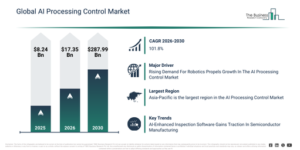
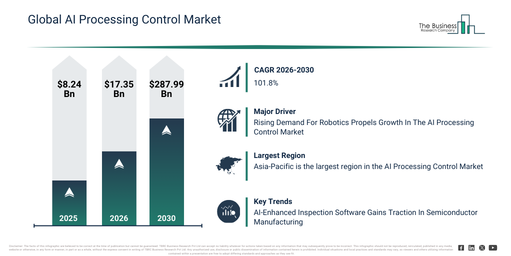
The AI processing control market size has experienced substantial expansion in recent years. It is projected to increase from $8.24 billion in 2025 to $17.35 billion in 2026, exhibiting a compound annual growth rate (CAGR) of 110.7%. The market’s growth during previous periods can be linked to factors such as a heightened demand for automation in manufacturing, the deployment of AI in chemical processing, the requirement to minimize operational expenses, a strong regulatory emphasis on safety and adherence, and the integration of older systems with contemporary digital solutions.
The AI processing control market size is poised for substantial expansion over the next few years. It is forecast to climb to $287.99 billion by 2030, exhibiting a compound annual growth rate (CAGR) of 101.8%. The projected growth during this period stems from various factors such as the increasing embrace of edge AI solutions, the proliferation of smart factories, the expansion of industrial IoT devices, a growing emphasis on sustainability and energy optimization, and the implementation of AI-driven predictive analytics. Prominent trends within the forecast span include advancements in process optimization, predictive maintenance, real-time monitoring capabilities, energy efficiency solutions, and the automation of safety and compliance protocols.
Get A Free Sample Report With In-Depth Market Insights:
AI Processing Control Market Growth Momentum: What Factors Are Shaping Demand?
The increasing need for robotics across various industries is projected to stimulate the expansion of the AI processing control market in the future. Robotics constitutes an interdisciplinary area of study and engineering, encompassing the design, building, operation, and application of robots. AI process control equips robots with the ability to dynamically learn, adjust, and improve their performance through machine learning algorithms, enabling ongoing enhancement derived from environmental data and past experiences, which is vital for tackling a variety of tasks and situations. As an illustration, in April 2024, data from the International Federation of Robotics, a robotics industry association located in Germany, indicated that the total installations of industrial robots grew by 12%, totaling 44,303 units in 2023. Consequently, the rising requirement for robotics in industrial settings is propelling the growth of the AI processing control market.
AI Processing Control Market Segments: Where Is Growth Concentrated?
The AI processing control market covered in this report is segmented –
1) By Deployment Mode: Cloud, On-premises
2) By Application: Forecasts And Prescriptive Models, Other Applications
3) By End User: Manufacturing, Healthcare, Transportation, Other End Users
Subsegments:
1) By Cloud: Public Cloud, Private Cloud, Hybrid Cloud
2) By On-premises: On-premises Data Centers, Edge Computing Solutions
AI Processing Control Market Trends Redefining Industry Growth
Leading companies active in the AI processing control market are developing advanced technologies, such as inspection software, to gain a competitive advantage. Inspection software is a computer program or application designed to simplify and streamline the evaluation, management, and inspection of various aspects of products, services, or processes. For instance, in January 2024, Cohu Inc., a US-based semiconductor equipment manufacturer, released DI-Core AI Inspection, an artificial intelligence (AI) inspection software. A key feature of this AI inspection software is its capacity to process data in real time, enabling semiconductor manufacturers to enhance visual inspection accuracy during production at faster speeds. It excels at identifying micro-scale defects in cosmetic patterns with greater precision than existing methods. Its proprietary deep learning and neural network technologies contribute to an improved inspection yield without compromising quality.
AI Processing Control Market Key Participants And Competitive Landscape
Major companies operating in the AI processing control market are Siemens AG; Schneider Electric SE; ABB Ltd.; Rockwell Automation; Yokogawa Electric Corporation; Beyond Limits; Tignis; Bright Machines; Honeywell International Inc; Emerson Electric Co; Mitsubishi Electric Corporation; Hitachi Ltd; GE Vernova Inc; Johnson Controls International plc; Endress+Hauser Group; Hexagon AB; Cognite AS; Uptake Technologies Inc; Seeq Corporation; Palantir Technologies Inc; Fanuc Corporation; Toshiba Corporation; Advantech Co Ltd
View The Full AI Processing Control Market Report:
AI Processing Control Market Regional Analysis And Top Geography
Asia-Pacific was the largest region in the AI Processing Control market in 2025. The regions covered in the AI processing control market report are Asia-Pacific, South East Asia, Western Europe, Eastern Europe, North America, South America, Middle East, Africa.
Reach Out To Our Team:
The Business Research Company: https://www.thebusinessresearchcompany.com/
Americas: +1 310-496-7795
Asia: +44 7882 955267 & +91 8897263534
Europe: +44 7882 955267
Email us at: marketing@tbrc.info
Follow us on:
LinkedIn: https://in.linkedin.com/company/the-business-research-company
YouTube: https://www.youtube.com/channel/UC24_fI0rV8cR5DxlCpgmyFQ
Global Market Model: https://www.thebusinessresearchcompany.com/global-market-model

Wasay has over a decade of experience in market research, data modelling, and analytics, with prior experience at GlobalData and Decision Tree Consulting Services. At The Business Research Company , he leads research operations across syndicated studies, customized consulting engagements, and the Global Market Model platform. His professional experience includes supporting organizations such as Boston Consulting Group, KPMG, and Ernst & Young. Wasay holds a degree in Electronics and Communications Engineering, postgraduate management qualifications from International Management Institute Belgium and Indian School of Business and Entrepreneurship, and completed the Integrated Program in Business Analytics from Indian Institute of Management Indore.