Built to provide research that’s more actionable and strategically valuable, The Business Research Company’s 2026 market reports include market attractiveness analysis, total addressable market sizing, company benchmarking matrices, interactive Excel dashboards, broader supply chain intelligence, emerging startup tracking, and in-depth product insights.
Discrete Automation Market Size Forecast: How Big Could The Market Get By 2030?
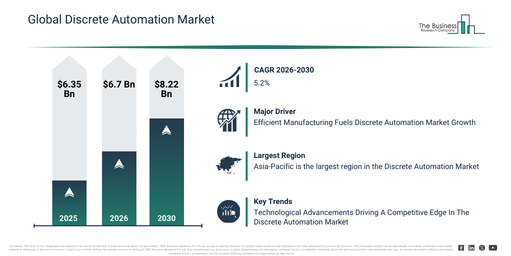
The discrete automation market has experienced robust expansion over recent years. Its size is projected to increase from $6.35 billion in 2025 to $6.7 billion in 2026, exhibiting a compound annual growth rate (CAGR) of 5.4%. This historical growth can be linked to factors such as an increasing requirement for automation in manufacturing, the imperative for precision and efficiency, the widespread adoption of PLC and DCS systems, the expansion within the automotive and aerospace industries, and a strong emphasis on quality control and production optimization.
The discrete automation market size is anticipated to experience robust expansion in the coming years, reaching $8.22 billion by 2030, with a compound annual growth rate (CAGR) of 5.2%. This projected growth throughout the forecast period is fueled by increasing adoption of AI-powered automation, the rise of smart factories, a greater need for IoT-enabled process control, a shift towards digital twins and simulation, and the expansion of automation in food processing and packaging. Significant trends expected during this period include the integration of predictive maintenance systems, real-time production monitoring and analytics, the development of modular and scalable automation solutions, enhanced adoption of human-machine interfaces (HMI), and the prevalence of cloud-based control and remote operations.
Get A Free Sample Report With In-Depth Market Insights:
Discrete Automation Market Development Factors: What’s Supporting Demand?
The escalating need for efficient manufacturing is projected to fuel the expansion of the discrete automation market moving forward. Efficient manufacturing denotes the capacity to produce items at the lowest overall cost, minimizing the waste of materials, time, and energy while enhancing the effectiveness and quality of output. Rising labor expenses, fluctuating raw material costs, and increasing energy expenditures force manufacturers to seek methods for process optimization and cost reduction, thereby encouraging the adoption of efficient manufacturing practices. Discrete automation technologies, including robotics, PLCs (programmable logic controllers), and conveyor systems, streamline production by enabling automated assembly lines to operate continuously at consistent speeds, thereby boosting productivity and decreasing cycle times. For instance, in July 2024, according to the Office for National Statistics (ONS), a UK-based government agency, in May 2024, monthly production output increased by 0.2%, with growth observed in 7 of the 13 sub-sectors. Therefore, the growing demand for efficient manufacturing is driving the growth of the discrete automation market.
Discrete Automation Market Segment Breakdown: Which Categories Lead On Revenue?
The discrete automation market covered in this report is segmented –
1) By Type: Product Lifecycle Management (PLM), Manufacturing Execution System (MES), Programmable Logic Controllers (PLC), Distributed Control System (DCS), Other Types
2) By Component: Solutions, Services
3) By Application: Packaging, Automotive, Textile, Aerospace And Defense, Other Applications
Subsegments:
1) By Product Lifecycle Management (PLM): Product Data Management (PDM), Product Design And Development, Change Management, Collaboration Tools
2) By Manufacturing Execution System (MES): Production Monitoring, Process Control, Quality Management, Inventory Management, Scheduling And Dispatching
3) By Programmable Logic Controllers (PLC): Modular PLC, Compact PLC, Rack-Mounted PLC
4) By Distributed Control System (DCS): Process Control Systems, Supervisory Control Systems, Integrated Control Systems
5) By Other Types: Human-Machine Interface (HMI), Supervisory Control And Data Acquisition (SCADA), Industrial Robots, Motion Control Systems
Discrete Automation Market Transformation Trends: What Innovations Are Driving Change?
Leading companies within the discrete automation market are increasingly concentrating on creating sophisticated solutions, such as life cycle assessment (LCA) automation, to secure a competitive advantage. LCA automation is a technology that delivers a comprehensive solution for discrete manufacturing, by integrating advanced automation technologies to streamline production processes, optimize efficiency, and enhance overall productivity. For example, in March 2023, Sphera Solutions Inc., a US-based software company, unveiled the most recent progress in LCA automation, which is transforming product sustainability practices in discrete manufacturing. With Sphera’s new solution, the time required to conduct enterprise-wide LCA analyses will shift from months to mere minutes, dramatically boosting efficiency. By automatically importing primary product data from the Bill of Materials (BOM) and quickly calculating emissions, this advancement enables discrete manufacturers to perform reliable LCAs at scale across their full product range within condensed timeframes. The overarching objective of LCA Automation is to allow businesses, particularly those handling intricate products, to systematically decrease greenhouse gas (GHG) emissions throughout their production processes, thereby aligning with sustainability goals.
Discrete Automation Market Leading Players And Competitive Positioning
Major companies operating in the discrete automation market are Hitachi Ltd.; Siemens AG; Mitsubishi Electric Corporation; Honeywell International Inc.; ABB Ltd.; Invensys plc; Toshiba Corporation; Eaton Corporation plc; Emerson Electric Co.; ANDRITZ GROUP; Rockwell Automation Inc.; Omron Corporation; Valmet Oyj; Azbil Corporation; Ingeteam; Chongqing Chuanyi Automation Co. Ltd.; HollySys Automation Technologies; Nanjing Sciyon Automation Group Co. Ltd.; ShanghAI Automation Instrumentation Co. Ltd.; Yokogawa Electric Corporation; SUPCON Technology Co. Ltd.; ShanghAI Xin Hua Control Technology Co. Ltd.; Nanjing Delto Technology.
View The Full Discrete Automation Market Report:
Discrete Automation Market Global Footprint: Which Region Leads The Market?
Asia-Pacific was the largest region in the discrete automation market in 2025. North America is expected to be the fastest-growing region in the forecast period. The regions covered in the discrete automation market report are Asia-Pacific, South East Asia, Western Europe, Eastern Europe, North America, South America, Middle East, Africa.
Reach Out To Our Team:
The Business Research Company: https://www.thebusinessresearchcompany.com/
Americas: +1 310-496-7795
Asia: +44 7882 955267 & +91 8897263534
Europe: +44 7882 955267
Email us at: marketing@tbrc.info
Follow us on:
LinkedIn: https://in.linkedin.com/company/the-business-research-company
YouTube: https://www.youtube.com/channel/UC24_fI0rV8cR5DxlCpgmyFQ
Global Market Model: https://www.thebusinessresearchcompany.com/global-market-model

Wasay has over a decade of experience in market research, data modelling, and analytics, with prior experience at GlobalData and Decision Tree Consulting Services. At The Business Research Company , he leads research operations across syndicated studies, customized consulting engagements, and the Global Market Model platform. His professional experience includes supporting organizations such as Boston Consulting Group, KPMG, and Ernst & Young. Wasay holds a degree in Electronics and Communications Engineering, postgraduate management qualifications from International Management Institute Belgium and Indian School of Business and Entrepreneurship, and completed the Integrated Program in Business Analytics from Indian Institute of Management Indore.