Backed by market attractiveness analysis, total addressable market sizing, company benchmarking matrices, interactive Excel dashboards, wider supply chain intelligence, emerging startup coverage, and detailed product-level insights, The Business Research Company’s 2026 market reports are designed to offer research that is more actionable and strategically valuable than ever.
Dynamic Random Access Memory Market Size Forecast: How Big Could The Market Get By 2030?
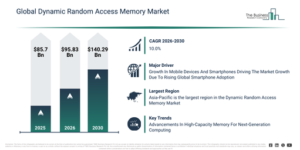
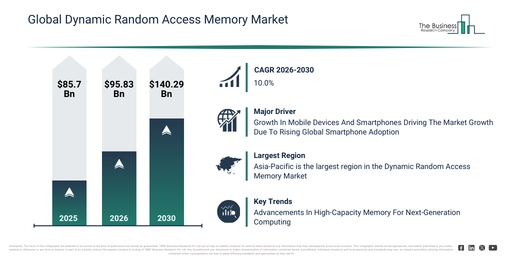
The dynamic random access memory market has seen substantial growth recently. It is set to expand from $85.7 billion in 2025 to $95.83 billion in 2026, reflecting a compound annual growth rate (CAGR) of 11.8%. This historical expansion can be attributed to several factors, including the increasing use of personal computing devices, the development of server and data center infrastructure, a growing need for faster processing speeds, heightened memory requirements for operating systems, and the broad adoption of multitasking applications.
The dynamic random access memory market is projected to experience robust expansion in the coming years. It is anticipated to reach a valuation of $140.29 billion by 2030, driven by a compound annual growth rate (CAGR) of 10.0%. Key factors contributing to this growth include the escalating deployment of artificial intelligence and machine learning workloads, a surge in memory requirements for electric vehicles, the expansion of cloud computing infrastructure, the need for energy-efficient memory solutions, and continuous advancements in semiconductor fabrication technologies. Prominent trends during this forecast timeframe encompass a shift towards high-bandwidth memory architectures, greater uptake of low-power DRAM variants, the integration of higher density memory cells, improved thermal management within memory modules, and the development of custom DRAM solutions tailored for specific workloads.
Get A Free Sample Report With In-Depth Market Insights:
Dynamic Random Access Memory Market Growth Backed By Core Demand Fundamentals
The expansion in the use of mobile devices and smartphones is anticipated to fuel the future growth of the dynamic random access memory market. These devices are defined as portable electronic gadgets, including cell phones, tablets, and various smart gadgets, which facilitate wireless communication, internet connectivity, and application execution. A key factor behind the rising adoption of mobile devices and smartphones is the increasing network coverage, providing more individuals with reliable mobile internet access, simplifying their use for communication, applications, and online services. This growth in mobile devices and smartphones subsequently boosts the need for dynamic random access memory, as such devices demand high-performance memory to effectively operate multiple applications, support quicker processing, store larger volumes of data, and allow for seamless multitasking and sophisticated functionalities. An illustration of this trend is seen in June 2024, where Ericsson, a telecommunications firm based in Sweden, reported that mobile subscriptions in the region are expected to climb from 1.2 billion in 2023 to 1.3 billion by 2029. Consequently, the proliferation of mobile devices and smartphones is a significant driver for the expansion of the dynamic random access memory market.
Dynamic Random Access Memory Market Segment Outlook: Which Categories Are Growing Fastest?
The dynamic random access memory market covered in this report is segmented –
1) By Type: Module Dynamic Random-Access Memory (DRAM), Component Dynamic Random-Access Memory (DRAM)
2) By Technology: Synchronous Dynamic Random-Access Memory (SDRAM), Rambus Dynamic Random-Access Memory (RDRAM), Double Data Rate Synchronous Dynamic Random-Access Memory (DDR SDRAM), Fast Page Dynamic Random-Access Memory (FP DRAM), Extended Data Output Dynamic Random-Access Memory (EDO DRAM)
3) By Application: Automotive, Data Centers, Industrial Automation, Information Technology (IT) And Telecommunications
Subsegments:
1) By Module Dynamic Random-Access Memory (DRAM): DDR (Double Data Rate) DRAM, LPDDR (Low Power DDR) DRAM, GDDR (Graphics DDR) DRAM, RDIMM (Registered DIMM), SO-DIMM (Small Outline DIMM), UDIMM (Unbuffered DIMM)
2) By Component Dynamic Random-Access Memory (DRAM): DRAM Chips, DRAM ICs (Integrated Circuits), DRAM Modules (Bare Or Component-Level)
Dynamic Random Access Memory Market Growth Trends Reshaping The Competitive Landscape
Leading companies in the dynamic random-access memory (DRAM) market are focused on developing advanced solutions, such as high-capacity DDR5 DRAM chips, to meet the increasing demand for high-performance computing, AI workloads, and energy-efficient data center memory systems. High-capacity DDR5 DRAM represents the newest generation of synchronous dynamic random-access memory, delivering significantly higher data-transfer rates, greater module densities, and improved power efficiency compared to traditional DDR4 memory, making it ideal for contemporary servers, high-end PCs, and AI-centric platforms. For instance, in September 2023, Samsung Electronics Co. Ltd., a South Korea-based semiconductor manufacturer, launched its 32-gigabit (Gb) DDR5 DRAM, built on 12 nm-class process technology. This module effectively doubles the capacity of previous 16 Gb chips within the same package size, enables 128 GB DRAM modules without relying on Through-Silicon Vias (TSV), and reduces power consumption by approximately 10%, thus providing high-capacity, energy-efficient memory for AI-driven systems and data centers.
Dynamic Random Access Memory Market Leading Companies And Competitive Benchmarking
Major companies operating in the dynamic random access memory market are Samsung Electronics Co. Ltd.; Intel Corporation; SK Hynix Inc.; Fujitsu Limited; Micron Technology Inc.; Advanced Micro Devices Inc. (AMD); Texas Instruments Incorporated; Infineon Technologies AG; Kingston Technology Company Inc.; ON Semiconductor Corporation; Powerchip Semiconductor Manufacturing Corp.; Nanya Technology Corporation; ChipMOS Technologies Inc.; Elite Semiconductor Microelectronics Technology Inc.; Integrated Silicon Solution Inc. (ISSI); Apacer Technology Inc.; Transcend Information Inc.; ATP Electronics Inc.; Viking Technology; GSI Technology Inc.; Centon Electronics Inc.; Etron Technology Inc.; Elpida Memory Inc.; Winbond Electronics Corporation; ProMOS Technologies Inc.; Alliance Memory Inc.
View The Full Dynamic Random Access Memory Market Report:
Dynamic Random Access Memory Market Largest Region: Which Geography Holds The Biggest Share?
Asia-Pacific was the largest region in the dynamic random access memory market in 2025. North America is expected to be the fastest-growing region in the forecast period. The regions covered in the dynamic random access memory market report are Asia-Pacific, South East Asia, Western Europe, Eastern Europe, North America, South America, Middle East, Africa.
Reach Out To Our Team:
The Business Research Company: https://www.thebusinessresearchcompany.com/
Americas: +1 310-496-7795
Asia: +44 7882 955267 & +91 8897263534
Europe: +44 7882 955267
Email us at: marketing@tbrc.info
Follow us on:
LinkedIn: https://in.linkedin.com/company/the-business-research-company
YouTube: https://www.youtube.com/channel/UC24_fI0rV8cR5DxlCpgmyFQ
Global Market Model: https://www.thebusinessresearchcompany.com/global-market-model

Wasay has over a decade of experience in market research, data modelling, and analytics, with prior experience at GlobalData and Decision Tree Consulting Services. At The Business Research Company , he leads research operations across syndicated studies, customized consulting engagements, and the Global Market Model platform. His professional experience includes supporting organizations such as Boston Consulting Group, KPMG, and Ernst & Young. Wasay holds a degree in Electronics and Communications Engineering, postgraduate management qualifications from International Management Institute Belgium and Indian School of Business and Entrepreneurship, and completed the Integrated Program in Business Analytics from Indian Institute of Management Indore.