Backed by market attractiveness analysis, total addressable market sizing, company benchmarking matrices, interactive Excel dashboards, wider supply chain intelligence, emerging startup coverage, and detailed product-level insights, The Business Research Company’s 2026 market reports are designed to offer research that is more actionable and strategically valuable than ever.
Crisis Management Software Market Set To Climb From $10.11 Billion In 2026 To $12.78 Billion By 2030
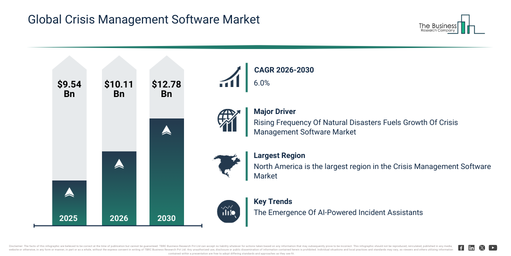
The crisis management software market size has experienced significant expansion over recent years. Looking ahead, this market is projected to expand from $9.54 billion in 2025 to $10.11 billion in 2026, demonstrating a compound annual growth rate (CAGR) of 5.9%. Historically, this growth has been driven by several factors, including the increasing demand for effective crisis response solutions, the rising occurrence of natural and man-made disasters, stricter regulatory mandates for emergency preparedness, the widespread adoption of enterprise risk management methodologies, and the previous reliance on manual crisis management techniques.
The crisis management software market is projected to experience substantial expansion in the coming years, reaching $12.78 billion by 2030, driven by a compound annual growth rate (CAGR) of 6.0%. This anticipated growth during the forecast period is primarily due to factors such as the incorporation of AI for predictive risk analysis, the proliferation of cloud-based crisis management solutions, a heightened emphasis on the safety of employees and stakeholders, widespread adoption across both SMEs and large enterprises, and the integration with IT and telecom infrastructure to facilitate real-time alerts. Key trends expected over the forecast horizon encompass real-time incident management, automated emergency notification systems, robust business continuity planning, advanced crisis communication platforms, and sophisticated risk assessment and simulation tools.
Get A Free Sample Report With In-Depth Market Insights:
Crisis Management Software Market Growth Backed By Core Demand Fundamentals
The increasing frequency of natural disasters is anticipated to drive expansion in the crisis management software market moving ahead. These catastrophic occurrences lead to extensive damage, fatalities, and considerable disruption to daily routines. Practices like deforestation, changes in land use, and modifications to natural ecosystems by humans can heighten vulnerability to specific natural disasters. Crisis management software improves communication, simplifies emergency procedures, and refines decision-making, thereby enabling robust response strategies and lessening the consequences in impacted areas. For example, in January 2024, the National Centers for Environmental Information (NCEI), a US government agency, reported 28 verified weather and climate disaster events across the United States, with each event incurring losses over $1 billion. These included one drought, four floods, 19 severe storms, two tropical cyclones, one wildfire, and one winter storm. Additionally, a report from March 2022 by the Fair Tech Institute Singapore, a not-for-profit organization, indicated a potential 37% increase in the annual frequency of natural disasters between 2025 and 2029. Consequently, the rising prevalence of natural disasters is fueling the expansion of the crisis management software market.
Crisis Management Software Market Segment Trends And Revenue Contributors
The crisis management software market covered in this report is segmented –
1) By Component: Solutions, Services
2) By Deployment Mode: Cloud, On-Premise
3) By Organization Size: Small And Medium-Sized Enterprises (SMEs), Large Enterprises
4) By Application: Business Continuity, Risk Assessment And Analysis, Emergency Notification System, Training And Simulation, Family Reunification, Other Applications
5) By Vertical: Government And Defense, Healthcare, Information Technology (IT) And Telecommunication, Banking, Financial Services And Insurance (BFSI), Energy And Utility, Education, Other Verticals
Subsegments:
1) By Solutions: Incident Management Software, Risk Assessment Tools, Communication And Collaboration Platforms, Emergency Response Software, Business Continuity Planning Solutions, Crisis Communication Systems, Situation Awareness Tools
2) By Services: Consulting Services, Training And Education Services, Implementation And Integration Services, Support And Maintenance Services, Managed Services
Crisis Management Software Market Growth Trends Reshaping The Competitive Landscape
Leading companies in the crisis management software market are intensifying their focus on creating advanced solutions, like AI-powered incident assistants, to gain a competitive advantage. This type of solution utilizes artificial intelligence algorithms and capabilities to assist in managing and responding to various incidents or emergencies. For instance, in February 2024, Blameless, a US-based software company, launched an AI-powered Incident Assistant feature. This feature represents a transformative tool within the Blameless platform, providing immediate clarity on the status of incidents by condensing thousands of lines of communication into a concise overview in less than a second. It employs AI to automatically generate incident summaries that are easy, instant, and up-to-date, revolutionizing the approach to briefing responders and keeping non-technical stakeholders informed. Additionally, Blameless ensures privacy and compliance by keeping all incident data within its customers’ enterprise accounts.
Crisis Management Software Market Competitive Landscape: Which Companies Lead The Industry?
Major companies operating in the crisis management software market are Lockheed Martin Corporation; International Business Machines Corporation; Honeywell International Inc.; Motorola Solutions; Blackboard Inc.; Everbridge Inc.; AlertMedia; OnSolve; xMatters Inc.; Resolver; ARCOS LLC; Agility Recovery; LogicGate; Eccentex Corporation; LiveSafe Inc.; Juvare LLC; The Response Group Inc.; CrisisGo Inc.; RockDove Solutions; Crisis Management Solutions Inc.; Regroup Mass Notification; Crisis Track; Bryghtpath LLC; RiskWatch International; Assurance Software; Rave Mobile Safety; Noggin; MissionMode Solutions Inc.
View The Full Crisis Management Software Market Report:
Crisis Management Software Market Regional Analysis: Which Geography Leads On Revenue?
North America was the largest region in the crisis management software market in 2025. Asia-Pacific is expected to be the fastest-growing region in the forecast period. The regions covered in the crisis management software market report are Asia-Pacific, South East Asia, Western Europe, Eastern Europe, North America, South America, Middle East, Africa.
Reach Out To Our Team:
The Business Research Company: https://www.thebusinessresearchcompany.com/
Americas: +1 310-496-7795
Asia: +44 7882 955267 & +91 8897263534
Europe: +44 7882 955267
Email us at: marketing@tbrc.info
Follow us on:
LinkedIn: https://in.linkedin.com/company/the-business-research-company
YouTube: https://www.youtube.com/channel/UC24_fI0rV8cR5DxlCpgmyFQ
Global Market Model: https://www.thebusinessresearchcompany.com/global-market-model

Wasay has over a decade of experience in market research, data modelling, and analytics, with prior experience at GlobalData and Decision Tree Consulting Services. At The Business Research Company , he leads research operations across syndicated studies, customized consulting engagements, and the Global Market Model platform. His professional experience includes supporting organizations such as Boston Consulting Group, KPMG, and Ernst & Young. Wasay holds a degree in Electronics and Communications Engineering, postgraduate management qualifications from International Management Institute Belgium and Indian School of Business and Entrepreneurship, and completed the Integrated Program in Business Analytics from Indian Institute of Management Indore.