Featuring market attractiveness scoring, total addressable market sizing, company benchmarking matrices, interactive Excel dashboards, deeper supply chain intelligence, emerging startup tracking, and granular product-level insights, The Business Research Company’s 2026 market reports are built to deliver research that is both more actionable and more strategically valuable.
Cyber Threat Intelligence Market Revenue Outlook: What CAGR Lies Ahead Through 2030?
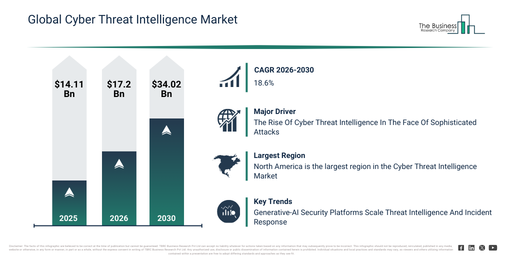
The cyber threat intelligence market has experienced significant expansion in recent years. It is projected to increase from $14.11 billion in 2025 to $17.2 billion in 2026, at a compound annual growth rate (CAGR) of 22.0%. The growth observed historically is attributable to factors such as the increasing sophistication of cyber threats, the adoption of siem and tips platforms, a rising demand for proactive security measures, the expansion of cloud deployment in enterprises, and a scarcity of in-house cybersecurity expertise.
The cyber threat intelligence market is projected to experience significant expansion in the coming years. It is anticipated to reach $34.02 billion by 2030, exhibiting a compound annual growth rate (CAGR) of 18.6%. This growth during the forecast period can be attributed to factors such as the integration of AI and machine learning for threat prediction, the expansion of cloud-based intelligence platforms, growing regulatory compliance requirements, an increasing demand for automated incident response, and the development of collaborative threat intelligence networks. Key trends anticipated within this period include advanced threat analytics, predictive cyberattack modeling, real-time threat intelligence sharing, incident response automation, and proactive vulnerability assessment.
Get A Free Sample Report With In-Depth Market Insights:
Cyber Threat Intelligence Market Growth Catalysts And Demand Drivers
The cyber threat intelligence market is projected to grow due to an increase in sophisticated cyberattacks. These attacks are hostile attempts to disable, damage, or gain unauthorized access to computer systems, networks, or digital devices. The rise in advanced cyberattacks is driven by evolving technology, enhanced connectivity, and the increasing value of digital assets, which encourages cybercriminals to develop more complex methods for exploiting vulnerabilities. Cyber threat intelligence (CTI) provides critical insights into the tactics, techniques, and procedures (TTPs) used by cyber adversaries, essential for defending against advanced threats. Furthermore, CTI also contributes to the sophistication of cyberattacks, as threat actors leverage it to identify potential targets, understand their weaknesses, and customize attacks for maximum effect and evasion. For example, in October 2025, the Australian Signals Directorate, a Australia-based government agency, stated that its Australian Cyber Security Centre (ACSC) received over 42,500 calls to the Australian Cyber Security Hotline in FY2024–25, indicating a 16% rise from the previous year. Therefore, the growing number of sophisticated cyberattacks is a primary driver for the expansion of the cyber threat intelligence market.
Cyber Threat Intelligence Market Segment Landscape And Growth Outlook
The cyber threat intelligence market covered in this report is segmented –
1) By Product: Software Product, Hardware Product
2) By Deployment: Cloud, On-Premise
3) By Application: Bank, Government, Enterprise, Other Applications
Subsegments:
1) By Software Product: Threat Intelligence Platforms (Tips), Security Information And Event Management (SIEM) Systems, Antivirus And Anti-Malware Software
2) By Hardware Product: Network Security Appliances, Intrusion Detection Systems (IDS), Firewalls
Cyber Threat Intelligence Market Trends Shaping Long-Term Demand
Major companies within the cyber threat intelligence market are increasingly prioritizing generative-AI–powered security platforms, including cloud-delivered AI copilots. These solutions integrate threat-intelligence data, real-time telemetry, and automated response orchestration to empower security teams to detect, analyze, and resolve threats with enhanced speed and scale. Generative-AI security platforms are defined as AI-driven suites that ingest malware data, vulnerability feeds, and behavioral threat indicators, subsequently performing automated threat analysis and contextual summarization. They support security workflows, helping organizations manage analyst overload and respond to complex cyber threats more effectively. As an illustration, in April 2023, Google LLC, a US-based technology company, unveiled Google Cloud Security AI Workbench. This security-focused generative-AI platform is powered by a specialized large language model (Sec-PaLM) combined with threat intelligence from Mandiant, delivering capabilities such as malware and vulnerability analysis, natural-language querying of threat data, automated alert summarization, and API integration for partner and enterprise threat-intelligence workflows. The platform is designed to assist security teams in accelerating threat detection and response by harnessing AI-driven insights and reducing manual analysis efforts. Through the combination of Google’s cloud infrastructure with advanced generative AI and Mandiant’s threat intelligence, organizations can proactively identify and mitigate cybersecurity risks across intricate IT environments.
Cyber Threat Intelligence Market Competitive Landscape: Who Leads The Industry?
Major companies operating in the cyber threat intelligence market are Dell Technologies Inc.; Siemens AG; International Business Machines Corporation; Cisco Systems Inc.; Broadcom Inc.; Honeywell International Inc.; Palo Alto Networks Inc.; Parsons Corporation; Optiv Security Inc.; Check Point Software Technologies Ltd.; Trend Micro Incorporated; CrowdStrike Holdings Inc.; FireEye Inc.; Kaspersky; Rapid7 Inc.; F-Secure Corporation; Webroot Inc.; Recorded Future Inc.; Sophos Group plc; Wurldtech Security Technologies; Lookingglass Cyber Solutions Inc.
View The Full Cyber Threat Intelligence Market Report:
Cyber Threat Intelligence Market Largest Region: Which Geography Holds The Biggest Share?
North America was the largest region in the cyber threat intelligence market in 2025. Asia-Pacific is expected to be the fastest-growing region in the forecast period. The regions covered in the cyber threat intelligence market report are Asia-Pacific, South East Asia, Western Europe, Eastern Europe, North America, South America, Middle East, Africa.
Reach Out To Our Team:
The Business Research Company: https://www.thebusinessresearchcompany.com/
Americas: +1 310-496-7795
Asia: +44 7882 955267 & +91 8897263534
Europe: +44 7882 955267
Email us at: marketing@tbrc.info
Follow us on:
LinkedIn: https://in.linkedin.com/company/the-business-research-company
YouTube: https://www.youtube.com/channel/UC24_fI0rV8cR5DxlCpgmyFQ
Global Market Model: https://www.thebusinessresearchcompany.com/global-market-model

Wasay has over a decade of experience in market research, data modelling, and analytics, with prior experience at GlobalData and Decision Tree Consulting Services. At The Business Research Company , he leads research operations across syndicated studies, customized consulting engagements, and the Global Market Model platform. His professional experience includes supporting organizations such as Boston Consulting Group, KPMG, and Ernst & Young. Wasay holds a degree in Electronics and Communications Engineering, postgraduate management qualifications from International Management Institute Belgium and Indian School of Business and Entrepreneurship, and completed the Integrated Program in Business Analytics from Indian Institute of Management Indore.