Backed by market attractiveness analysis, total addressable market sizing, company benchmarking matrices, interactive Excel dashboards, wider supply chain intelligence, emerging startup coverage, and detailed product-level insights, The Business Research Company’s 2026 market reports are designed to offer research that is more actionable and strategically valuable than ever.
Railway Telematics Market Poised To Hit $7.29 Billion By 2030 With A 8.2% CAGR
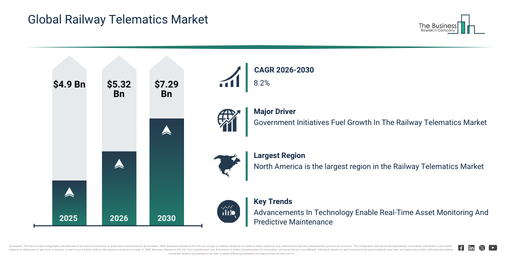
The railway telematics market has demonstrated significant growth in recent years. This market is expected to expand from $4.9 billion in 2025 to $5.32 billion in 2026, exhibiting a compound annual growth rate (CAGR) of 8.7%. The expansion observed historically is attributable to factors such as the growth of freight rail transportation, a heightened demand for fleet visibility, the implementation of GPS-based tracking systems, increased endeavors to optimize fuel efficiency, and the need for enhanced rail safety monitoring.
The railway telematics market is projected to experience robust expansion over the coming years. It will grow to $7.29 billion in 2030 at a compound annual growth rate (CAGR) of 8.2%. This projected growth is driven by factors such as greater investments in connected rail infrastructure, the increasing use of AI-driven analytics, the proliferation of real-time logistics monitoring, a rising need for predictive fleet information, and enhanced integration with digital supply chains. Key trends anticipated during this period involve the wider implementation of real-time railcar tracking, a surge in sensor-based condition monitoring, the expanding integration of cloud-based telematics solutions, the development of fleet optimization tools, and a sharpened emphasis on data-centric rail operations.
Get A Free Sample Report With In-Depth Market Insights:
Railway Telematics Market Growth Momentum: What Factors Are Shaping Demand?
The global railway telematics market is significantly propelled by the increasing government initiatives focused on smart railways. Governments worldwide are implementing various smart railway projects to establish superior transportation infrastructure. These initiatives are escalating due to a heightened demand for improved safety, as cutting-edge technologies like telematics, automation, and real-time monitoring are instrumental in accident prevention, operational efficiency enhancement, and ensuring the security of both passengers and cargo. Government efforts bolster railway telematics by advocating for the adoption of advanced digital technologies and intelligent systems that boost safety, efficiency, and connectivity throughout rail networks, thereby stimulating modernization through strategic investments, policy frameworks, and the development of smart infrastructure. For instance, in June 2024, Invest India, the National Investment Promotion and Facilitation Agency of the Government of India, reported that the Indian railway sector aims to contribute 1.5% to the country’s GDP by strengthening infrastructure to capture 45% of the freight modal share. Two Dedicated Freight Corridors (DFCs) are being accelerated: one connecting Jawaharlal Nehru Port to Dadri and another from Ludhiana to Dankuni. Kisan Rail trains have completed 2,359 trips across 167 routes, transporting nearly 7.9 lakh tones of goods. As of December 31, 2023, 6,521 stations, representing 98.8% of the total, have been upgraded with Electrical/Electronic Signaling Interlocking Systems. The Union Budget 2024-25 designates a record capital outlay of INR 2.62 lakh crore for Indian Railways. Additionally, the average freight train speed has risen to 44.36 km/h, and the National Rail Plan targets increasing the freight traffic share from 27% to 45% by 2030. Consequently, government initiatives for smart railways are set to escalate the demand for railway telematics, thus driving the railway telematics market growth.
Railway Telematics Market Segment Performance And Emerging Opportunities
The railway telematics market covered in this report is segmented –
1) By Solution: Fleet Management, Automatic Stock Control, Remote Data Access, Railcar Tracking And Tracing
2) By Railcar: Hoppers, Tank Cars, Well Cars, Boxcars, Refrigerated Boxcars
3) By Component Type: Telematics Control Unit, Sensors
Subsegments:
1) By Fleet Management: Vehicle Tracking, Maintenance Management
2) By Automatic Stock Control: Inventory Management, Supply Chain Monitoring
3) By Remote Data Access: Real-Time Data Monitoring, Cloud-Based Data Storage
4) By Railcar Tracking And Tracing: GPS Tracking, Condition Monitoring, Location-Based Services
Railway Telematics Market Trends Redefining Industry Growth
Leading firms within the railway telematics market are concentrating on creating advanced solutions, like real-time asset monitoring, to boost operational effectiveness and elevate safety standards. This real-time asset monitoring involves the uninterrupted tracking of an asset’s whereabouts, state, and functionality utilizing sensors and digital tools. It aids businesses in enhancing operational efficiency, averting interruptions via predictive maintenance, increasing safety, streamlining resource deployment, and making informed decisions for superior overall governance. As an illustration, during December 2023, Wabtec Corporation, a US-based supplier of freight and transit rail solutions, introduced its railcar telematics platform through a collaboration with the Dutch firm Intermodal Telematics B.V., thereby entering the railcar telematics sector. This platform comprises sensor modules that can be retrofitted onto railcars, gateways for transmitting data wirelessly, and analytics software. These components allow operators to monitor location, handbrake status, the opening/closing of hatches and doors, cargo temperature and pressure (especially for tank containers), and whether they are loaded or unloaded. Its distinctive capabilities encompass integration for new builds as well as retrofit compatibility, adaptable dashboards, and a comprehensive view of KPIs across the fleet. Its uses extend across freight car operations, tank container surveillance, maintenance planning, and the optimization of asset utilization, delivering advantages such as decreased downtime, elevated safety, increased throughput, and more intelligent asset deployment.
Railway Telematics Market Key Players: Which Companies Lead Industry Competition?
Major companies operating in the railway telematics market are Siemens AG; Alstom SA; Hitachi Ltd.; Wabtec Corporation; Thales Group; CAF Signalling; Mitsubishi Electric Corporation; CRRC Corporation Limited; ZTR Control Systems; Intermodal Telematics B.V.; INTREX Telematics Systems AD; Railnova SA; Nomad Digital; EKE-Electronics Ltd.; HaslerRail AG; Lilee Systems; Quester Tangent Corporation; Advantech Co Ltd; Senceive Ltd; Rail Vision Ltd
View The Full Railway Telematics Market Report:
Railway Telematics Market Regional Breakdown: Where Is Demand Concentrated?
North America will be the largest region in the railway telematics market in 2025.Asia-Pacific is expected to be the fastest-growing region in the forecast period. The regions covered in the railway telematics market report are Asia-Pacific, South East Asia, Western Europe, Eastern Europe, North America, South America, Middle East, Africa.
Reach Out To Our Team:
The Business Research Company: https://www.thebusinessresearchcompany.com/
Americas: +1 310-496-7795
Asia: +44 7882 955267 & +91 8897263534
Europe: +44 7882 955267
Email us at: marketing@tbrc.info
Follow us on:
LinkedIn: https://in.linkedin.com/company/the-business-research-company
YouTube: https://www.youtube.com/channel/UC24_fI0rV8cR5DxlCpgmyFQ
Global Market Model: https://www.thebusinessresearchcompany.com/global-market-model

Wasay has over a decade of experience in market research, data modelling, and analytics, with prior experience at GlobalData and Decision Tree Consulting Services. At The Business Research Company , he leads research operations across syndicated studies, customized consulting engagements, and the Global Market Model platform. His professional experience includes supporting organizations such as Boston Consulting Group, KPMG, and Ernst & Young. Wasay holds a degree in Electronics and Communications Engineering, postgraduate management qualifications from International Management Institute Belgium and Indian School of Business and Entrepreneurship, and completed the Integrated Program in Business Analytics from Indian Institute of Management Indore.