Featuring market attractiveness scoring, total addressable market sizing, company benchmarking matrices, interactive Excel dashboards, deeper supply chain intelligence, emerging startup tracking, and granular product-level insights, The Business Research Company’s 2026 market reports are built to deliver research that is both more actionable and more strategically valuable.
Remote towers Market Size Forecast: How Big Could The Market Get By 2030?
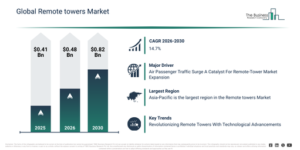
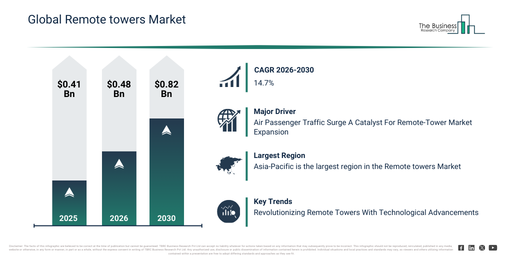
The remote towers market has witnessed substantial growth over recent years. It is anticipated to increase from $0.41 billion in 2025 to $0.48 billion in 2026, at a compound annual growth rate (CAGR) of 15.8%. The growth observed in prior periods stemmed from the expansion of regional and low-traffic airports, increasing air traffic management modernization initiatives, the early uptake of digital ATC technologies, a greater emphasis on optimizing operational costs, and the availability of high-speed communication networks.
The remote towers market is projected to experience substantial expansion in the coming years, set to reach $0.82 billion by 2030, exhibiting a compound annual growth rate (CAGR) of 14.7%. This growth throughout the forecast period stems from factors such as increased investments in intelligent airport infrastructure, a rise in the implementation of centralized Air Traffic Control (ATC) models, broader deployment of digital surveillance and visualization tools, a heightened emphasis on remote and contingency operations, and growing regulatory approval for remote tower systems. Key trends during this period are anticipated to involve the increased use of remote air traffic control operations, the wider establishment of multi-airport remote tower centers, greater integration of sophisticated visualization systems, the expansion of highly available network solutions, and a stronger emphasis on improving controller situational awareness.
Get A Free Sample Report With In-Depth Market Insights:
Remote towers Market Expansion Drivers: What’s Shaping Future Growth?
The rising number of individuals traveling by air is anticipated to fuel the expansion of the remote-tower market in the future. Flying passenger traffic specifically encompasses the transportation of passengers through both aircraft and positioning flights. Thanks to contemporary camera and sensor technology, remote towers offer controllers a clearer and more comprehensive perspective of the airport and its surrounding airspace, which can lead to safer operations and greater passenger trust. Consequently, an increase in air travel is stimulating the growth of this market. For example, according to Eurostat, the Luxembourg-based statistical office of the European Union (EU), in November 2024, air travel in the EU significantly increased in 2023, with 973 million passengers, marking a 19.3% rise compared to 2022. Thus, the growing volume of passengers flying is a key driver for the remote tower market’s growth.
Remote towers Market Breakdown By Product Type And Application
The remote towers market covered in this report is segmented –
1) By Operation Type: Single, Multiple, Contingency
2) By System Type: Airport Equipment, Remote Tower Module, Network Solution
3) By Application: Communication, Information And Control, Flight Data Handling, Surveillance, Visualization
4) By End User: Military Airport, Commercial Airport
Subsegments:
1) By Single: Single Air Traffic Control Tower Operations, Standalone Remote Tower Operations, Independent Remote Tower Operations
2) By Multiple: Multi-Tower Integrated Operations, Coordinated Remote Tower Operations, Clustered Remote Tower Operations
3) By Contingency: Backup Remote Tower Operations, Emergency Remote Tower Operations, Temporary Remote Tower Operations
Remote towers Market Strategic Trends: What Defines The Next Growth Phase?
Leading companies in the remote towers market are concentrating on developing sophisticated solutions, such as modular deployable towers, to enhance operational agility, ensure safety, and support rapid deployment in various scenarios. Modular deployable towers refer to digital air traffic control systems that can be swiftly erected at permanent or temporary airstrips, offering full operational capabilities while being controlled remotely from secure locations. For instance, in June 2023, Saab AB, a Sweden-based aerospace and defense company, introduced a unique r-TWR, a modular, secure, and quickly deployable digital tower for adaptable air traffic control operations, in collaboration with Conlog Oy. The r-TWR Deployable is a digital tower designed for deployment, offering high availability, mission-to-mission modularity, and flexibility. It can achieve mission-ready status within an hour and can be managed remotely from a secure position on a base or linked to a centralized center hundreds of miles away, thereby ensuring the safety of military personnel. Some of these attributes could also prove beneficial for foreign relief missions, allowing for the rapid deployment of such utilities into a disaster-affected country. The r-TWR Deployable provides everything necessary for air traffic control at a permanent or temporary touchdown strip and can be transported quickly by rail or road on one or two standardized trailers, or via a cargo aircraft the size of a C-130 Hercules. Conlog Oy is a Finland-based company specializing as a principal defense systems integrator.
Remote towers Market Company Landscape And Competitive Strategy
Major companies operating in the remote towers market are Frequentis Group; Indra Sistemas S.A.; Thales Group; Svenska Aeroplan Aktiebolaget; L3Harris Technologies Inc.; Raytheon Technologies Corporation; Leonardo S.p.A; DFS Deutsche Flugsicherung GmbH; Searidge Technologies; RETIA Inc.; Kongsberg Gruppen; Rohde & Schwarz GmbH & Co KG; Altys Technologies; Atech; BAE Systems plc; Era Corporation; HungaroControl; Intelcan Technosystems; Isavia ANS; SkySoft-ATM
View The Full Remote towers Market Report:
Remote towers Market Regional Breakdown: Where Is Demand Concentrated?
Asia-Pacific was the largest region in the remote towers market in 2025 and is expected to be the fastest-growing region in the remote towers market report during the forecast period. The regions covered in the remote towers market report are Asia-Pacific, South East Asia, Western Europe, Eastern Europe, North America, South America, Middle East, Africa.
Reach Out To Our Team:
The Business Research Company: https://www.thebusinessresearchcompany.com/
Americas: +1 310-496-7795
Asia: +44 7882 955267 & +91 8897263534
Europe: +44 7882 955267
Email us at: marketing@tbrc.info
Follow us on:
LinkedIn: https://in.linkedin.com/company/the-business-research-company
YouTube: https://www.youtube.com/channel/UC24_fI0rV8cR5DxlCpgmyFQ
Global Market Model: https://www.thebusinessresearchcompany.com/global-market-model

Wasay has over a decade of experience in market research, data modelling, and analytics, with prior experience at GlobalData and Decision Tree Consulting Services. At The Business Research Company , he leads research operations across syndicated studies, customized consulting engagements, and the Global Market Model platform. His professional experience includes supporting organizations such as Boston Consulting Group, KPMG, and Ernst & Young. Wasay holds a degree in Electronics and Communications Engineering, postgraduate management qualifications from International Management Institute Belgium and Indian School of Business and Entrepreneurship, and completed the Integrated Program in Business Analytics from Indian Institute of Management Indore.