Delivering more actionable and strategically valuable research, The Business Research Company’s 2026 market reports feature market attractiveness analysis, total addressable market evaluation, company benchmarking matrices, interactive Excel dashboards, expanded supply chain intelligence, emerging startup coverage, and detailed product insights.
In-Space Manufacturing Market Expansion From $1.49 Billion In 2026 To $3.5 Billion In 2030
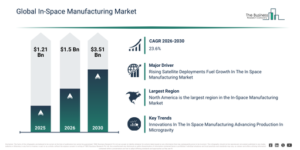
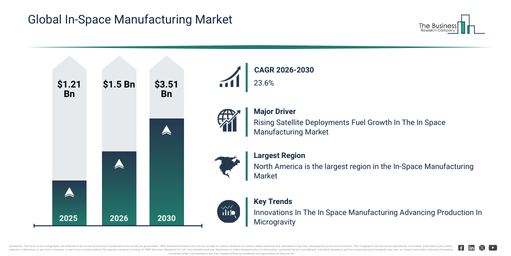
The scale of the in-space manufacturing market has experienced substantial expansion in recent years. This market is set to increase from $1.21 billion in 2025 to $1.5 billion in 2026, achieving a compound annual growth rate (CAGR) of 23.7%. The historical progression can be linked to the emergence of microgravity 3D printing technologies, the initial embrace of orbital satellite servicing missions, improvements in manufacturing exotic metal alloys for space applications, governmental financial backing and agreements for space manufacturing research, and the creation of private businesses focused on in-space manufacturing.
The in-space manufacturing market size is anticipated to experience substantial growth in the upcoming years. It is projected to increase to $3.51 billion by 2030, exhibiting a compound annual growth rate (CAGR) of 23.6%. This growth over the forecast period is driven by factors such as the increasing demand for on-orbit satellite assembly and repair, the expansion of commercial space stations, the rise in microgravity-based material research, progress in in-space refueling infrastructure, and greater investment from both private and public sectors in sustainable space exploration. Significant trends for the forecast period include orbital 3D printing & additive manufacturing, in-orbit satellite servicing & refueling, microgravity material innovation, modular space infrastructure assembly, and space resource utilization & recycling.
Download A Free Sample Report For Comprehensive Market Insights:
In-Space Manufacturing Market Opportunity Drivers: What Is Creating New Revenue Potential?
The increasing quantity of satellites is projected to stimulate the expansion of the in-space manufacturing market in the future. Satellites are man-made devices deliberately deployed into orbit around Earth or other heavenly bodies, serving purposes such as communication, weather prediction, navigation, scientific exploration, earth monitoring, and military operations. This growth in satellite numbers stems from a heightened demand for worldwide communication networks, the spread of 5G capabilities, climate tracking, and catastrophe response. In-space manufacturing provides a framework enabling satellites to execute crucial operations like assembling, mending, and upholding other satellites directly within orbit, leveraging the microgravity conditions. For example, data from April 2024, provided by Slingshot Aerospace, a US-based software firm specializing in satellite tracking, space traffic coordination, and space modeling, indicated roughly 9,241 active satellites orbiting in 2023, a rise from 6,718 by the close of 2022. Consequently, the growing count of satellites acts as a key impetus for the in-space manufacturing market.
In-Space Manufacturing Market Segment Outlook: Which Categories Are Expanding The Fastest?
The in-space manufacturing market covered in this report is segmented –
1) By Product: Perovskite Photovoltaics Cell, Graphene And Solid-State Lithium Batteries, Quantum Dot Display,
2) By Point Of Use: Space, Terrestrial
3) By Material: Metals, Polymers, Ceramics, Composites
4) By Application: Communication Satellites, Medical Implants, Scientific Equipment, Automotive Components
5) By End-User: Commercial, Government And Military
Subsegments:
1) By Perovskite Photovoltaics Cell: Flexible Perovskite Solar Cells, Tandem Perovskite Solar Cells, Large-Area Perovskite Solar Modules
2) By Graphene And Solid-State Lithium Batteries: Graphene-Based Batteries, Solid-State Lithium-Ion Batteries, Hybrid Graphene-Solid-State Batteries
3) By Quantum Dot Display: Quantum Dot LED (QLED) Displays, Quantum Dot OLED Displays, Quantum Dot Solar Cells
In-Space Manufacturing Market Industry Trends: What Changes Are Reshaping Demand?
Leading companies in the in-space manufacturing market are concentrating on creating innovative products, such as space factories, to enable the production of advanced materials and components in microgravity, thereby enhancing the efficiency and capabilities of space missions. A space factory is a facility or system specifically designed to manufacture goods in space, leveraging the unique environmental conditions of outer space, including microgravity, vacuum, and radiation. For instance, in June 2023, Varda Space Industries, Inc., a US-based space industry company, launched the W-Series 1 Satellite, a spacecraft engineered to function as a space factory for pharmaceutical production. This spacecraft is composed of three main components: a satellite bus, a payload module, and a reentry capsule. The mission’s goal is to explore the potential of manufacturing drugs in microgravity, particularly focusing on the active pharmaceutical ingredient ritonavir, which is used in treatments for HIV. Once production is complete, the materials will be transported back to Earth using Varda’s reentry vehicle, designed to withstand speeds of up to 19,000 miles per hour.
In-Space Manufacturing Market Key Companies And Competitive Benchmarking
Major companies operating in the in-space manufacturing market are Airbus SAS, Northrop Grumman Corporation, Blue Origin LLC, Sierra Space Corp., Redwire Corporation, Axiom Space Inc., Astroscale Holdings Inc, Honeybee Robotics Ltd., Varda Space Industries Inc., Astrobotic Technology Inc., Nanoracks LLC, Orbit Fab Inc., Astra Space Inc., Xplore Inc., Le Verre Fluore Fiber Solutions, Global Graphene Group Inc., Allevi Inc., Nedstack Fuel Cell Technology B.V., Virgin Galactic Holdings Inc., Momentus Space Inc.
Access The Complete In-Space Manufacturing Market Report:
In-Space Manufacturing Market Largest Region By Revenue And Market Share
North America was the largest region in the in-space manufacturing market in 2025. Asia-Pacific is expected to be the fastest-growing region in the forecast period. The regions covered in the in-space manufacturing market report are Asia-Pacific, South East Asia, Western Europe, Eastern Europe, North America, South America, Middle East, Africa.
Access a Customized In-Space Manufacturing Market Report for Deeper Competitive Insights
https://www.thebusinessresearchcompany.com/customise?id=25358&type=smp
The Business Research Company: https://www.thebusinessresearchcompany.com/
Americas: +1 310-496-7795
Asia: +44 7882 955267 & +91 8897263534
Europe: +44 7882 955267
Email us at: marketing@tbrc.info
Follow us on:
LinkedIn: https://in.linkedin.com/company/the-business-research-company
YouTube: https://www.youtube.com/channel/UC24_fI0rV8cR5DxlCpgmyFQ
Global Market Model: https://www.thebusinessresearchcompany.com/global-market-model

Wasay has over a decade of experience in market research, data modelling, and analytics, with prior experience at GlobalData and Decision Tree Consulting Services. At The Business Research Company , he leads research operations across syndicated studies, customized consulting engagements, and the Global Market Model platform. His professional experience includes supporting organizations such as Boston Consulting Group, KPMG, and Ernst & Young. Wasay holds a degree in Electronics and Communications Engineering, postgraduate management qualifications from International Management Institute Belgium and Indian School of Business and Entrepreneurship, and completed the Integrated Program in Business Analytics from Indian Institute of Management Indore.