Featuring market attractiveness scoring, total addressable market sizing, company benchmarking matrices, interactive Excel dashboards, deeper supply chain intelligence, emerging startup tracking, and granular product-level insights, The Business Research Company’s 2026 market reports are built to deliver research that is both more actionable and more strategically valuable.
Smart Card in Healthcare Market Poised To Hit $3.55 Billion By 2030 With A 15.5% CAGR
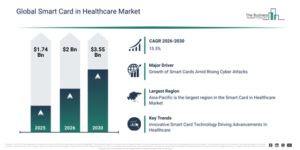
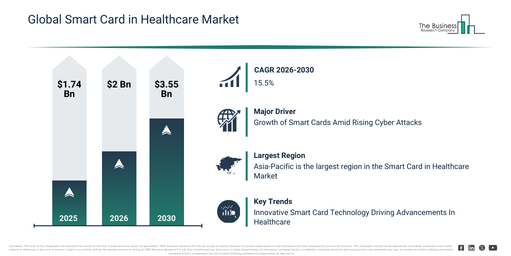
The smart card in healthcare market size has experienced substantial expansion in recent years. It is anticipated to increase from $1.74 billion in 2025 to $2 billion in 2026, at a compound annual growth rate (CAGR) of 15.2%. This historical growth can be attributed to elements such as the increasing digitization of healthcare records, a rising demand for accurate patient identification, the expansion of health insurance coverage systems, the growing adoption of hospital information systems, and an increasing focus on healthcare operational efficiency.
The smart card in healthcare market is poised for rapid expansion in the coming years. It will grow to $3.55 billion in 2030 at a compound annual growth rate (CAGR) of 15.5%. This growth during the projected period stems from several factors, including heightened investments in digital health infrastructure, a surging need for interoperable patient data systems, the wider implementation of national health identification programs, an elevated emphasis on cybersecurity within healthcare, and the increasing uptake of contactless healthcare solutions. Key trends for the forecast period encompass a greater acceptance of secure patient identification systems, an increased deployment of contactless healthcare cards, deeper integration with electronic health records, the proliferation of multi-application smart health cards, and a heightened commitment to data privacy and authentication.
Get A Free Sample Report With In-Depth Market Insights:
Smart Card in Healthcare Market Growth Factors: What’s Supporting Expansion?
The smart card in the healthcare market is experiencing growth driven by the escalating incidents of data breaches and unauthorized access occurring within healthcare portals. Such occurrences involve the compromise of sensitive patient data resulting from insufficient security protocols or malicious cyber-attacks. This surge in security compromises is attributed to the rise in cyber threats, inadequate security measures, and the increasing digitization of healthcare records. Smart cards offer a solution by mitigating these risks through secure authentication and encryption capabilities. For example, a report from Check Point in September 2024 revealed that between January to September 2024, the global healthcare sector faced an average of 2,018 attacks per organization weekly, marking a 32% increase compared to the same timeframe in January to September 2023. Consequently, the increasing prevalence of data breaches and unauthorized access in healthcare portals is projected to stimulate market expansion throughout the forecast period.
Smart Card in Healthcare Market Driver: Growth Of Smart Cards In Healthcare Fueled By Adoption Of Electronic Health Records (EHRS)
The smart card in the healthcare market is anticipated to experience further growth due to the expanding adoption of Electronic Health Records (EHRs). An EHR serves as a digital representation of a patient’s medical history, providing a real-time, patient-focused record that authorized personnel can access immediately and securely. Smart cards facilitate the verification of healthcare providers accessing EHRs and can encrypt EHR data, thereby safeguarding patient privacy and preventing unauthorized access to medical records. For example, a report from the UK Parliament’s House of Commons Library in July 2025 indicated that by May 2025, 91% of secondary care trusts had implemented an electronic patient record system, with the government aiming for all trusts to adopt such a system by March 2026. Consequently, the rising implementation of Electronic Health Records (EHRs) is significantly boosting the smart card in the healthcare market.
Smart Card in Healthcare Market Segmentation: How Does The Market Break Down By Category?
The smart card in healthcare market covered in this report is segmented –
1) By Type: Contactless Smart Cards, Contact-Based Smart Cards, Dual-interface Smart Cards
2) By Component: Memory Card-Based Smart Cards, Microcontroller-Based Smart Cards
3) By Application: Personal Identity, Patient History, Billing and Payment, Security
Subsegments:
1) By Contactless Smart Cards: RFID-Based Healthcare Cards, NFC-Enabled Health Cards
2) By Contact-Based Smart Cards: Chip-Based Medical ID Cards, Health Insurance Cards
3) By Dual-Interface Smart Cards: Cards That Support Both Contact And Contactless Transactions, Multi-Application Healthcare Cards
Smart Card in Healthcare Market Industry Trends: What’s Reshaping Demand?
Major companies in the smart cards for healthcare market are introducing advanced offerings like payment cards to expand their customer base and maintain a competitive advantage over rivals. A payment card is a digital or physical instrument that allows patients to directly pay for medical services and treatments, simplifying the claims process and lessening the need for reimbursement claims. For example, in February 2024, AXA Global Healthcare, a UK-based software firm, launched its new virtual healthcare payment card, designed to streamline the claims experience for its customers. A recent survey indicated that significant obstacles in making health insurance claims are time and administration. This virtual card can be added to digital wallets including Apple Pay or Google Pay, enabling members to pay for eligible outpatient treatments, such as over-the-counter prescriptions, directly without utilizing personal funds or submitting extensive claims. Research also shows that many international claims are for low-value expenses, often self-paid, which makes the claims process cumbersome for members.
Smart Card in Healthcare Market Competitive Overview And Top Companies
Major companies operating in the smart card in healthcare market are Atos SE; Giesecke+Devrient GmbH; Thales Group; IDEMIA France SAS; Infineon Technologies AG; NXP Semiconductors N.V.; STMicroelectronics N.V.; Renesas Electronics Corporation; CardLogix Corporation; HID Global Corporation; Entrust Corporation; Oberthur Fiduciaire SAS; Watchdata Technologies Pte. Ltd.; Eastcompeace Technology Co. Ltd.; Goldpac Group Limited; CPI Card Group Inc.; Valid S.A.; Zetes Industries S.A.; Gemalto N.V.; Feitian Technologies Co. Ltd.
View The Full Smart Card in Healthcare Market Report:
Smart Card in Healthcare Market Regional Split: Which Areas Are Fueling Growth?
Asia-Pacific was the largest region in the smart card in healthcare market in 2025. Asia-Pacific is expected to be the fastest-growing region in the forecast period. The regions covered in the smart card in healthcare market report are Asia-Pacific, South East Asia, Western Europe, Eastern Europe, North America, South America, Middle East, Africa.
Reach Out To Our Team:
The Business Research Company: https://www.thebusinessresearchcompany.com/
Americas: +1 310-496-7795
Asia: +44 7882 955267 & +91 8897263534
Europe: +44 7882 955267
Email us at: marketing@tbrc.info
Follow us on:
LinkedIn: https://in.linkedin.com/company/the-business-research-company
YouTube: https://www.youtube.com/channel/UC24_fI0rV8cR5DxlCpgmyFQ
Global Market Model: https://www.thebusinessresearchcompany.com/global-market-model

Wasay has over a decade of experience in market research, data modelling, and analytics, with prior experience at GlobalData and Decision Tree Consulting Services. At The Business Research Company , he leads research operations across syndicated studies, customized consulting engagements, and the Global Market Model platform. His professional experience includes supporting organizations such as Boston Consulting Group, KPMG, and Ernst & Young. Wasay holds a degree in Electronics and Communications Engineering, postgraduate management qualifications from International Management Institute Belgium and Indian School of Business and Entrepreneurship, and completed the Integrated Program in Business Analytics from Indian Institute of Management Indore.