Backed by market attractiveness analysis, total addressable market sizing, company benchmarking matrices, interactive Excel dashboards, wider supply chain intelligence, emerging startup coverage, and detailed product-level insights, The Business Research Company’s 2026 market reports are designed to offer research that is more actionable and strategically valuable than ever.
Smart Factory Market Set To Climb From $99.79 Billion In 2026 To $157.8 Billion By 2030
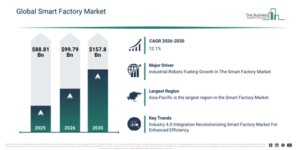
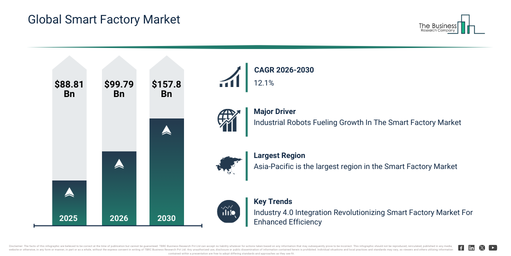
The smart factory market has observed substantial expansion in recent years. Its valuation is expected to rise from $88.81 billion in 2025 to $99.79 billion in 2026, achieving a compound annual growth rate (CAGR) of 12.4%. The historical progress of this market is attributable to several factors, including an increase in manufacturing automation levels, a heightened need for operational efficiency, the adoption of programmable control systems, the broadening use of sensor-based monitoring, and the expanding implementation of data-driven manufacturing processes.
The smart factory market size is anticipated to undergo significant expansion in the forthcoming years. It is predicted to attain a value of $157.8 billion by 2030, demonstrating a compound annual growth rate (CAGR) of 12.1%. This growth throughout the projected period can be ascribed to a surge in investments in smart manufacturing infrastructure, the increasing adoption of AI-driven production optimization, the expansion of IIoT-enabled factories, a rising demand for flexible manufacturing systems, and an intensified focus on resilient supply chains. Prominent trends for the forecast period encompass a greater deployment of connected manufacturing systems, an escalating embrace of industrial robotics and automation, an increased utilization of real-time production analytics, the broadening of predictive maintenance capabilities, and a stronger emphasis on digital twin integration.
Get A Free Sample Report With In-Depth Market Insights:
Smart Factory Market Growth Momentum: What Factors Are Shaping Demand?
The escalating need for industrial robots is anticipated to fuel the expansion of the smart factory market in the future. Industrial robots are defined as automated mechanical devices designed to execute production processes within industrial settings. A smart factory concentrates on optimizing and automating its industrial resources through the application of tools like information and smart sensor technologies, robotics, the internet of things, and artificial intelligence. For example, as reported by the International Federation of Robotics (IFR), a non-profit organization based in Germany, in September 2024, a total of 4,281,585 industrial robots were operational globally, representing a 10% increase from 2023. Yearly installations exceeded half a million units for the third consecutive year. Regionally, Asia comprised 70% of all new robot installations in 2023, with Europe contributing 17% and the Americas 10%. Consequently, the increasing demand for industrial robots is a key driver for the smart factory market.
Smart Factory Market Segment Landscape: Which Areas Lead Development?
The smart factory market covered in this report is segmented –
1) By Product: Machine Vision Systems, Industrial Robotics, Control Devices, Sensor Communication Technologies, Other Products
2) By Component: Smart Factory Hardware, Smart Factory Software, Smart Factory Services
3) By Industry Vertical: Automotive, Aerospace And Defense, Electrical And Electronics, Food And Beverages, Energy And Utilities, Healthcare And Pharmaceuticals, Other Industry Verticals
Subsegments:
1) By Machine Vision Systems: 2D Machine Vision, 3D Machine Vision, Vision Sensors, Frame Grabbers, Vision Software
2) By Industrial Robotics: Articulated Robots, SCARA Robots, Cartesian Robots, Collaborative Robots (Cobots), Gantry Robots
3) By Control Devices: Programmable Logic Controllers (PLCs), Distributed Control Systems (DCS), Supervisory Control And Data Acquisition (SCADA) Systems, Human-Machine Interface (HMI) Devices
4) By Sensor Communication Technologies: Wired Communication, Wireless Communication, Industrial Internet Of Things (IIoT) Protocols
5) By Other Products: Advanced Analytics Software, Artificial Intelligence Solutions, Cloud Computing Services
Smart Factory Market Trends Redefining Industry Growth
Major companies in the smart factory market are integrating new and innovative technologies, such as Industry 4.0 solutions, to automate production capacity and improve efficiency when installing new production lines or setting up new production units. Industry 4.0, also known as the Fourth Industrial Revolution, involves incorporating the Internet of Things (IoT), cloud computing and analytics, artificial intelligence (AI), and machine learning technologies into their operations and manufacturing facilities. For instance, in February 2023, Deloitte Touche Tohmatsu Limited (Deloitte), a UK-based professional services network company, through its subsidiary Deloitte Canada, inaugurated a new 9,000-square-foot smart factory in Montreal. This facility demonstrates various Industry 4.0 solutions for automating production and warehousing. The factory will operate manufacturing lines, manage inventory storage and transfer, track shipments, and utilize diverse technologies, including artificial intelligence (AI), sensors, robots, IoT, big data, and the cloud.
Smart Factory Market Industry Leaders And Competitive Landscape
Major companies operating in the smart factory market are ABB Ltd.; Emerson Electric Co.; General Electric Company; Honeywell International Inc.; International Business Machines Corporation; Johnson Controls International PLC; Mitsubishi Electric Corporation; Robert Bosch GmbH; Rockwell Automation Inc.; Schneider Electric SE; Siemens AG; Yokogawa Electric Corp.; Cisco Systems Inc.; Dassault Systèmes SE; Endress+Hauser AG; Kollmorgen Corp.; KUKA AG; Omron Corporation; Oracle Corporation; Microsoft Corporation; PTC Inc.; SAP SE; Hitachi Ltd.; Fanuc Corporation; Cognex Corporation; FLIR Systems Inc.; CoreTigo Ltd.
View The Full Smart Factory Market Report:
Smart Factory Market Top Region By Revenue And Market Share
Asia-Pacific was the largest region in the smart factory market in 2025. Asia-Pacific is expected to be the fastest-growing region in the forecast period. The regions covered in the smart factory market report are Asia-Pacific, South East Asia, Western Europe, Eastern Europe, North America, South America, Middle East, Africa.
Reach Out To Our Team:
The Business Research Company: https://www.thebusinessresearchcompany.com/
Americas: +1 310-496-7795
Asia: +44 7882 955267 & +91 8897263534
Europe: +44 7882 955267
Email us at: marketing@tbrc.info
Follow us on:
LinkedIn: https://in.linkedin.com/company/the-business-research-company
YouTube: https://www.youtube.com/channel/UC24_fI0rV8cR5DxlCpgmyFQ
Global Market Model: https://www.thebusinessresearchcompany.com/global-market-model

Wasay has over a decade of experience in market research, data modelling, and analytics, with prior experience at GlobalData and Decision Tree Consulting Services. At The Business Research Company , he leads research operations across syndicated studies, customized consulting engagements, and the Global Market Model platform. His professional experience includes supporting organizations such as Boston Consulting Group, KPMG, and Ernst & Young. Wasay holds a degree in Electronics and Communications Engineering, postgraduate management qualifications from International Management Institute Belgium and Indian School of Business and Entrepreneurship, and completed the Integrated Program in Business Analytics from Indian Institute of Management Indore.