Backed by market attractiveness analysis, total addressable market sizing, company benchmarking matrices, interactive Excel dashboards, wider supply chain intelligence, emerging startup coverage, and detailed product-level insights, The Business Research Company’s 2026 market reports are designed to offer research that is more actionable and strategically valuable than ever.
#Artificial Intelligence (AI) Deception Tools Market Set To Climb From $0.72 Billion In 2026 To $1.85 Billion By 2030#_x000D_
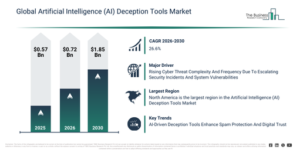
The market size for artificial intelligence (AI) deception tools has seen rapid expansion in recent years. It will grow from $0.57 billion in 2025 to $0.72 billion in 2026 at a compound annual growth rate (CAGR) of 26.3%. This historical growth can be attributed to factors such as increased social media content consumption, the expansion of generative AI models, a rise in cybercrime activities, an increase in digital media manipulation incidents, and the accessibility of open-source AI tools._x000D_
_x000D_
The artificial intelligence (AI) deception tools market is poised for significant expansion in the coming years, with projections indicating a valuation of $1.85 billion by 2030, growing at a compound annual growth rate (CAGR) of 26.6%. This expected growth is largely due to advancements in large language model capabilities, the wider availability of multimedia AI generation tools, an increasing demand for security simulation platforms, the rise of online misinformation campaigns, and greater investment in adversarial AI research. Prominent trends observed during this forecast period include the development of advanced deepfake content generation, automated tools for disinformation campaigns, the expansion of synthetic media creation, the evolution of realistic voice cloning, and AI-based social engineering simulations._x000D_
_x000D_
#Get A Free Sample Report With In-Depth Market Insights:#_x000D_
_x000D_
#Artificial Intelligence (AI) Deception Tools Market Growth Backed By Core Demand Fundamentals#_x000D_
The increasing complexity and frequency of cyber threats are projected to drive the expansion of the artificial intelligence (AI) deception tools market in the future. Cyber threats involve malicious activities designed to harm, steal from, or interrupt data, digital systems, or networks. The escalating intricacy and frequency of these threats are attributed to an increasing reliance on interconnected digital systems, which inherently create more vulnerabilities for potential attackers to exploit. Artificial intelligence (AI) deception tools tackle the growing complexity and frequency of cyber threats by deploying realistic decoys and traps to mislead attackers, while also detecting malicious activity at an early stage and gathering intelligence on attack patterns to protect legitimate systems. For instance, October 2025, National Cyber Security Centre (NCSC), a UK-based government cyber security agency, reported 204 nationally significant cyber-attacks in the year to August 2025, more than doubling from 89 the previous year, in which out of 429 total incidents, 18 were highly significant, marking a 50% rise. Therefore, the rising complexity and frequency of cyber threats are fueling the growth of the artificial intelligence (AI) deception tools market._x000D_
_x000D_
#Artificial Intelligence (AI) Deception Tools Market Segment Trends And Revenue Contributors#_x000D_
The artificial intelligence (AI) deception tools market covered in this report is segmented – _x000D_
_x000D_
1) By Tools: Generative Adversarial Networks (GANs), Fuzzing Tools, Attack Simulation Tools, Data Poisoning Tools, Other Tools_x000D_
2) By Technology: Natural Language Processing (NLP), Machine Learning, Large Language Model (LLM), Generative AI (GANs), Computer Vision, Other Technologies_x000D_
3) By Deployment Type: Cloud-Based, On-Premises, Hybrid_x000D_
4) By Application: Fraud Detection, Security Testing, Data Privacy_x000D_
5) By End-Use: Healthcare, Banking, Financial Services, And Insurance (BFSI), Telecom And Information Technology (IT), Government, Retail, Other End-Uses_x000D_
_x000D_
Subsegments:_x000D_
1) By Generative Adversarial Networks: Image Generation Models, Video Generation Models, Audio Generation Models, Text Generation Models_x000D_
2) By Fuzzing Tools: Mutation-Based Fuzzers, Generation-Based Fuzzers, Coverage-Guided Fuzzers, Protocol Fuzzers_x000D_
3) By Attack Simulation Tools: Network Attack Simulators, Endpoint Attack Simulators, Social Engineering Simulators, Application Attack Simulators_x000D_
4) By Data Poisoning Tools: Label Flipping Tools, Backdoor Injection Tools, Feature Manipulation Tools, Gradient Manipulation Tools_x000D_
5) By Other Tools: Deepfake Detection Tools, Adversarial Example Generation Tools, Model Evasion Tools, Model Inversion Tools_x000D_
_x000D_
#Artificial Intelligence (AI) Deception Tools Market Growth Trends Reshaping The Competitive Landscape#_x000D_
Leading companies in the artificial intelligence (AI) deception tools market are prioritizing the development of sophisticated solutions, including AI-powered protection against spam, to combat fraudulent activities and enhance trust across digital platforms. AI-driven spam protection employs AI algorithms to detect and block undesirable or malicious messages, constantly learning from evolving patterns to combat spam and adapt to new threats. For example, in February 2024, Bumble Inc., a US-based online dating and social networking company, launched Deception Detector, an AI-driven tool providing spam protection designed to identify and block spam, scams, and fake profiles across its platforms, such as Bumble, Badoo, and Bumble For Friends. This tool leverages advanced machine learning to verify account authenticity and remove suspicious profiles before users interact with them. Through the integration of automated detection and human moderation, Bumble observed a 45% reduction in member reports of deceptive accounts within merely two months, underscoring its commitment to fostering safer and more reliable online connections._x000D_
_x000D_
#Artificial Intelligence (AI) Deception Tools Market Competitive Landscape: Which Companies Lead The Industry?#_x000D_
Major companies operating in the artificial intelligence (AI) deception tools market are Fortinet Inc., Proofpoint Inc., Commvault Systems Inc., Rapid7 Inc., SentinelOne Inc., Darktrace PLC., Cybereason Inc., ZeroFOX Holdings Inc., Cynet Ltd., Shield AI Inc., Acalvio Technologies Inc., CounterCraft Ltd., CyberTrap Machine Learning GmbH, Sensity Systems Inc., HiddenLayer Inc., Deceptive Bytes Ltd., Treacle Technologies Private Limited., PacketViper LLC, Lupovis Ltd., NeroSwarm GmbH Ltd. _x000D_
_x000D_
#View The Full Artificial Intelligence (AI) Deception Tools Market Report:#_x000D_
_x000D_
#Artificial Intelligence (AI) Deception Tools Market Regional Analysis: Which Geography Leads On Revenue?#_x000D_
North America was the largest region in the artificial intelligence (AI) deception tools market in 2025. Asia-Pacific is expected to be the fastest-growing region in the forecast period. The regions covered in the artificial intelligence (AI) deception tools market report are Asia-Pacific, South East Asia, Western Europe, Eastern Europe, North America, South America, Middle East, Africa._x000D_
_x000D_
#Reach Out To Our Team:#_x000D_
_x000D_
The Business Research Company: https://www.thebusinessresearchcompany.com/_x000D_
Americas: +1 310-496-7795_x000D_
Asia: +44 7882 955267 & +91 8897263534_x000D_
Europe: +44 7882 955267_x000D_
Email us at: marketing@tbrc.info_x000D_
_x000D_
#Follow us on:#_x000D_
_x000D_
LinkedIn: https://in.linkedin.com/company/the-business-research-company_x000D_
YouTube: https://www.youtube.com/channel/UC24_fI0rV8cR5DxlCpgmyFQ_x000D_
Global Market Model: https://www.thebusinessresearchcompany.com/global-market-model

Wasay has over a decade of experience in market research, data modelling, and analytics, with prior experience at GlobalData and Decision Tree Consulting Services. At The Business Research Company , he leads research operations across syndicated studies, customized consulting engagements, and the Global Market Model platform. His professional experience includes supporting organizations such as Boston Consulting Group, KPMG, and Ernst & Young. Wasay holds a degree in Electronics and Communications Engineering, postgraduate management qualifications from International Management Institute Belgium and Indian School of Business and Entrepreneurship, and completed the Integrated Program in Business Analytics from Indian Institute of Management Indore.