Backed by market attractiveness analysis, total addressable market sizing, company benchmarking matrices, interactive Excel dashboards, wider supply chain intelligence, emerging startup coverage, and detailed product-level insights, The Business Research Company’s 2026 market reports are designed to offer research that is more actionable and strategically valuable than ever.
#Artificial Intelligence (AI) Hearing Aid Market Size Outlook: How Quickly Will Revenue Expand Through 2030?#_x000D_
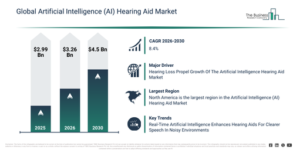
The artificial intelligence (AI) hearing aid market size has demonstrated significant expansion in recent years. This market is projected to grow from $2.99 billion in 2025 to $3.26 billion in 2026, at a compound annual growth rate (CAGR) of 8.8%. The historical growth can be attributed to the increasing prevalence of hearing loss, an aging global population, technological progress in digital hearing aids, heightened awareness of hearing health, and the early adoption of noise reduction technologies._x000D_
_x000D_
The artificial intelligence (AI) hearing aid market is anticipated to experience substantial expansion over the upcoming years. Its valuation is projected to reach $4.5 billion in 2030, exhibiting a compound annual growth rate (CAGR) of 8.4%. This projected increase throughout the forecast period stems from factors such as the incorporation of deep learning algorithms, a growing need for customized healthcare devices, the expansion of tele-audiology provisions, an increase in the adoption of wearable health technologies, and greater investments in healthcare digitalization. Key developments expected during this timeframe encompass adaptive sound environment recognition, AI-driven speech enhancement, the creation of personalized hearing profiles, real-time noise suppression capabilities, and integrated smart device connectivity._x000D_
_x000D_
#Get A Free Sample Report With In-Depth Market Insights:#_x000D_
_x000D_
#Artificial Intelligence (AI) Hearing Aid Market Growth Drivers: What’s Behind The Acceleration?#_x000D_
The increasing occurrence of hearing loss is anticipated to drive expansion in the artificial intelligence hearing aid market. This condition, hearing loss, denotes a partial or complete inability to perceive sounds, which can impede communication and diminish life quality. The surge in hearing loss can be attributed to multiple factors such as an aging demographic, exposure to loud noise, the use of certain ototoxic drugs, and inherited predispositions. Artificial intelligence hearing aids improve the handling of hearing loss by adjusting autonomously to diverse sound settings, enhancing audibility, and decreasing ambient noise. For example, in February 2024, data from the World Health Organization, an international public health body based in Switzerland, indicated that more than 5% of the world’s populace, roughly 430 million individuals, require rehabilitation for disabling hearing loss, among them 34 million children. Predictions suggest that by 2050, over 700 million people, equivalent to 1 in 10 individuals, will be affected by disabling hearing loss. Consequently, the widespread nature of hearing loss is fueling the development of the artificial intelligence hearing aid market._x000D_
_x000D_
#Artificial Intelligence (AI) Hearing Aid Market Segment Analysis: What Are The Core Market Categories?#_x000D_
The artificial intelligence (AI) hearing aid market covered in this report is segmented – _x000D_
_x000D_
1) By Product Type: Behind The Ear (BTE), In The Ear (ITE), Receiver In The Canal (RIC), Completely In The Canal (CIC)_x000D_
2) By Technology: Machine Learning Algorithms (MLA), Deep Neural Network (DNN), Real-Time Noise Reduction (RTNR), Speech Enhancement Algorithms_x000D_
3) By Indication: Sensorineural Hearing Loss, Conductive Hearing Loss_x000D_
4) By Diagnosis: Audiometry, Otoacoustic Emissions (OAE) Testing, Real-Ear Measurement (REM), Patient-Reported Outcomes (PROs)_x000D_
5) By End User: Individuals, Hospitals And Clinics, Ear, Nose, and Throat (ENT) Specialists_x000D_
_x000D_
Subsegments:_x000D_
1) By Behind The Ear (BTE): Standard BTE Hearing Aids, BTE with Slim Tube, BTE with Receiver in the Ear (RITE), BTE with Bluetooth Connectivity, BTE with Rechargeable Batteries _x000D_
2) By In The Ear (ITE): Full-Shell ITE Hearing Aids, Half-Shell ITE Hearing Aids, In-the-Canal (ITC) ITE Hearing Aids, ITE with Bluetooth Connectivity, ITE with Rechargeable Batteries _x000D_
3) By Receiver In The Canal (RIC): Standard RIC Hearing Aids, RIC with Rechargeable Batteries, RIC with Bluetooth Connectivity, RIC with AI-Powered Noise Reduction, RIC with Tinnitus Masking Features _x000D_
4) By Completely In The Canal (CIC): Standard CIC Hearing Aids, CIC with AI-Powered Speech Enhancement, CIC with Rechargeable Batteries, Invisible CIC Hearing Aids, CIC with Bluetooth Connectivity_x000D_
_x000D_
#Artificial Intelligence (AI) Hearing Aid Market Trends: What’s Defining The Industry’s Next Phase?#_x000D_
Leading companies operating in the artificial intelligence hearing aid market are concentrating on technological breakthroughs, such as real-time artificial intelligence, to improve speech clarity amidst background noise. Real-time artificial intelligence within hearing aids processes sound input instantaneously to enhance auditory experiences, adapting in real time to various environments and user needs, which refines speech clarity and reduces ambient noise. For instance, in August 2024, Sonova Holding AG, a Switzerland-based medical equipment manufacturing company, unveiled Sphere Infinio, designed to meet a critical requirement for individuals with hearing loss. This product integrates real-time AI sound processing, enhancing speech intelligibility and connectivity through advanced dual-chip technology. Specifically developed to improve hearing in noisy settings like public transport and restaurants, the DEEPSONIC chip allows the hearing aid to proficiently differentiate clear speech from background noise, substantially elevating speech comprehension in acoustically challenging surroundings._x000D_
_x000D_
#Artificial Intelligence (AI) Hearing Aid Market Top Companies Driving Competitive Growth#_x000D_
Major companies operating in the artificial intelligence (AI) hearing aid market are Koninklijke Philips N.V., Sonova Holding AG, Amplifon S.p.A., Starkey Laboratories Inc., Oticon, Widex A/S, MED-EL Medical Electronics, Beltone Electronics Corporation, Hear.com NV, Earlens Corporation, iHEAR Medical Inc., Signia Inc., Audibel, Tunity Inc., NuEar Hearing Instruments, Rexton Inc., Alango Technologies Ltd., Audicus Inc., Orka Labs Inc., Soundwave Hearing LLC _x000D_
_x000D_
#View The Full Artificial Intelligence (AI) Hearing Aid Market Report:#_x000D_
_x000D_
#Artificial Intelligence (AI) Hearing Aid Market Regional Breakdown: Where Is Demand Concentrated?#_x000D_
North America was the largest region in the artificial intelligence hearing aid market in 2025. The regions covered in the artificial intelligence (AI) hearing aid market report are Asia-Pacific, South East Asia, Western Europe, Eastern Europe, North America, South America, Middle East, Africa._x000D_
_x000D_
#Reach Out To Our Team:#_x000D_
_x000D_
The Business Research Company: https://www.thebusinessresearchcompany.com/_x000D_
Americas: +1 310-496-7795_x000D_
Asia: +44 7882 955267 & +91 8897263534_x000D_
Europe: +44 7882 955267_x000D_
Email us at: marketing@tbrc.info_x000D_
_x000D_
#Follow us on:#_x000D_
_x000D_
LinkedIn: https://in.linkedin.com/company/the-business-research-company_x000D_
YouTube: https://www.youtube.com/channel/UC24_fI0rV8cR5DxlCpgmyFQ_x000D_
Global Market Model: https://www.thebusinessresearchcompany.com/global-market-model

Wasay has over a decade of experience in market research, data modelling, and analytics, with prior experience at GlobalData and Decision Tree Consulting Services. At The Business Research Company , he leads research operations across syndicated studies, customized consulting engagements, and the Global Market Model platform. His professional experience includes supporting organizations such as Boston Consulting Group, KPMG, and Ernst & Young. Wasay holds a degree in Electronics and Communications Engineering, postgraduate management qualifications from International Management Institute Belgium and Indian School of Business and Entrepreneurship, and completed the Integrated Program in Business Analytics from Indian Institute of Management Indore.