Built to provide research that’s more actionable and strategically valuable, The Business Research Company’s 2026 market reports include market attractiveness analysis, total addressable market sizing, company benchmarking matrices, interactive Excel dashboards, broader supply chain intelligence, emerging startup tracking, and in-depth product insights.
Wireless Connectivity Market Growth Potential: How Will Market Size Shift Through 2030?
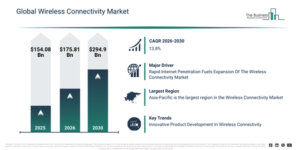
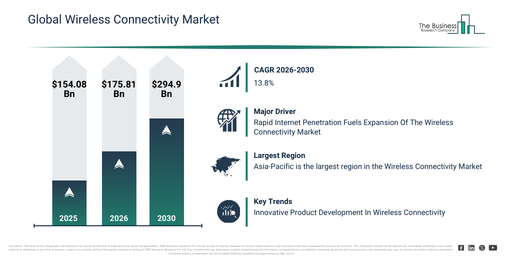
Significant growth has been observed in the wireless connectivity market size over recent years. This market is projected to expand from $154.08 billion in 2025 to reach $175.81 billion by 2026, demonstrating a compound annual growth rate (CAGR) of 14.1%. Historically, this growth has been driven by factors such as the increased adoption of consumer electronics, wider availability and usage of wireless internet, greater smartphone penetration, advancements in wireless standards, and the escalating demand for enterprise mobility solutions.
The wireless connectivity market is projected to experience substantial expansion over the upcoming years. This market is forecast to reach $294.9 billion by 2030, demonstrating a compound annual growth rate (CAGR) of 13.8%. Key factors contributing to this anticipated growth include the rollout of 5G networks, the proliferation of industrial IoT applications, the increasing need for uninterrupted device connectivity, the rise of smart city initiatives, and the greater uptake of cloud-integrated devices. Significant trends anticipated during this period encompass the swift embrace of IoT-enabled connectivity solutions, a rising demand for low-power wide-area networks, the spread of wireless infrastructure within smart buildings, a growing reliance on short-range wireless technologies, and the incorporation of cloud-centric connectivity platforms.
Get A Free Sample Report With In-Depth Market Insights:
Wireless Connectivity Market Opportunity Drivers: What’s Unlocking New Revenue Potential?
The expansion of internet penetration rates is projected to enhance the wireless connectivity market going forward. The internet penetration rate refers to the percentage of a given country’s or region’s total population that accesses the internet. As internet users have increased, so has the adoption of new technological devices by consumers, including phones, microphones, and digital cameras. Consequently, an increasing internet penetration rate is expected to stimulate the wireless connectivity market. For instance, in November 2024, a report from the International Telecommunication Union (ITU), a Switzerland-based specialized UN agency, revealed that 5.5 billion people were online in 2024, representing 68 per cent of the world population, up from 65 per cent in 2023. The year-on-year growth rate has also risen, from 2.7 just one year ago to 3.4 per cent this year. Therefore, the growing Internet penetration rate is a significant driver for the growth of the wireless connectivity market.
Wireless Connectivity Market Segmentation And Category Overview
The wireless connectivity market covered in this report is segmented –
1) By Type: LPWAN (Low Power Wide Area Network), Cellular M2M (Machine-To-machine), WPAN (Wireless Personal Area Network), Satellite (GNSS) Global Navigation Satellite System, WLAN (Wireless Local Area Network)
2) By Component: Control Devices, Gateways
3) By Technology: Bluetooth, WI-FI, Ultra-Wideband, NFC, Cellular, Zigbee
4) By End Use: Wearable Devices, Healthcare, Consumer Electronics, Building Automation, Automotive And Transportation, Other End Uses
Subsegments:
1) By LPWAN (Low Power Wide Area Network): LoRaWAN, Sigfox, NB-IoT (Narrowband IoT)
2) By Cellular M2M (Machine-To-Machine): 2G Or 3G Or 4G LTE, 5G
3) By WPAN (Wireless Personal Area Network): Bluetooth, Zigbee, Z-Wave
4) By Satellite (GNSS) Global Navigation Satellite System: GPS, GLONASS, Galileo
5) By WLAN (Wireless Local Area Network): Wi-Fi, Wi-Fi Direct
Wireless Connectivity Market Innovation Trends Shaping Future Development
Leading companies in the wireless connectivity market are concentrating on developing innovative products, such as wireless access receivers, to gain a competitive advantage. A wireless access receiver, also known as a Wi-Fi adapter or dongle, is a device that allows a computer or other equipment to connect to a wireless network. For example, in June 2023, Nokia Corporation, a Finland-based telecommunications, information technology, and consumer electronics company, introduced the FastMile 5G receiver. The FastMile 5G receiver utilizes a powerful antenna with a gain of 9 dBi to effectively capture and amplify weak 5G signals, even in challenging environments. The receiver’s wideband support encompasses a comprehensive range of 4G and 5G bands, including CBRS (Citizens Broadband Radio Service) in both 4G and 5G configurations, as well as the c-band. Additionally, it supports up to 4CA (carrier aggregation) and NR (New Radio), allowing operators to aggregate multiple bands for increased throughput and capacity. The FastMile 5G receiver is designed for outdoor installation, enabling it to capture the strongest signals available.
Wireless Connectivity Market Competitive Analysis Of Leading Industry Participants
Major companies operating in the wireless connectivity market are Intel Corporation; Texas Instruments Incorporated; Qualcomm Incorporated; Broadcom Inc.; STMicroelectronics; NXP Semiconductors; Microchip Technology Inc.; MediaTek Inc.; Renesas Electronics Corporation; Panasonic Corporation; Cypress Semiconductor Corporation; AT&T Inc.; Cisco Systems Inc.; Nokia Corporation; Marvell Technology Group Ltd.; Nordic Semiconductor ASA; Sierra Wireless Inc.; Skyworks Solutions Inc.; Sequans Communications S.A.; Lantronix Inc.; Qorvo Inc.; Murata Manufacturing Co. Ltd.; Inseego Corp.; u-blox Holding AG; Cambium Networks Corporation; Onsemi; Semtech Corporation; Celeno Communications; Redpine Signals Inc.
View The Full Wireless Connectivity Market Report:
Wireless Connectivity Market Regional Analysis: Which Geography Leads On Revenue?
Asia-Pacific was the largest region in the wireless connectivity market in 2025. The regions covered in the wireless connectivity market report are Asia-Pacific, South East Asia, Western Europe, Eastern Europe, North America, South America, Middle East, Africa.
Reach Out To Our Team:
The Business Research Company: https://www.thebusinessresearchcompany.com/
Americas: +1 310-496-7795
Asia: +44 7882 955267 & +91 8897263534
Europe: +44 7882 955267
Email us at: marketing@tbrc.info
Follow us on:
LinkedIn: https://in.linkedin.com/company/the-business-research-company
YouTube: https://www.youtube.com/channel/UC24_fI0rV8cR5DxlCpgmyFQ
Global Market Model: https://www.thebusinessresearchcompany.com/global-market-model

Wasay has over a decade of experience in market research, data modelling, and analytics, with prior experience at GlobalData and Decision Tree Consulting Services. At The Business Research Company , he leads research operations across syndicated studies, customized consulting engagements, and the Global Market Model platform. His professional experience includes supporting organizations such as Boston Consulting Group, KPMG, and Ernst & Young. Wasay holds a degree in Electronics and Communications Engineering, postgraduate management qualifications from International Management Institute Belgium and Indian School of Business and Entrepreneurship, and completed the Integrated Program in Business Analytics from Indian Institute of Management Indore.