Built to provide research that’s more actionable and strategically valuable, The Business Research Company’s 2026 market reports include market attractiveness analysis, total addressable market sizing, company benchmarking matrices, interactive Excel dashboards, broader supply chain intelligence, emerging startup tracking, and in-depth product insights.
5G Base Station Equipment Market Forecast: Value Set To Climb From $37.21 Billion To $62.08 Billion
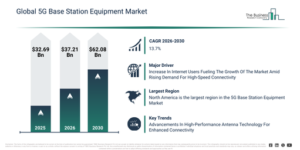
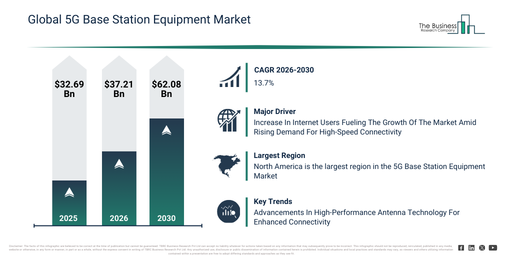
The 5G base station equipment market has observed significant expansion in recent years. This market is set to increase from $32.69 billion in 2025 to $37.21 billion in 2026, registering a compound annual growth rate (CAGR) of 13.8%. The historical growth in this sector is largely due to LTE infrastructure modernization, investments in telecom capital expenditure, spectrum refarming initiatives, initial 5G trials, and the rising data traffic.
The 5G base station equipment market size is poised for rapid expansion in the coming years, projected to reach $62.08 billion in 2030 with a compound annual growth rate (CAGR) of 13.7%. This growth over the forecast period is fueled by factors such as cloud RAN adoption, mandates for energy-efficient networks, the rise of private enterprise 5G networks, improved connectivity for smart manufacturing, and the extension of 5G into rural areas. Significant trends anticipated during this period include the deployment of massive MIMO antennas, the integration of virtualized baseband units, the adoption of high-efficiency power supply systems, the development of modular and scalable equipment designs, and the implementation of advanced cooling technologies.
Get A Free Sample Report With In-Depth Market Insights:
5G Base Station Equipment Market Opportunity Drivers: What’s Unlocking New Revenue Potential?
The future expansion of the 5G base station equipment market is anticipated to be fueled by the rising count of internet users. Internet users are defined as individuals who access and utilize the internet for diverse purposes, including web browsing, social networking, communication, e-commerce, and professional tasks. This growth in internet users stems from factors such as widespread smartphone adoption, ongoing digital transformation, the surge in online commerce and remote work, and advancements in online learning. Essential for providing high-speed internet, 5G base station equipment facilitates this by transmitting and receiving wireless signals between users and the network infrastructure. Their strategic deployment guarantees uninterrupted coverage, allowing for rapid data transmission and minimal delay for users. As an illustration, the International Telecommunication Union, a specialized agency based in Switzerland, reported in February 2024 that the global count of internet users expanded from 5.1 billion in 2022 to 5.4 billion in 2023. Consequently, the expanding internet user base is a key driver for the growth of the 5G base station equipment market.
5G Base Station Equipment Market Segment Landscape: Which Areas Lead Development?
The 5G base station equipment market covered in this report is segmented –
1) By Component: Antennas, Transceivers, Baseband Units, Power Supply Units, Other Components
2) By Deployment Location: Urban, Rural, Suburban
3) By Network Architecture: Standalone, Non-Standalone
4) By Frequency Band: Low Band, Mid Band, High Band
5) By End-User: Telecom Operators, Enterprises, Government, Other End-Users
Subsegments:
1) By Antennas: MIMO Antennas, Phased Array Antennas, Active Antennas, Passive Antennas
2) By Transceivers: RF Transceivers, Optical Transceivers, Frequency-Division Duplex (FDD) Transceivers, Time-Division Duplex (TDD) Transceivers
3) By Baseband Units: Centralized Baseband Units (BBUs), Distributed Baseband Units (BBUs), Virtualized Baseband Units (vBBUs)
4) By Power Supply Units: AC Power Supply Units, DC Power Supply Units, Hybrid Power Supply Units
5) By Other Components: Cooling Systems, Controllers, Backhaul Equipment, Signal Processors
5G Base Station Equipment Market Innovation Trends Shaping Future Development
Companies active in the 5G base station equipment market are prioritizing the creation of advanced products, such as external 5G antennas. These innovations aim to boost signal strength, broaden coverage, and accelerate data transfer by minimizing interference and optimizing connectivity across both urban and remote settings. External 5G antennas are sophisticated devices engineered to improve 5G signal reception and transmission, thereby expanding coverage, enhancing data speeds, and reducing latency for both outdoor and indoor uses. For instance, in March 2024, Quectel Wireless Solutions, an IoT solutions provider based in China, introduced the YEMN016AA and YEMN017AA 5G 5-in-1 combo antennas, alongside the YECN001J1A and YECT000WBA external 5G antennas. The YEMN017AA is a 5G screw mount 5-in-1 combo antenna puck, specifically optimized for 5G and 4G networks. It incorporates several antennas like 5G, 4G, GNSS, and Wi-Fi within its compact 103.5mm x 42.5mm dimensions. This product offers various mounting choices, including screw, pole, wall, magnetic, and adhesive, along with adaptable cable lengths and connector types, providing greater adaptability for outdoor applications. Furthermore, Quectel’s YECN001J1A and YECT000WBA external 5G antennas are designed to support 5G NR sub-6GHz bands while also being compatible with 4G, 3G, 2G, and LPWA networks. These highly efficient, omnidirectional antennas, which measure 40.6mm x 104mm, guarantee consistent high-speed data transmission for wireless communication devices like routers, outdoor equipment, and real-time monitoring systems. Both antenna types adhere to RoHS and REACH standards and come with customizable installation features for optimal performance.
5G Base Station Equipment Market Industry Leaders And Competitive Landscape
Major companies operating in the 5G base station equipment market are Samsung Electronics Co., Intel Corporation, Cisco Systems Inc., Qualcomm Technologies Inc., Fujitsu Limited, Telefonaktiebolaget LM Ericsson, Nokia Oyj, NEC Corporation, Huawei Technologies Co. Ltd., ZTE Corporation, TE Connectivity Ltd., Syensqo, CommScope Holding Company Inc., Keysight Technologies Inc., Juniper Networks Inc., Belden Inc., Mavenir Systems Inc., Radisys Corporation, Comba Telecom Systems Holdings Ltd., JMA Wireless, Ceragon Networks Ltd., Parallel Wireless Inc., Airspan Networks Inc., Alpha Wireless Ltd.
View The Full 5G Base Station Equipment Market Report:
5G Base Station Equipment Market Geographic Landscape: Which Region Leads Industry Growth?
North America was the largest region in the 5G base station equipment market in 2025. Asia-Pacific is expected to be the fastest-growing region in the forecast period. The regions covered in the 5G base station equipment market report are Asia-Pacific, South East Asia, Western Europe, Eastern Europe, North America, South America, Middle East, Africa.
Reach Out To Our Team:
The Business Research Company: https://www.thebusinessresearchcompany.com/
Americas: +1 310-496-7795
Asia: +44 7882 955267 & +91 8897263534
Europe: +44 7882 955267
Email us at: marketing@tbrc.info
Follow us on:
LinkedIn: https://in.linkedin.com/company/the-business-research-company
YouTube: https://www.youtube.com/channel/UC24_fI0rV8cR5DxlCpgmyFQ
Global Market Model: https://www.thebusinessresearchcompany.com/global-market-model

Wasay has over a decade of experience in market research, data modelling, and analytics, with prior experience at GlobalData and Decision Tree Consulting Services. At The Business Research Company , he leads research operations across syndicated studies, customized consulting engagements, and the Global Market Model platform. His professional experience includes supporting organizations such as Boston Consulting Group, KPMG, and Ernst & Young. Wasay holds a degree in Electronics and Communications Engineering, postgraduate management qualifications from International Management Institute Belgium and Indian School of Business and Entrepreneurship, and completed the Integrated Program in Business Analytics from Indian Institute of Management Indore.