Built to provide research that’s more actionable and strategically valuable, The Business Research Company’s 2026 market reports include market attractiveness analysis, total addressable market sizing, company benchmarking matrices, interactive Excel dashboards, broader supply chain intelligence, emerging startup tracking, and in-depth product insights.
Space On-board Computing Platform Market Growth From $1.86 Billion In 2026 To $3.11 Billion By 2030 At A CAGR Of 13.7%
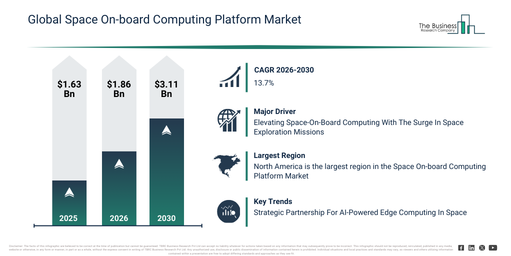
The space on-board computing platform market size has seen rapid expansion in recent years. It is forecast to rise from $1.63 billion in 2025 to $1.86 billion in 2026, exhibiting a compound annual growth rate (CAGR) of 14.1%. The growth observed in the past can be ascribed to the broadening of earth observation satellite missions, the development of satellite-based navigation services, the escalating requirement for onboard data processing, the adoption of COTS-based space electronics, and increasing investments in space exploration programs.
The space on-board computing platform market is set to experience significant growth over the next few years, with its valuation expected to climb to $3.11 billion by 2030, exhibiting a compound annual growth rate (CAGR) of 13.7%. This projected growth stems from various factors such as the expanding deployment of low earth orbit satellite constellations, an increasing demand for autonomous satellite operations, the broadening scope of real-time space data analytics, a rising focus on edge computing in space systems, and increased investments in next-generation spacecraft avionics. Key developments anticipated during this period include the wider adoption of AI-enabled onboard data processing, the growing implementation of high-performance space processors, a greater use of radiation-hardened computing platforms, the expansion of modular satellite computing architectures, and an intensified emphasis on real-time in-orbit analytics.
Get A Free Sample Report With In-Depth Market Insights:
Space On-board Computing Platform Market Demand Drivers Opening New Revenue Streams
An anticipated increase in space exploration missions is projected to drive the expansion of the space-on-board computing platform market in the future. These platforms are widely utilized across numerous space exploration endeavors because they can collect information via diverse applications, store and analyze data, and then disseminate it to facilitate mapping and navigation during both terrestrial and extraterrestrial exploration. Furthermore, space on-board computing enables applications to adjust to evolving circumstances or requirements and quickly implement fresh updates or algorithms into current systems for tasks like image analysis in various space missions or explorations. As an illustration, in November 2023, figures released by the United Nations Office for Outer Space Affairs (UNOOSA), which is a UN entity that promotes and coordinates space activities and policies, indicated that it recorded more than 2,050 satellite registrations in 2022, and by 2023, registrations had reached 2,250, making up 35 percent of all satellites. Consequently, the increasing volume of space exploration missions is propelling the growth of the space on-board computing platform market.
Space On-board Computing Platform Market Segmentation And Category Overview
The space on-board computing platform market covered in this report is segmented –
1) By Platform: Nano Satellite, MicroSatellite, Small Satellite, Medium Satellite, Large Satellite, Spacecraft
2) By Technology: Cots, Non-Cots
3) By Orbit: Low Earth Orbit (LEO), Medium Earth Orbit (MEO), Geostationary Earth Orbit (GEO)
4) By Communication Frequency: S-Band, X-Band, C-Band, K-Band, Other Communication Frequencies
5) By Application: Communication, Earth Observation, Navigation, Meteorology, Other Applications
Subsegments:
1) By Nano Satellite: 1U CubeSats, 3U CubeSats, Other Nano Satellites
2) By Microsatellite: 10-100 Kg Satellites, Specialized Microsatellites
3) By Small Satellite: 100-500 Kg Satellites, Small Science Satellites
4) By Medium Satellite: 500-2,000 Kg Satellites, Medium Communication Satellites
5) By Large Satellite: Over 2,000 Kg Satellites, Large Earth Observation Satellites
6) By Spacecraft: Manned Spacecraft, Unmanned Spacecraft, Space Probes
Space On-board Computing Platform Market Trends Powering Strategic Industry Growth
Leading companies in the space on-board computing platform market are increasingly adopting a strategic partnership approach to enhance technology integration and broaden their market presence. Such a strategic partnership typically describes a collaborative relationship between two or more organizations, where they combine their resources, expertise, and efforts to achieve common goals or objectives. For example, in April 2024, Firefly Aerospace, a US-based aerospace company, joined forces with Klepsydra Technologies, a Switzerland-based software company, to host an AI application on Firefly’s Elytra vehicle, which is slated to launch aboard the Alpha rocket later this year. Elytra, functioning as an edge computing platform, is designed to process data in real-time on orbit, thereby supporting various software applications. Klepsydra will leverage Elytra to test its AI navigation models for attitude determination, guidance, and control, along with a cloud detection algorithm. This collaboration seeks to demonstrate dynamic AI application switching and Klepsydra’s AI as a-service solution.
Space On-board Computing Platform Market Competitive Analysis Of Leading Industry Participants
Major companies operating in the space on-board computing platform market are BAE Systems plc; Thales Group; L3Harris Technologies Inc.; Lockheed Martin Corporation; Honeywell International Inc.; Raytheon Technologies Corporation; Northrop Grumman Corporation; Airbus SE; Ball Corporation; Cobham Gaisler AB; Leonardo S.p.A.; ST Engineering; Teledyne Technologies Inc.; MDA Corporation; Ramon Space; LMO Space; Space Micro Inc.; Blue Canyon Technologies; AAC Clyde Space; Astro Digital
View The Full Space On-board Computing Platform Market Report:
Space On-board Computing Platform Market Top Region: Where Does Most Revenue Come From?
North America was the largest region in the space on-board computing platform market in 2025. Asia-Pacific is expected to be the fastest-growing region in the forecast period. The regions covered in the space on-board computing platform market report are Asia-Pacific, South East Asia, Western Europe, Eastern Europe, North America, South America, Middle East, Africa.
Reach Out To Our Team:
The Business Research Company: https://www.thebusinessresearchcompany.com/
Americas: +1 310-496-7795
Asia: +44 7882 955267 & +91 8897263534
Europe: +44 7882 955267
Email us at: marketing@tbrc.info
Follow us on:
LinkedIn: https://in.linkedin.com/company/the-business-research-company
YouTube: https://www.youtube.com/channel/UC24_fI0rV8cR5DxlCpgmyFQ
Global Market Model: https://www.thebusinessresearchcompany.com/global-market-model

Wasay has over a decade of experience in market research, data modelling, and analytics, with prior experience at GlobalData and Decision Tree Consulting Services. At The Business Research Company , he leads research operations across syndicated studies, customized consulting engagements, and the Global Market Model platform. His professional experience includes supporting organizations such as Boston Consulting Group, KPMG, and Ernst & Young. Wasay holds a degree in Electronics and Communications Engineering, postgraduate management qualifications from International Management Institute Belgium and Indian School of Business and Entrepreneurship, and completed the Integrated Program in Business Analytics from Indian Institute of Management Indore.