Backed by market attractiveness analysis, total addressable market sizing, company benchmarking matrices, interactive Excel dashboards, wider supply chain intelligence, emerging startup coverage, and detailed product-level insights, The Business Research Company’s 2026 market reports are designed to offer research that is more actionable and strategically valuable than ever.
Threat Intelligence Market CAGR Outlook And Future Development
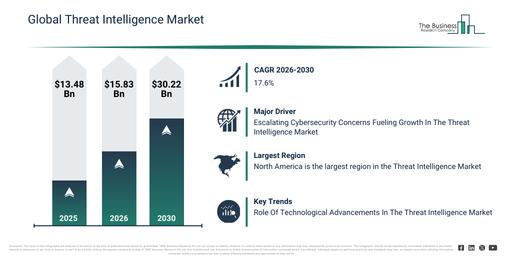
The threat intelligence market has experienced rapid expansion in recent years. It is projected to increase from $13.48 billion in 2025 to $15.83 billion in 2026, achieving a compound annual growth rate (CAGR) of 17.4%. The historical growth of this market can be attributed to several factors, including a rise in cyberattacks and data breaches, the expansion of IT infrastructure, regulatory compliance mandates, the adoption of enterprise security solutions, and the ongoing need for threat detection and response.
The threat intelligence market is poised for significant expansion in the coming years. This market is projected to reach $30.22 billion by 2030, exhibiting a compound annual growth rate (CAGR) of 17.6%. Factors driving this growth during the forecast period include the rise of AI-powered threat intelligence platforms, increased cloud adoption, the proliferation of IoT devices, a heightened emphasis on identity and access management, and the need for automated incident response. Key developments anticipated within this period involve the broadening of managed threat intelligence services, the integration of SIEM and security analytics, a sharper focus on vulnerability scanning and patch management, the widespread adoption of identity and access management (IAM) solutions, and a growing reliance on user and entity behavior analytics.
Get A Free Sample Report With In-Depth Market Insights:
Threat Intelligence Market Industry Drivers: What’s Behind The Revenue Growth?
The rising concern over cyber security is projected to fuel the expansion of the threat intelligence market in the future. Cybersecurity refers to the practice of protecting computers, servers, mobile devices, electronic systems, networks, and data from malicious attacks. Threat intelligence, a proactive approach involving the analysis and understanding of potential cyber threats, vulnerabilities, and attack patterns, is employed to address these cybersecurity concerns and enhance an organization’s ability to detect, prevent, and respond effectively to security incidents. For instance, in November 2024, the Australian Cyber Security Centre, an Australia-based government agency, reported that its Australian Cybersecurity Hotline, operated by ASD, received more than 36,700 calls in the financial year 2023–24, indicating a 12% rise compared to the previous year. Furthermore, ASD handled over 1,100 cybersecurity incidents during the same period. Thus, the growing apprehension concerning cyber security is a significant driver for the threat intelligence market.
Threat Intelligence Market Breakdown By Product Type And Application
The threat intelligence market covered in this report is segmented –
1) By Solution: Threat Intelligence Platforms, Risk And Compliance Management, Security Information And Event Management (SIEM), Security And Vulnerability Management (SVM), Identity And Access Management (IAM), User And Entity Behavior Analytics, Incident Forensics
2) By Deployment: On-Premise, Cloud
3) By Organization Size: Small And Medium-Sized Enterprises, Large Enterprises
4) By Vertical: Healthcare, Transportation, IT And Telecom, Manufacturing, Banking, Financial Services, And Insurance, Energy And Utilities, Government And Defense, Retail, Education
Subsegments:
1) By Threat Intelligence Platforms: External Threat Intelligence, Internal Threat Intelligence, Managed Threat Intelligence Services
2) By Risk And Compliance Management: Risk Assessment And Management, Compliance Management, Audit Management
3) By Security Information And Event Management (SIEM): Log Management, Event Correlation, Incident Detection And Response
4) By Security And Vulnerability Management (SVM): Vulnerability Scanning, Patch Management, Configuration Management
5) By Identity And Access Management (IAM): User Provisioning, Single Sign-On (SSO), Multi-Factor Authentication (MFA)
6) By User And Entity Behavior Analytics: Anomaly Detection, Risk Scoring, Threat Detection
7) By Incident Forensics: Incident Forensics, Digital Forensics, Incident Response Services, Malware Analysis
#Threat Intelligence Market Growth Trends: What’s Shaping The Future Outlook?
Leading firms within the threat intelligence market are prioritizing technological superiority to secure competitive advantages. Progress in technology and the creation of novel tools in threat intelligence provide insights that surpass an attacker’s capabilities, thereby aiding in the prevention of cybersecurity incidents and ensuring long-term resilience. A pertinent example is Google, a US-based search engine company, which launched Google Threat Intelligence in May 2024. This Google Threat Intelligence uniquely merges Mandiant’s direct operational knowledge, the extensive reach of the VirusTotal community, and Google’s broad observational capacity across billions of device and email signals. Furthermore, the integration of Gemini, an AI-powered conversational search agent, allows users to swiftly explore a vast threat intelligence database, facilitating more rapid and well-informed reactions to new threats.
Threat Intelligence Market Company Landscape And Competitive Strategy
Major companies operating in the threat intelligence market are Dell Technologies Inc.; IBM Corporation; Cisco Systems Inc.; Anomali Inc.; IntSights Cyber Intelligence Ltd.; Palo Alto Networks Inc.; Fortinet Inc.; Check Point Software Technologies Ltd.; CrowdStrike Inc.; Proofpoint Inc.; Kaspersky Lab; Optiv Security Inc.; Rapid7 Inc.; FireEye Inc.; Recorded Future Inc.; Webroot Inc.; LogRhythm Inc.; Flashpoint Inc.; Lookingglass Cyber Solutions Inc.; VMware Carbon Black Inc.; RiskIQ Inc.; ThreatConnect Inc.; PhishLabs; Digital Shadows Ltd.; Blueliv; F-Secure Corporation; McAfee LLC; DomainTools LLC; Trend Micro Inc.
View The Full Threat Intelligence Market Report:
Threat Intelligence Market Largest Region: Which Geography Holds The Biggest Share?
North America was the largest region in the threat intelligence market in 2025. Asia-Pacific is expected to be the fastest-growing region in the forecast period. The regions covered in the threat intelligence market report are Asia-Pacific, South East Asia, Western Europe, Eastern Europe, North America, South America, Middle East, Africa.
Reach Out To Our Team:
The Business Research Company: https://www.thebusinessresearchcompany.com/
Americas: +1 310-496-7795
Asia: +44 7882 955267 & +91 8897263534
Europe: +44 7882 955267
Email us at: marketing@tbrc.info
Follow us on:
LinkedIn: https://in.linkedin.com/company/the-business-research-company
YouTube: https://www.youtube.com/channel/UC24_fI0rV8cR5DxlCpgmyFQ
Global Market Model: https://www.thebusinessresearchcompany.com/global-market-model

Wasay has over a decade of experience in market research, data modelling, and analytics, with prior experience at GlobalData and Decision Tree Consulting Services. At The Business Research Company , he leads research operations across syndicated studies, customized consulting engagements, and the Global Market Model platform. His professional experience includes supporting organizations such as Boston Consulting Group, KPMG, and Ernst & Young. Wasay holds a degree in Electronics and Communications Engineering, postgraduate management qualifications from International Management Institute Belgium and Indian School of Business and Entrepreneurship, and completed the Integrated Program in Business Analytics from Indian Institute of Management Indore.