Delivering more actionable and strategically valuable research, The Business Research Company’s 2026 market reports feature market attractiveness analysis, total addressable market evaluation, company benchmarking matrices, interactive Excel dashboards, expanded supply chain intelligence, emerging startup coverage, and detailed product insights.
Autonomous Crop Residue Management Robot Market Revenue Outlook: What CAGR Is Expected Through 2030?
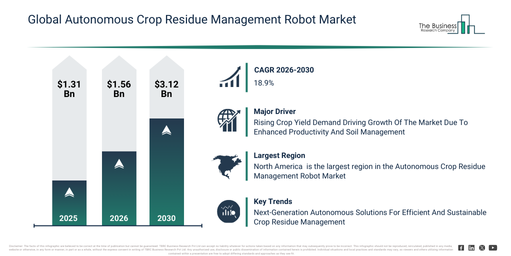
The autonomous crop residue management robot market has seen significant expansion in recent years. It is projected to expand from $1.31 billion in 2025 to $1.56 billion in 2026, achieving a compound annual growth rate (CAGR) of 19.1. This historical growth can be attributed to factors such as increasing agricultural mechanization, a heightened need for efficient residue handling, escalating concerns about residue burning, the initial adoption of semi-automatic mulching tools, and growing labor shortages in farming.
The autonomous crop residue management robot market size is anticipated to experience substantial growth in the upcoming years. It is forecast to expand to $3.12 billion by 2030, progressing at a compound annual growth rate (CAGR) of 18.9. This expansion during the forecast period is primarily driven by the increasing deployment of autonomous field robots, the rising demand for sustainable residue management solutions, greater integration of AI-driven soil analysis, the expansion of multi-functional agricultural robots, and growing investment in precision agriculture technologies. Significant trends for this period include the increasing application of autonomous robots for post-harvest field cleaning, the growing adoption of soil-enhancing residue recycling practices, a rising demand for precision shredding and mulching technologies, the proliferation of multi-functional robots for field preparation tasks, and an enhanced focus on reducing manual labor in residue management processes.
Download A Free Sample Report For Comprehensive Market Insights:
Autonomous Crop Residue Management Robot Market Demand Drivers: What Is Fueling Industry Growth?
The escalating demand for crop yield is projected to boost the expansion of the autonomous crop residue management robot market. Crop yield signifies the quantity of crops gathered from a particular land area, serving as an indicator of farmland’s productivity. The need for increased crop yield is growing due to the world’s expanding population, as more people require a larger and more dependable food supply, compelling farmers to maximize agricultural output to meet rising consumption needs. An autonomous crop residue management robot contributes to higher crop yields by effectively removing or handling leftover crop residues, which enhances soil health, improves nutrient availability, and allows for timely sowing of the subsequent crop, collectively boosting overall productivity. For instance, in January 2024, according to the Department of Agriculture, a US-based government department, corn production for grain in the United States achieved a record high of 15.3 billion bushels in 2023, marking a 12 increase over the 2022 estimate. The average yield also set a record at 177.3 bushels per acre, an increase of 3.9 bushels from 173.4 bushels per acre in 2022. Additionally, the area harvested for grain was estimated at 86.5 million acres, reflecting a 10 rise from the prior year. Consequently, the rising demand for crop yield is driving the growth of the autonomous crop residue management robot market.
Autonomous Crop Residue Management Robot Market Segment Analysis Highlighting Growth Areas
The autonomous crop residue management robot market covered in this report is segmented –
1) By Product: Fully Autonomous Robots, Semi-Autonomous Robots
2) By Power Source: Electric, Solar, Hybrid, Other Power Sources
3) By Distribution Channel: Direct Sales, Distributors, Online Sales, Other Distribution Channels
4) By Application: Crop Residue Collection, Mulching, Soil Preparation, Field Cleaning, Other Applications
5) By End User: Large Farms, Small And Medium Farms, Agricultural Contractors, Other End Users
Subsegments:
1) By Fully Autonomous Robots: Field Monitoring Robots, Residue Collection Robots, Residue Shredding Robots
2) By Semi-Autonomous Robots: Residue Handling Robots, Residue Transportation Robots, Residue Mulching Robots
Autonomous Crop Residue Management Robot Market Innovation Trends: Which Developments Are Transforming The Industry?
Companies operating in the autonomous crop residue management robot market are concentrating on creating sophisticated solutions, such as resilient autonomous vehicles, to boost operational effectiveness, lessen dependence on human labor, and refine crop residue management for improved farm output. A resilient autonomous vehicle refers to a self-operating machine that can consistently execute tasks across varied field environments, featuring sophisticated sensors, navigation setups, and AI-driven decision-making to overcome obstructions, changes in terrain, and operational difficulties without human involvement. For example, in February 2025, Robotics Plus, an agri-technology firm based in New Zealand, launched the Prospr autonomous crop residue management robot to elevate efficiency and decrease labor needs in orchards and vineyards. The Prospr robot achieves a 70 reduction in fuel consumption, lowers emissions, and mitigates reliance on scarce labor through its AI-powered navigation and modular tool systems. Its purpose is to enhance productivity and sustainability, simultaneously maximizing the return on investment for growers.
Autonomous Crop Residue Management Robot Market Leading Companies: Who Holds Significant Market Presence?
Major companies operating in the autonomous crop residue management robot market are Kubota Corporation, AGCO GmbH, Rockwell Automation Inc., YANMAR HOLDINGS CO. LTD, CLAAS KGaA mbH, Trimble Inc., Monarch Tractor Inc., Blue River Technology, Carbon Robotics Inc., FarmWise Labs Inc., ecoRobotix SA, Burro, MetoMotion, Robotics Plus Limited, RootWave Ltd., Agrobot, EarthSense Inc., FarmDroid, Harvest CROO LLC, Swarmfarm Robitics, Aigen Robotics Inc.
Access The Complete Autonomous Crop Residue Management Robot Market Report:
Autonomous Crop Residue Management Robot Market Leading Geography: Which Region Generates The Most Revenue?
North America was the largest region in the autonomous crop residue management robot market in 2025. Asia-Pacific is expected to be the fastest-growing region in the forecast period. The regions covered in the autonomous crop residue management robot market report are Asia-Pacific, South East Asia, Western Europe, Eastern Europe, North America, South America, Middle East, Africa.
Access a Customized Autonomous Crop Residue Management Robot Market Report for Deeper Competitive Insights
Get in touch with us:
The Business Research Company: https://www.thebusinessresearchcompany.com/?utm_source=BlogsPR&utm_medium=Paid&utm_campaign=home_page_test
Americas: +1 310-496-7795
Asia: +44 7882 955267 & +91 8897263534
Europe: +44 7882 955267
Email us at: marketing@tbrc.info
Follow us on:
LinkedIn: https://in.linkedin.com/company/the-business-research-company
YouTube: https://www.youtube.com/channel/UC24_fI0rV8cR5DxlCpgmyFQ
Global Market Model: https://www.thebusinessresearchcompany.com/global-market-model

Wasay has over a decade of experience in market research, data modelling, and analytics, with prior experience at GlobalData and Decision Tree Consulting Services. At The Business Research Company , he leads research operations across syndicated studies, customized consulting engagements, and the Global Market Model platform. His professional experience includes supporting organizations such as Boston Consulting Group, KPMG, and Ernst & Young. Wasay holds a degree in Electronics and Communications Engineering, postgraduate management qualifications from International Management Institute Belgium and Indian School of Business and Entrepreneurship, and completed the Integrated Program in Business Analytics from Indian Institute of Management Indore.