Backed by market attractiveness analysis, total addressable market sizing, company benchmarking matrices, interactive Excel dashboards, wider supply chain intelligence, emerging startup coverage, and detailed product-level insights, The Business Research Company’s 2026 market reports are designed to offer research that is more actionable and strategically valuable than ever.
Cloud Applications Market Growth Analysis: How Will Revenue Trend Over The Forecast Period?
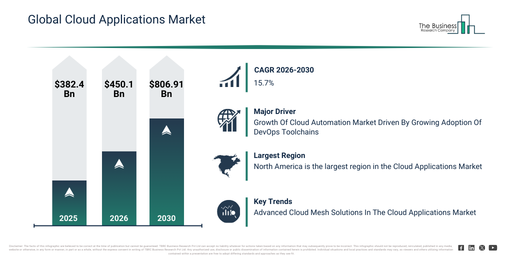
The cloud applications market has experienced rapid expansion in recent years. Its valuation is set to increase from $382.4 billion in 2025 to $450.1 billion in 2026, exhibiting a compound annual growth rate (CAGR) of 17.7%. In the past, this growth was primarily driven by factors like the surge in enterprise digital transformation initiatives, increasing internet penetration, the rise of subscription-based software models, the broader availability of cloud infrastructure, and the growing adoption of mobile applications.
The cloud applications market is anticipated to experience substantial growth in the next few years. It is projected to expand to $806.91 billion in 2030, showing a compound annual growth rate (CAGR) of 15.7%. This expansion throughout the forecast period is fueled by factors such as a rising demand for industry-specific cloud applications, increased investments in AI-powered business software, the growth of multi-cloud application deployments, a stronger focus on application interoperability, and greater adoption among small and medium-sized enterprises (SMEs). Significant trends for this period include the increasing uptake of SaaS-based business applications, a surging need for scalable cloud-native applications, the expanding integration of AI-driven application features, the widespread development of remote work enablement tools, and an enhanced emphasis on application security and compliance.
Get A Free Sample Report With In-Depth Market Insights:
Cloud Applications Market Growth Drivers: What’s Behind The Acceleration?
The expansion of DevOps toolchain implementation is anticipated to boost the cloud application market. These toolchains represent collections of integrated tools and methods employed within DevOps practices to automate and optimize software development, testing, deployment, and monitoring. They automate various parts of the software development lifecycle, extending from code integration to final deployment, thereby accelerating the creation and release of cloud applications. The inherent automation capabilities of DevOps tools facilitate quick deployment and updates for cloud applications, effectively shortening time-to-market and enhancing responsiveness to customer needs. This increased efficiency makes cloud applications more appealing to businesses. For example, in January 2023, the US-based technology training firm InfoSec Institute reported that by 2023, 60% of companies would integrate infrastructure automation into their DevOps toolchains, thereby increasing application deployment efficiency by 25%. Consequently, the increasing adoption of DevOps toolchains is fueling the expansion of the cloud application market.
Cloud Applications Market Segment Analysis And Revenue Potential
The cloud applications market covered in this report is segmented –
1) By Type: Software as a Service (SaaS), Platform-Based Cloud Applications, Web-Based Enterprise Applications, Mobile Cloud Applications, Industry-Specific Cloud Applications
2) By Organization: Small And Medium-Sized Enterprises, Large Enterprises
3) By Application: Customer Relationship Management, Enterprise Resource Management, Human Capital Management, Content Management, Collaboration And Productive Suites, Supply Chain Management, Business Intelligence And Analytics, Other Applications
4) By Vertical: Banking Financial Services And Insurance, Energy And Utilities, Government And Public Sector, Healthcare And Life Sciences, Manufacturing, Retail And Consumer Goods, Telecommunication, Transportation And Logistics, Travel And Hospitality, Other Verticals
Subsegments:
1) By Software as a Service (SaaS): Customer Relationship Management (CRM) Software, Enterprise Resource Planning (ERP) Software, Human Capital Management (HCM) Software, Accounting and Financial Management Software, Collaboration and Productivity Software, Content Management Systems (CMS), Business Intelligence and Analytics Software
2) By Platform-Based Cloud Applications: Application Development and Deployment Platforms, Integration Platform as a Service (iPaaS) Applications, Workflow and Business Process Automation Platforms, Low-Code and No-Code Application Platforms, API Management and Application Enablement Platforms
3) By Web-Based Enterprise Applications: Web-Based Procurement and Spend Management Applications, Web-Based Supply Chain Management Applications, Web-Based Customer Support and Service Applications, Web-Based Project and Portfolio Management Applications, Web-Based Enterprise Asset Management Applications
4) By Mobile Cloud Applications: Mobile Customer Engagement Applications, Mobile Workforce Management Applications, Mobile Expense and Travel Management Applications, Mobile Collaboration and Communication Applications, Mobile Sales and Field Service Applications
5) By Industry-Specific Cloud Applications: Cloud Applications for Banking Financial Services and Insurance, Cloud Applications for Healthcare and Life Sciences, Cloud Applications for Retail and Consumer Goods, Cloud Applications for Manufacturing, Cloud Applications for Government and Public Sector, Cloud Applications for Travel Transportation and Hospitality
Cloud Applications Market Trends: What’s Defining The Industry’s Next Phase?
Leading companies active in the cloud applications market are developing technologically advanced solutions, such as cloud mesh, to enhance application-centric connectivity across hybrid and multi-cloud environments. Cloud mesh is an advanced networking architecture crafted to interconnect multiple cloud environments, enabling seamless integration and communication. For instance, in May 2023, IBM, a US-based technology and consulting company, launched the IBM Hybrid Cloud Mesh. This solution is designed to allow enterprises to utilize simple, scalable, and secure application connectivity across hybrid and multi-cloud environments. The goal is to aid organizations in overcoming the isolation of various IT environments and expedite application deployment and management. It is presented as a solution addressing the increasing need for enhanced multi-cloud and hybrid-cloud connectivity, visibility, and management.
Cloud Applications Market Key Players Shaping Industry Direction
Major companies operating in the cloud applications market are Google LLC, Microsoft Corporation, Salesforce.com Inc., SAP SE, Oracle Corporation, Adobe Inc., ServiceNow Inc., Workday Inc., Intuit Inc., Zoho Corporation Pvt. Ltd., The Sage Group plc, Infor Global Solutions Inc., Epicor Software Corporation, OpenText Corporation, Box Inc., Atlassian Corporation Plc, Shopify Inc., HubSpot Inc., Dropbox Inc., Slack Technologies Inc., Twilio Inc., Zendesk Inc.
View The Full Cloud Applications Market Report:
Cloud Applications Market Regional Split: Which Areas Are Fueling Growth?
North America was the largest region in the cloud application market in 2025. Asia-Pacific is expected to be the fastest-growing region in the forecast period. The regions covered in the cloud applications market report are Asia-Pacific, South East Asia, Western Europe, Eastern Europe, North America, South America, Middle East, Africa.
Reach Out To Our Team:
The Business Research Company: https://www.thebusinessresearchcompany.com/
Americas: +1 310-496-7795
Asia: +44 7882 955267 & +91 8897263534
Europe: +44 7882 955267
Email us at: marketing@tbrc.info
Follow us on:
LinkedIn: https://in.linkedin.com/company/the-business-research-company
YouTube: https://www.youtube.com/channel/UC24_fI0rV8cR5DxlCpgmyFQ
Global Market Model: https://www.thebusinessresearchcompany.com/global-market-model

Wasay has over a decade of experience in market research, data modelling, and analytics, with prior experience at GlobalData and Decision Tree Consulting Services. At The Business Research Company , he leads research operations across syndicated studies, customized consulting engagements, and the Global Market Model platform. His professional experience includes supporting organizations such as Boston Consulting Group, KPMG, and Ernst & Young. Wasay holds a degree in Electronics and Communications Engineering, postgraduate management qualifications from International Management Institute Belgium and Indian School of Business and Entrepreneurship, and completed the Integrated Program in Business Analytics from Indian Institute of Management Indore.