Built to provide research that’s more actionable and strategically valuable, The Business Research Company’s 2026 market reports include market attractiveness analysis, total addressable market sizing, company benchmarking matrices, interactive Excel dashboards, broader supply chain intelligence, emerging startup tracking, and in-depth product insights.
#Next Generation Computing Market Growth Analysis: How Will Revenue Trend Over The Forecast Period?#_x000D_
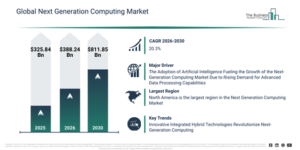
The next generation computing market has experienced significant expansion in recent years. It is projected to increase from $325.84 billion in 2025 to $388.24 billion in 2026, at a compound annual growth rate (CAGR) of 19.2%. Historically, this growth can be attributed to factors such as the evolution of high-performance computing, advancements in semiconductor technology, the rising demand for faster data processing, the expansion of cloud computing, and the increase in computational research._x000D_
_x000D_
The next generation computing market is projected to experience substantial growth over the coming years. It is set to reach $811.85 billion in 2030 at a compound annual growth rate (CAGR) of 20.3%. This expansion during the forecast period can be attributed to the advancement of quantum computing systems, the proliferation of edge computing devices, increased adoption within the healthcare and BFSI sectors, improvements in energy-efficient processors, and the growth of AI-driven computing applications. Notable trends anticipated during this period include high-performance computing solutions, the integration of quantum computing, energy-efficient processing, advanced data processing techniques, and the deployment of edge computing._x000D_
_x000D_
#Get A Free Sample Report With In-Depth Market Insights:#_x000D_
_x000D_
#Next Generation Computing Market Development Factors: What’s Supporting Demand?#_x000D_
The increasing integration of artificial intelligence is anticipated to drive the expansion of the next-generation computing market in the future. Artificial intelligence refers to machines’ ability to execute functions traditionally demanding human intellect, including learning, reasoning, and making decisions. The escalating application of AI, particularly machine learning and deep learning, necessitates significant computational power. This need is intensifying with the emergence of next-gen technologies such as quantum and neuromorphic computing, enabling complex AI operations to be executed with greater efficiency and speed compared to conventional computing approaches. Next-generation computing augments artificial intelligence by delivering the advanced processing capabilities, swiftness, and effectiveness essential for training intricate models, processing vast datasets instantly, and fostering more intelligent, adaptable AI systems across various uses. For example, data from March 2025, reported by the Office for National Statistics, a UK-based government department, indicated that 9 % of companies adopted artificial intelligence (AI) in 2023, representing an increase from prior years, with projections showing this figure will climb to 22 % in 2024. Consequently, the increased adoption of artificial intelligence is a key driver for the expansion of the next-generation computing market._x000D_
_x000D_
#Next Generation Computing Market Segment Landscape: Which Areas Lead Development?#_x000D_
The next generation computing market covered in this report is segmented – _x000D_
_x000D_
1) By Type: High Performance Computing, Quantum Computing, Brain Type Computing, Approximate And Probabilistic Computing, Energy Efficiency Computing, Thermodynamic Computing, Memory Based Computing, Optical Computing, Edge Computing, Other Types _x000D_
2) By Component: Hardware, Software, Solution_x000D_
3) By Deployment: Cloud, On-Premise_x000D_
4) By Enterprise Size: Small And Medium-Sized Enterprises (SMEs), Large Enterprises_x000D_
5) By End-Use Industry: Banking, Financial Services And Insurance (BFSI), Energy And Power, Transportation And Logistics, Chemicals, Academic, Government, Information Technology (IT) And Telecommunications, Healthcare, Space And Defense, Manufacturing_x000D_
_x000D_
Subsegments:_x000D_
1) By High Performance Computing: Supercomputers, Distributed Computing Systems _x000D_
2) By Quantum Computing: Quantum Annealers, Gate Model Quantum Computers _x000D_
3) By Brain Type Computing: Neuromorphic Computing, Spiking Neural Networks _x000D_
4) By Approximate And Probabilistic Computing: Stochastic Computing, Probabilistic Programming _x000D_
5) By Energy Efficiency Computing: Low-Power Processors, Green Computing Solutions _x000D_
6) By Thermodynamic Computing: Thermal Management Systems, Thermodynamic Models _x000D_
7) By Memory Based Computing: In-Memory Computing, Memristor Technology _x000D_
8) By Optical Computing: Photonic Processors, Optical Interconnects _x000D_
9) By Edge Computing: Edge Devices, Edge Analytics _x000D_
10) By Other Types: Hybrid Computing, Reversible Computing _x000D_
_x000D_
#Next Generation Computing Market Transformation Trends: What Innovations Are Driving Change?#_x000D_
Leading firms in the next-generation computing market are developing innovative technologies, such as integrated hybrids, to meet the increasing demand for more powerful, energy-efficient, and versatile computing solutions. Integrated Hybrid is a feature of Azure Quantum that enables researchers to effortlessly combine classical and quantum computing resources. For instance, in March 2023, Microsoft Corporation, a US-based technology corporation, launched its next generation of hybrid quantum computing known as Integrated Hybrid. This innovative technology incorporates an Azure Quantum feature that allows researchers to seamlessly combine classical and quantum computing resources. This simplification makes it easier to develop and deploy hybrid quantum computing applications. This interface effectively abstracts the inherent complexity of various hardware platforms, thereby allowing researchers to focus on developing their applications._x000D_
_x000D_
#Next Generation Computing Market Industry Leaders And Competitive Landscape#_x000D_
Major companies operating in the next generation computing market are Amazon Web Services Inc.; Alphabet Inc.; Google LLC; Microsoft Corporation; Alibaba Group Holding Limited; Dell Inc.; Lenovo Group Ltd.; Intel Corp.; International Business Machines Corporation; Cisco Systems Inc.; Oracle Corporation; Broadcom Inc.; SAP SE; Micron Technology Inc.; Hewlett Packard Enterprise Development LP; NVIDIA Corp.; NEC Corporation; Advanced Micro Device Inc.; Infosys Limited; VMware Inc.; Atos SE; Equinix Inc.; NetApp Inc.; Juniper Networks Inc.; Citrix Systems Inc.; Splunk Inc.; Pure Storage Inc.; Nutanix Inc. _x000D_
_x000D_
#View The Full Next Generation Computing Market Report:#_x000D_
_x000D_
#Next Generation Computing Market Regional Breakdown: Where Is Demand Concentrated?#_x000D_
North America was the largest region in the next generation computing market in 2025. Asia-Pacific is expected to be the fastest-growing region in the forecast period. The regions covered in the next generation computing market report are Asia-Pacific, South East Asia, Western Europe, Eastern Europe, North America, South America, Middle East, Africa._x000D_
_x000D_
#Reach Out To Our Team:#_x000D_
_x000D_
The Business Research Company: https://www.thebusinessresearchcompany.com/_x000D_
Americas: +1 310-496-7795_x000D_
Asia: +44 7882 955267 & +91 8897263534_x000D_
Europe: +44 7882 955267_x000D_
Email us at: marketing@tbrc.info_x000D_
_x000D_
#Follow us on:#_x000D_
_x000D_
LinkedIn: https://in.linkedin.com/company/the-business-research-company_x000D_
YouTube: https://www.youtube.com/channel/UC24_fI0rV8cR5DxlCpgmyFQ_x000D_
Global Market Model: https://www.thebusinessresearchcompany.com/global-market-model

Wasay has over a decade of experience in market research, data modelling, and analytics, with prior experience at GlobalData and Decision Tree Consulting Services. At The Business Research Company , he leads research operations across syndicated studies, customized consulting engagements, and the Global Market Model platform. His professional experience includes supporting organizations such as Boston Consulting Group, KPMG, and Ernst & Young. Wasay holds a degree in Electronics and Communications Engineering, postgraduate management qualifications from International Management Institute Belgium and Indian School of Business and Entrepreneurship, and completed the Integrated Program in Business Analytics from Indian Institute of Management Indore.