Featuring market attractiveness scoring, total addressable market sizing, company benchmarking matrices, interactive Excel dashboards, deeper supply chain intelligence, emerging startup tracking, and granular product-level insights, The Business Research Company’s 2026 market reports are built to deliver research that is both more actionable and more strategically valuable.
Generative AI In Cyber Security Market Revenue Outlook: What CAGR Lies Ahead Through 2030?
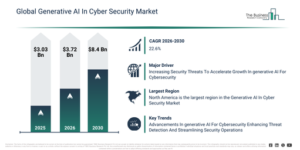
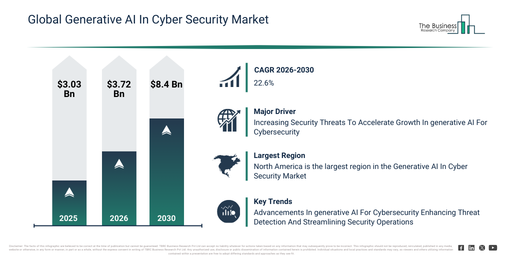
The generative AI in cyber security market size has exhibited exponential expansion recently. This market is projected to expand from $3.03 billion in 2025 to $3.72 billion in 2026, demonstrating a compound annual growth rate (CAGR) of 22.9%. Historically, this expansion has been driven by factors such as the rising incidence and complexity of cyber attacks, the integration of advanced AI and ML technologies into cybersecurity practices, the expansion of digital infrastructure and cloud services, stricter regulatory compliance demands, and the growing requirement for continuous threat monitoring.
The generative AI in cyber security market size is expected to undergo significant expansion in the upcoming years. It is projected to reach $8.4 billion in 2030, demonstrating a compound annual growth rate (CAGR) of 22.6%. The expansion observed throughout the forecast period can be attributed to the incorporation of generative AI for proactive threat modeling, the wider adoption of automated incident response solutions, the implementation of ueBA and predictive risk scoring, the advancement of network security and encrypted traffic analysis solutions, and its increased utilization in BFSI, healthcare, and critical infrastructure sectors. Key developments anticipated during this period include automated threat detection and response, adversarial AI defense systems, insider threat prediction and monitoring, optimization of network security, and automation for data privacy and compliance.
Get A Free Sample Report With In-Depth Market Insights:
Generative AI In Cyber Security Market Growth Factors: What’s Supporting Expansion?
The escalating security threats are projected to fuel the expansion of the generative AI in cyber security market moving forward. Security threats are vulnerabilities that capitalize on system defects or weaknesses, resulting in unauthorized entry, data loss, or other forms of damage. These threats are intensifying due to the increasing complexity of technology, expanded digital attack surfaces, and sophisticated strategies employed by cybercriminals. Generative artificial intelligence (AI) in cybersecurity aids in tackling security threats by constructing advanced models that forecast, identify, and respond to potential risks through continuous analysis of data patterns and threat simulations. For instance, in April 2023, according to the Department for Science, Innovation, and Technology, a UK-based government body, cybercrime impacted 11% of businesses and 8% of charities in total over the past 12 months; this figure climbed to 26% of medium-sized businesses, 37% of large businesses, and 25% of high-income charities. Therefore, the rise in security threats is propelling the generative AI in cyber security market.
Generative AI In Cyber Security Market Segment Analysis Spotlighting Growth Areas
The generative AI in cyber security market covered in this report is segmented –
1) By Type: Threat Detection And Analysis, Adversarial Defense, Insider Threat Detection, Network Security, Other Types
2) By Component: Hardware, Software, Services
3) By Technology: Generative Adversarial Networks (GANs), Variational Autoencoders (VAEs), Reinforcement Learning (RL), Deep Neural Networks (DNNs), Natural Language Processing (NLP), Other Technologies
4) By End-Use: Banking, Financial Services, And Insurance (BFSI), Healthcare And Life Sciences, Government And Defense, Retail And E-commerce, Manufacturing And Industrial, Information Technology (IT) And Telecommunications, Energy And Utilities, Other End-Uses
Subsegments:
1) By Threat Detection and Analysis: Malware Detection, Phishing Detection, Anomaly Detection, Zero-Day Threat Identification, Automated Incident Response
2) By Adversarial Defense: Adversarial Attack Simulation, Defensive Machine Learning, Robust Model Training, Adversarial Input Detection, Secure Model Deployment
3) By Insider Threat Detection: Behavioral Analysis, User And Entity Behavior Analytics (UEBA), Privileged Access Monitoring, Data Exfiltration Detection, Predictive Risk Scoring
4) By Network Security: Traffic Anomaly Detection, Intrusion Detection And Prevention Systems (IDPS), Encrypted Traffic Analysis, Automated Firewall Rules, Secure Network Architecture Design
5) By Other Types: Data Privacy and Compliance, Fraud Detection, Vulnerability Scanning, Secure Software Development, Automated Threat Hunting
Generative AI In Cyber Security Market Industry Trends: What’s Reshaping Demand?
Leading companies in the generative AI in cybersecurity market are concentrating on developing advanced solutions, like cybersecurity assistants, to maintain their market standing. A cybersecurity assistant is a system or tool, frequently powered by AI or machine learning, created to support and improve cybersecurity efforts through automating tasks such as identifying threats, responding to incidents, and managing vulnerabilities. For instance, in August 2024, International Business Machines Corporation (IBM), a US-based technology company, unveiled a new generative AI-powered cybersecurity assistant. Constructed on IBM’s Watsonx AI platform, this tool is intended to enhance threat detection and response. Its primary features include expedited threat investigations through historical correlation analysis, integration with IBM’s existing threat detection services, and a conversational AI engine for real-time support. This solution improves threat management by cross-referencing alerts from multiple sources and continuously learning from specific client environments to provide more precise and efficient security insights.
Generative AI In Cyber Security Market Leading Companies: Who Holds The Strongest Market Presence?
Major companies operating in the generative AI in cyber security market are Microsoft Corporation, Intel Corporation, International Business Machines Corporation, Cisco Systems Inc., NVIDIA Corporation, Palo Alto Networks Inc., Fortinet Inc., LexisNexis, CrowdStrike Holdings Inc., Palantir Technologies Inc., Trend Micro Inc., Elastic NV, Proofpoint Inc., Rapid7, Tanium, Darktrace plc, Sumo Logic Inc., SentinelOne Inc., LogRhythm Inc., Snyk, Vectra AI Inc., Aqua Security Software Ltd., Illumio, Sophos Ltd., Acalvio Technologies
View The Full Generative AI In Cyber Security Market Report:
Generative AI In Cyber Security Market Top Region By Revenue And Market Share
North America was the largest region in the generative AI in cyber security market in 2025. Asia-Pacific is expected to be the fastest-growing region in the forecast period. The regions covered in the generative AI in cyber security market report are Asia-Pacific, South East Asia, Western Europe, Eastern Europe, North America, South America, Middle East, Africa.
Reach Out To Our Team:
The Business Research Company: https://www.thebusinessresearchcompany.com/
Americas: +1 310-496-7795
Asia: +44 7882 955267 & +91 8897263534
Europe: +44 7882 955267
Email us at: marketing@tbrc.info
Follow us on:
LinkedIn: https://in.linkedin.com/company/the-business-research-company
YouTube: https://www.youtube.com/channel/UC24_fI0rV8cR5DxlCpgmyFQ
Global Market Model: https://www.thebusinessresearchcompany.com/global-market-model

Wasay has over a decade of experience in market research, data modelling, and analytics, with prior experience at GlobalData and Decision Tree Consulting Services. At The Business Research Company , he leads research operations across syndicated studies, customized consulting engagements, and the Global Market Model platform. His professional experience includes supporting organizations such as Boston Consulting Group, KPMG, and Ernst & Young. Wasay holds a degree in Electronics and Communications Engineering, postgraduate management qualifications from International Management Institute Belgium and Indian School of Business and Entrepreneurship, and completed the Integrated Program in Business Analytics from Indian Institute of Management Indore.