Built to provide research that’s more actionable and strategically valuable, The Business Research Company’s 2026 market reports include market attractiveness analysis, total addressable market sizing, company benchmarking matrices, interactive Excel dashboards, broader supply chain intelligence, emerging startup tracking, and in-depth product insights.
Generative Artificial Intelligence (AI) In Automation Market Size Outlook: How Quickly Will Revenue Expand Through 2030?
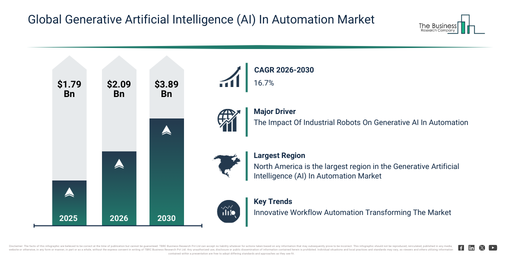
The market size for generative artificial intelligence (AI) in automation has experienced rapid expansion over recent years. This market is projected to expand from $1.79 billion in 2025 to $2.09 billion in 2026, demonstrating a compound annual growth rate (CAGR) of 17.1%. Historically, this expansion has been driven by the implementation of early automation systems, the integration of artificial intelligence within manufacturing processes, the evolution of deep learning algorithms, advances in robotics technology, and an escalating need for greater process efficiency.
The generative artificial intelligence (AI) in automation market is expected to experience substantial expansion in the coming years. It is projected to grow to $3.89 billion in 2030, achieving a compound annual growth rate (CAGR) of 16.7%. This increase during the forecast period is driven by factors such as the expansion of AI-driven autonomous systems, the increased deployment of predictive maintenance solutions, the integration of AI in smart factories, the growth in intelligent RPA adoption, and the advancement of immersive AI technologies in automation. Key trends anticipated in the forecast period include AI-powered process optimization, predictive maintenance systems, intelligent robotic process automation (RPA), automated quality control and anomaly detection, and AI-driven chatbots and virtual assistants.
Get A Free Sample Report With In-Depth Market Insights:
Generative Artificial Intelligence (AI) In Automation Market Development Factors: What’s Supporting Demand?
The generative AI in automation market is projected for growth, spurred by the increasing deployment of industrial robots. Industrial robots are programmable, automated machines adept at performing diverse manufacturing tasks with precision, speed, and consistency. Their widespread adoption stems from their capacity to boost production efficiency, elevate product quality, reduce labor expenses, and execute intricate operations accurately. Generative AI, when applied in automation, empowers these robots to optimize operations through advanced planning and decision-making, enhances their adaptability to new tasks with minimal reprogramming, and improves performance by generating precise, context-aware instructions and simulations for complex manufacturing processes. Illustratively, in September 2025, the International Federation of Robotics, a German non-profit, stated that the global stock of industrial robots reached 4,664,000 units in 2024, indicating a 9% increase from the previous year. Consequently, the rising adoption of industrial robots is a key driver for the generative AI in automation market.
Generative Artificial Intelligence (AI) In Automation Market Segment Trends And Revenue Contributors
The generative artificial intelligence (AI) in automation market covered in this report is segmented –
1) By Technology: Computer Vision, Natural Language Processing (NLP), Reinforcement Learning, Deep Learning, Other Technologies
2) By Application: Robotic Process Automation (RPA), Process Optimization, Intelligent Chatbots, Predictive Maintenance, Quality Control And Anomaly Detection, Other Applications
3) By End Users: Automotive, Aerospace, Electronics, Consumer Goods, Other End Users
Subsegments:
1) By Computer Vision: Image Recognition, Object Detection, Facial Recognition, Image Segmentation, Optical Character Recognition (OCR)
2) By Natural Language Processing (NLP): Text Analysis, Speech Recognition, Sentiment Analysis, Chatbots and Virtual Assistants, Machine Translation
3) By Reinforcement Learning: Model-Based Reinforcement Learning, Model-Free Reinforcement Learning, Deep Reinforcement Learning, Multi-Agent Reinforcement Learning
4) By Deep Learning: Neural Networks, Convolutional Neural Networks (CNN), Recurrent Neural Networks (RNN), Generative Adversarial Networks (GANs), Autoencoders
5) By Other Technologies: Robotic Process Automation (RPA), Edge AI, Quantum Computing in AI, Federated Learning, Explainable AI (XAI)
Generative Artificial Intelligence (AI) In Automation Market Transformation Trends: What Innovations Are Driving Change?
Major enterprises operating in the generative artificial intelligence (AI) in automation market are actively engaged in creating workflow automation platforms to optimize intricate operational flows by automating repetitive assignments and critical decision processes. These workflow automation platforms serve as pivotal instruments, allowing companies to enhance their operational effectiveness by automating and overseeing commercial procedures, thereby boosting productivity, minimizing human involvement, and ensuring uniform completion across various tasks. For instance, in February 2024, Tungsten Automation, a US-based software company, introduced TotalAgility 8, a business process management (BPM) and workflow automation platform crafted to assist businesses in refining and improving their procedures. The platform’s groundbreaking functionalities, including AI-powered Copilots and extensive document libraries, empower individuals across various expertise levels to efficiently simplify operations. With this introduction, Tungsten Automation reinforces its standing as a frontrunner in the Intelligent Automation sector, catalyzing significant evolution for enterprises.
Generative Artificial Intelligence (AI) In Automation Market Competitive Landscape: Which Companies Lead The Industry?
Major companies operating in the generative artificial intelligence (AI) in automation market are Microsoft Corporation, Amazon Web Services Inc., Siemens AG, General Electric Company, International Business Machines Corporation, Cisco Systems Inc., Oracle Corporation, Salesforce Inc., Nvidia Corporation, Zebra Technologies Corp., Autodesk Inc., SAS Institute Inc., OpenAI, Databricks Inc., UiPath Inc., Quantiphi, Darktrace plc, Automation Anywhere Inc., C3.AI Inc., Blue Prism, Google DeepMind Technologies Limited, Cerebras Systems Inc., Syntiant Corp., ClarifAI Inc., Trifacta
View The Full Generative Artificial Intelligence (AI) In Automation Market Report:
Generative Artificial Intelligence (AI) In Automation Market Largest Region: Which Geography Holds The Biggest Share?
North America was the largest region in the generative artificial intelligence (AI) in automation market in 2025. Asia-Pacific is expected to be the fastest-growing region in the forecast period. The regions covered in the generative artificial intelligence (AI) in automation market report are Asia-Pacific, South East Asia, Western Europe, Eastern Europe, North America, South America, Middle East, Africa.
Reach Out To Our Team:
The Business Research Company: https://www.thebusinessresearchcompany.com/
Americas: +1 310-496-7795
Asia: +44 7882 955267 & +91 8897263534
Europe: +44 7882 955267
Email us at: marketing@tbrc.info
Follow us on:
LinkedIn: https://in.linkedin.com/company/the-business-research-company
YouTube: https://www.youtube.com/channel/UC24_fI0rV8cR5DxlCpgmyFQ
Global Market Model: https://www.thebusinessresearchcompany.com/global-market-model

Wasay has over a decade of experience in market research, data modelling, and analytics, with prior experience at GlobalData and Decision Tree Consulting Services. At The Business Research Company , he leads research operations across syndicated studies, customized consulting engagements, and the Global Market Model platform. His professional experience includes supporting organizations such as Boston Consulting Group, KPMG, and Ernst & Young. Wasay holds a degree in Electronics and Communications Engineering, postgraduate management qualifications from International Management Institute Belgium and Indian School of Business and Entrepreneurship, and completed the Integrated Program in Business Analytics from Indian Institute of Management Indore.