Backed by market attractiveness analysis, total addressable market sizing, company benchmarking matrices, interactive Excel dashboards, wider supply chain intelligence, emerging startup coverage, and detailed product-level insights, The Business Research Company’s 2026 market reports are designed to offer research that is more actionable and strategically valuable than ever.
Generative Artificial Intelligence (AI) In E-Commerce Market Growth From $1.24 Billion In 2026 To $2.44 Billion By 2030 At A CAGR Of 18.5%
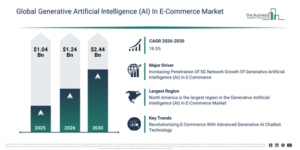
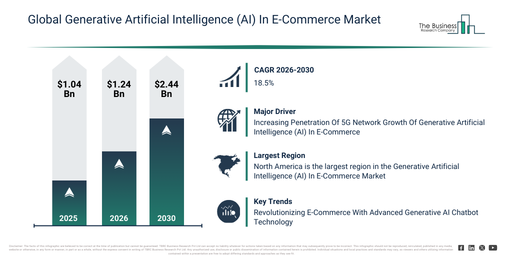
The generative artificial intelligence (AI) in e-commerce market size has experienced substantial growth recently. It is forecast to grow from $1.04 billion in 2025 to $1.24 billion in 2026, achieving a compound annual growth rate (CAGR) of 18.8%. This historical expansion can be attributed to factors such as the growth of online retail platforms, the early adoption of AI chatbots, increased mobile commerce usage, the expansion of e-commerce logistics, and the rise of personalized marketing techniques.
The generative artificial intelligence (AI) in e-commerce market is anticipated to observe significant expansion over the next few years, projected to reach a value of $2.44 billion by 2030, demonstrating a compound annual growth rate (CAGR) of 18.5%. This growth during the forecast period is primarily driven by the integration of AR/VR to enhance shopping experiences, the adoption of AI-driven visual search tools, the expansion of predictive analytics for customer behavior, the increase in hybrid cloud deployment for e-commerce AI, and the heightened use of voice-activated shopping assistants. Noteworthy trends for this period encompass AI-powered personalized recommendations, automated product description generation, visual search and image recognition functionalities, dynamic pricing and inventory optimization, and AR-enabled virtual try-on experiences.
Get A Free Sample Report With In-Depth Market Insights:
Generative Artificial Intelligence (AI) In E-Commerce Market Growth Drivers: What’s Behind The Acceleration?
The expanding adoption of 5G networks is anticipated to fuel the advancement of generative artificial intelligence (AI) within the e-commerce market. As the fifth generation of mobile network technology, 5G delivers quicker speeds, reduced latency, and more dependable connections compared to earlier versions. The surge in 5G network adoption stems from the need for accelerated internet, enhanced connectivity, and novel applications demanding elevated speeds and minimal latency. Through its low-latency, high-speed connectivity, 5G boosts generative AI in e-commerce by facilitating quicker data processing, immediate personalization, and smooth customer interactions. An illustration of this trend is found in North America, where the 5G penetration rate hit an impressive 40% by September 2023, growing by 25.5% in the first half of 2023, as reported by 5G Americas, a US-based industry trade organization. Forecasts suggest that 5G connections in North America will climb to 669 million by 2028. Consequently, the increasing reach of 5G networks is indeed fostering the expansion of artificial intelligence (AI) within the e-commerce market.
Generative Artificial Intelligence (AI) In E-Commerce Market Segment Analysis And Revenue Potential
The generative artificial intelligence (AI) in e-commerce market covered in this report is segmented –
1) By Technology: Natural Language Processing, Computer Vision, Machine Learning, Speech Recognition, Augmented Reality
2) By Deployment Mode: Cloud-Based, On-Premises, Hybrid
3) By Application: Business To Business (B2B), Business To Consumer (B2C), Personal, Business Use, Seasonal Use, Other Applications
Subsegments:
1) By Natural Language Processing (NLP): Chatbots And Virtual Assistants, Sentiment Analysis For Customer Feedback, Automated Content Creation For Product Descriptions, Personalized Recommendations And Search, Language Translation Services
2) By Computer Vision: Image Recognition For Product Categorization, Visual Search Capabilities, Automated Quality Inspection Of Products, Augmented Reality (AR) For Virtual Try-Ons, Facial Recognition For Personalized Marketing
3) By Machine Learning: Predictive Analytics For Customer Behavior, Recommendation Systems, Dynamic Pricing Algorithms, Inventory Management Optimization, Fraud Detection And Prevention
4) By Speech Recognition: Voice-Activated Shopping Assistants, Customer Service Automation, Voice Search Optimization, Accessibility Features For Disabled Users, Voice-Based Product Recommendations
5) By Augmented Reality (AR): Virtual Try-On Solutions For Apparel And Accessories, Interactive Product Demos, Enhanced Customer Engagement Through AR Experiences, In-Store Navigation And Visualization, Virtual Showrooms And Experiences.
Generative Artificial Intelligence (AI) In E-Commerce Market Trends: What’s Defining The Industry’s Next Phase?
Major companies operating in generative artificial intelligence (AI) in e-commerce are developing generative artificial intelligence (AI) chatbot tools to enhance various aspects of the shopping experience. Generative artificial intelligence (AI) chatbots are advanced software programs designed to simulate human conversation through text or voice interactions. For instance, in July 2023, Shopify Inc., a Canada-based e-commerce company, launched Sidekick. It is a chatbot that utilizes advanced generative AI models to engage customers in natural, human-like conversations. It offers personalized product recommendations, assists with order tracking, and provides real-time customer support. Sidekick aims to improve customer satisfaction, streamline interactions, and help merchants optimize their e-commerce operations.
Generative Artificial Intelligence (AI) In E-Commerce Market Key Players Shaping Industry Direction
Major companies operating in the generative artificial intelligence (AI) in e-commerce market are Wal-Mart Inc., Amazon Inc., Kroger Co, Alibaba Cloud LLC, Best Buy Co. Inc., Nvidia Corporation, Salesforce Inc., Zalando SE, Ebay Inc., Shopify Inc., Farfetch Ltd, LivePerson Inc., Grid Dynamics Holdings Inc., Bloomreach Inc., Algolia Inc., Coveo Solutions Inc, Magento Inc., Dynamic Yield Ltd, Leewayhertz Technologies Private Limited, MAVERICK Technologies LLC, QSS Technosoft Pvt. Ltd., Bluebash Consulting Pvt Ltd.
View The Full Generative Artificial Intelligence (AI) In E-Commerce Market Report:
Generative Artificial Intelligence (AI) In E-Commerce Market Top Region By Revenue And Market Share
North America was the largest region in the generative artificial intelligence (AI) in the e-commerce market in 2025. Asia-Pacific is expected to be the fastest-growing region in the forecast period. The regions covered in the generative artificial intelligence (AI) in e-commerce market report are Asia-Pacific, South East Asia, Western Europe, Eastern Europe, North America, South America, Middle East, Africa.
Reach Out To Our Team:
The Business Research Company: https://www.thebusinessresearchcompany.com/
Americas: +1 310-496-7795
Asia: +44 7882 955267 & +91 8897263534
Europe: +44 7882 955267
Email us at: marketing@tbrc.info
Follow us on:
LinkedIn: https://in.linkedin.com/company/the-business-research-company
YouTube: https://www.youtube.com/channel/UC24_fI0rV8cR5DxlCpgmyFQ
Global Market Model: https://www.thebusinessresearchcompany.com/global-market-model

Wasay has over a decade of experience in market research, data modelling, and analytics, with prior experience at GlobalData and Decision Tree Consulting Services. At The Business Research Company , he leads research operations across syndicated studies, customized consulting engagements, and the Global Market Model platform. His professional experience includes supporting organizations such as Boston Consulting Group, KPMG, and Ernst & Young. Wasay holds a degree in Electronics and Communications Engineering, postgraduate management qualifications from International Management Institute Belgium and Indian School of Business and Entrepreneurship, and completed the Integrated Program in Business Analytics from Indian Institute of Management Indore.