Featuring market attractiveness scoring, total addressable market sizing, company benchmarking matrices, interactive Excel dashboards, deeper supply chain intelligence, emerging startup tracking, and granular product-level insights, The Business Research Company’s 2026 market reports are built to deliver research that is both more actionable and more strategically valuable.
Generative Artificial Intelligence (AI) In Utilities Market Value Growth And Long-Term Outlook
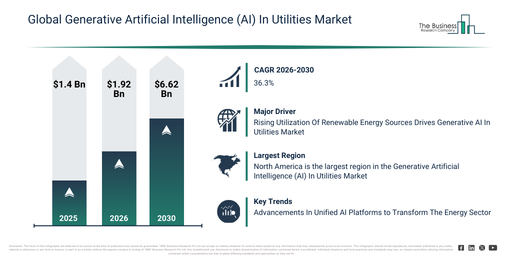
The market size for generative artificial intelligence (AI) in utilities has experienced significant growth in recent years. It is forecast to expand from $1.4 billion in 2025 to $1.92 billion in 2026, demonstrating a compound annual growth rate (CAGR) of 36.6%. The expansion observed historically can be linked to the increasing need for reliable electricity and water supply, the growing adoption of smart meters, a rise in investment in renewable energy, the early implementation of predictive maintenance, and the broadening of utility analytics solutions.
The market for generative artificial intelligence (AI) in utilities is projected to experience substantial expansion over the upcoming years. It will grow to $6.62 billion in 2030 at a compound annual growth rate (CAGR) of 36.3%. Key drivers for this anticipated growth encompass progress in generative AI algorithms, the seamless integration of AI with smart grids and IoT devices, the widespread use of cloud-based platforms for utility management, the development of solutions for managing renewable energy, and an increase in customized energy services for customers. Significant developments during this period are anticipated to involve predictive maintenance for utility infrastructure, optimized smart grid systems, tools for forecasting energy usage, platforms for integrating renewable energy, and improved customer engagement alongside personalized energy management strategies.
Get A Free Sample Report With In-Depth Market Insights:
Generative Artificial Intelligence (AI) In Utilities Market Growth Catalysts And Demand Drivers
The growing adoption of renewable energy sources is anticipated to boost the expansion of generative artificial intelligence (AI) within the utilities market. These energy sources are naturally regenerative resources, including solar, wind, hydro, geothermal, and biomass, which are harnessed for power generation. Their application is accelerating due to their inherent scalability, declining expenses, and broad acceptance. Generative AI assists utilities, particularly those involving renewable energy, by offering sustainable, data-informed insights to enhance energy management and lessen dependence on fossil fuels. For example, in February 2025, the World Resources Institute, a US-based non-profit research organization, reported that solar power surpassed its 2023 record in 2024, with an estimated 39.6 GW of new capacity installed, which was an increase from 27.4 GW in the prior year. This brought the overall U.S. installed solar capacity to approximately 220 GW, contributing over 7% to the nation’s electricity supply. Consequently, the heightened use of renewable energy sources is propelling the growth of generative artificial intelligence (AI) in the utilities market.
Generative Artificial Intelligence (AI) In Utilities Market Segment Breakdown: Which Categories Lead On Revenue?
The generative artificial intelligence (AI) in utilities market covered in this report is segmented –
1) By Type: Electricity Generation, Transmission And Distribution, Customer Engagement And Energy Efficiency, Water And Wastewater Management, Gas And Oil Utilities, Renewable Energy Integration
2) By Deployment: On-Premises, Cloud-Based, Hybrid, Edge Computing, Collaborative, Customized In-House
3) By Application: Create Personalized Customer Experiences, Improve Asset Management, Develop New Products And Services, Improve Safety, Other Applications
Subsegments:
1) By Electricity Generation: Predictive Maintenance For Power Plants, Energy Demand Forecasting, Load Balancing And Optimization, Grid Management Solutions
2) By Transmission And Distribution: Smart Grid Technologies, Fault Detection And Diagnostics, Real-Time Monitoring Systems, Asset Management Solutions
3) By Customer Engagement and Energy Efficiency: Personalized Energy Management Tools, Customer Behavior Analytics, Energy Usage Forecasting, Loyalty and Rewards Programs
4) By Water and Wastewater Management: Leak Detection and Monitoring Systems, Water Quality Analysis Tools, Demand Forecasting For Water Supply, Wastewater Treatment Optimization
5) By Gas and Oil Utilities: Pipeline Monitoring And Integrity Management, Leak Detection Technologies, Supply Chain Optimization, Predictive Maintenance For Equipment
6) By Renewable Energy Integration: Energy Storage Management, Integration Of Distributed Energy Resources (DERs), Microgrid Management Solutions, Renewable Energy Forecasting
Generative Artificial Intelligence (AI) In Utilities Market Trends Shaping Long-Term Demand
Companies primarily engaged in generative artificial intelligence (AI) within the utility sector are focused on delivering real-time insights, aligning with the adoption of data-driven approaches like a unified platform for the energy industry. This strategy aims to improve operational efficiency and offer sophisticated data analytics to support better decision-making. A unified platform for the energy sector functions as an extensive system that integrates various technologies to streamline operations, enhance data analysis capabilities, and facilitate informed choices. For instance, in April 2024, Databricks Inc., a US-based data and AI firm, introduced a data intelligence platform. This platform features large language model (LLM)-powered chatbots for personalized user support, Internet of Things (IoT) predictive maintenance designed to maximize uptime and reduce costs, real-time data processing utilizing digital twins, artificial intelligence (AI) or machine learning (ML) models for wind turbine upkeep, and grid-edge analytics to boost grid performance and prevent outages. Furthermore, the real-time data ingestion platform (RTDIP) provides a cloud-native framework for standardizing data and enabling predictive analytics.
Generative Artificial Intelligence (AI) In Utilities Market Leading Players And Competitive Positioning
Major companies operating in the generative artificial intelligence (AI) in utilities market are Microsoft Corporation, Hitachi Ltd, Amazon Web Services Inc., Siemens AG, General Electric Company, IBM Corporation, Schneider Electric SE, Honeywell International Inc., SAP SE, ABB Ltd., NVIDIA Corporation, Capgemini SE, Eaton Corporation, Infosys Limited, Emerson Electric Co., Wipro Limited, Rockwell Automation Inc., The Tata Power Company Ltd., AVEVA Group plc, C3.AI Inc., SparkCognition Inc., Bidgely Inc.
View The Full Generative Artificial Intelligence (AI) In Utilities Market Report:
Generative Artificial Intelligence (AI) In Utilities Market Geographic Analysis: Where Is Demand Rising Fastest?
North America was the largest region in the generative artificial intelligence (AI) in the utilities market in 2025. The regions covered in the generative artificial intelligence (AI) in utilities market report are Asia-Pacific, South East Asia, Western Europe, Eastern Europe, North America, South America, Middle East, Africa.
Reach Out To Our Team:
The Business Research Company: https://www.thebusinessresearchcompany.com/
Americas: +1 310-496-7795
Asia: +44 7882 955267 & +91 8897263534
Europe: +44 7882 955267
Email us at: marketing@tbrc.info
Follow us on:
LinkedIn: https://in.linkedin.com/company/the-business-research-company
YouTube: https://www.youtube.com/channel/UC24_fI0rV8cR5DxlCpgmyFQ
Global Market Model: https://www.thebusinessresearchcompany.com/global-market-model

Wasay has over a decade of experience in market research, data modelling, and analytics, with prior experience at GlobalData and Decision Tree Consulting Services. At The Business Research Company , he leads research operations across syndicated studies, customized consulting engagements, and the Global Market Model platform. His professional experience includes supporting organizations such as Boston Consulting Group, KPMG, and Ernst & Young. Wasay holds a degree in Electronics and Communications Engineering, postgraduate management qualifications from International Management Institute Belgium and Indian School of Business and Entrepreneurship, and completed the Integrated Program in Business Analytics from Indian Institute of Management Indore.