Backed by market attractiveness analysis, total addressable market sizing, company benchmarking matrices, interactive Excel dashboards, wider supply chain intelligence, emerging startup coverage, and detailed product-level insights, The Business Research Company’s 2026 market reports are designed to offer research that is more actionable and strategically valuable than ever.
Differential-Privacy Edge-Device Market Poised To Hit $5.23 Billion By 2030 With A 25.7% CAGR
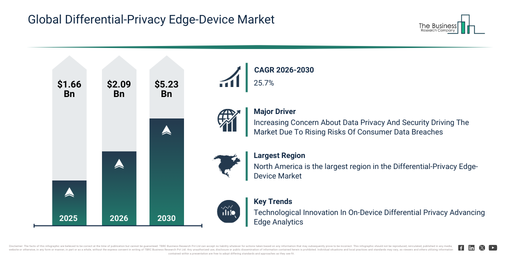
The differential-privacy edge-device market has experienced substantial growth in its size over recent years. This market is anticipated to expand from $1.66 billion in 2025 to $2.09 billion in 2026, demonstrating a compound annual growth rate (CAGR) of 26.0%. The expansion observed in the historic period is primarily attributable to escalating concerns over user data privacy, the widespread adoption of edge computing, the increasing use of sensors and gateways, mandatory regulatory compliance requirements, and the growing deployment of IoT devices.
The differential-privacy edge-device market is set for substantial growth over the next few years. It is projected to achieve a valuation of $5.23 billion by 2030, demonstrating a compound annual growth rate (CAGR) of 25.7%. This expansion during the forecast period can be attributed to the integration of AI-driven privacy algorithms, the widespread adoption of cloud and hybrid edge deployments, increasing application in healthcare and BFSI sectors, the demand for secure federated learning, and the development of specialized differential privacy SDKs and platforms. Prominent trends for the upcoming period include privacy-preserving edge analytics, the implementation of federated learning, the adoption of differential privacy mechanisms, optimization of local data processing, and secure data sharing across networks.
Get A Free Sample Report With In-Depth Market Insights:
Differential-Privacy Edge-Device Market Growth Drivers: What’s Behind The Acceleration?
Rising worries regarding data privacy and security are projected to fuel the expansion of the differential-privacy edge-device market in the future. Data privacy and security encompass policies, controls, and safeguards designed to shield personally identifiable information from unauthorized access or misuse, simultaneously ensuring its confidentiality, integrity, and availability. This apprehension is escalating because of a significant, government-reported surge in consumer fraud losses, indicating wider threats to personal data. Differential-privacy edge devices offer assistance by performing analytics and aggregation locally, thereby reducing the transmission of raw personal data and diminishing vulnerability to breaches across networks. For example, data from September 2023, provided by Deloitte, a UK-based professional services firm, revealed that in 2023, 67% of smartphone users were concerned about data security and privacy on their devices. Likewise, 62% of smart home users voiced comparable concerns, representing a rise of 13 and 10 percentage points, respectively, from 2022. Consequently, the growing unease surrounding data privacy and security is propelling the differential-privacy edge-device market.
Differential-Privacy Edge-Device Market Breakdown By Product Type And Application
The differential-privacy edge-device market covered in this report is segmented –
1) By Component: Hardware, Software, Services
2) By Device Type: Sensors, Gateways, Cameras, Wearables, Other Device Types
3) By Deployment Mode: On-Premises, Cloud, Hybrid
4) By End-User: Banking, Financial Services, And Insurance (BFSI), Healthcare, Manufacturing, Retail, Government, Information Technology (IT) And Telecommunications, Other End-Users
Subsegments:
1) By Hardware: Edge processors, Sensors, Memory And Storage, Network Modules, Secure Enclaves Or TPM
2) By Software: Differential Privacy SDKs, Privacy-Preserving Analytics Platforms, Data Anonymization Tools, Security And Encryption Software
3) By Services: Consulting And Implementation, Managed Privacy Services, Support And Maintenance, Training And Certification
Differential-Privacy Edge-Device Market Trends: What’s Defining The Industry’s Next Phase?
Leading firms within the differential-privacy edge-device market are prioritizing the creation of innovations like on-device differentially private product analytics to securely gather aggregate usage data from devices. This type of analytics introduces mathematically calibrated noise and employs either threshold or secure aggregation, ensuring that only patterns at a crowd level are identified, and individual user data stays hidden. As an example, in September 2024, Brave Software, a US-based software company specializing in privacy-centric internet tools, introduced Nebula. This system offers differentially private capabilities for privacy-preserving analytics within the Brave browser, featuring formal differential-privacy guarantees achieved through sample-and-threshold DP, complete with verifiable user-side thresholding and dummy data. It boasts an efficient design, leading to reduced server overhead compared to local or shuffle differential-privacy (DP) models. Furthermore, it provides population-level product insights without disclosing any individual user’s selections. Lastly, it drives privacy-preserving telemetry directly from edge devices (such as browsers or phones), aiming to enhance features while ensuring sensitive information remains on the device itself.
Differential-Privacy Edge-Device Market Company Landscape And Competitive Strategy
Major companies operating in the differential-privacy edge-device market are Apple Inc., Google LLC, Microsoft Corporation, Samsung Electronics Co. Ltd., Meta Platforms Inc., Alibaba Group Holding Limited, Amazon Web Services Inc., Huawei Technologies Co. Ltd., Robert Bosch GmbH, Sony Group Corporation, International Business Machines Corporation (IBM Corporation), Intel Corporation, Xiaomi Corporation, Qualcomm Technologies Inc., NVIDIA Corporation, NEC Corporation, ZTE Corporation, Tuya Inc., Shelly Group AD, Edge Impulse Inc.
View The Full Differential-Privacy Edge-Device Market Report:
Differential-Privacy Edge-Device Market Global Footprint: Which Region Leads The Market?
North America was the largest region in the differential-privacy edge-device market in 2025. Asia-Pacific is expected to be the fastest-growing region in the forecast period. The regions covered in the differential-privacy edge-device market report are Asia-Pacific, South East Asia, Western Europe, Eastern Europe, North America, South America, Middle East, Africa.
Reach Out To Our Team:
The Business Research Company: https://www.thebusinessresearchcompany.com/
Americas: +1 310-496-7795
Asia: +44 7882 955267 & +91 8897263534
Europe: +44 7882 955267
Email us at: marketing@tbrc.info
Follow us on:
LinkedIn: https://in.linkedin.com/company/the-business-research-company
YouTube: https://www.youtube.com/channel/UC24_fI0rV8cR5DxlCpgmyFQ
Global Market Model: https://www.thebusinessresearchcompany.com/global-market-model

Wasay has over a decade of experience in market research, data modelling, and analytics, with prior experience at GlobalData and Decision Tree Consulting Services. At The Business Research Company , he leads research operations across syndicated studies, customized consulting engagements, and the Global Market Model platform. His professional experience includes supporting organizations such as Boston Consulting Group, KPMG, and Ernst & Young. Wasay holds a degree in Electronics and Communications Engineering, postgraduate management qualifications from International Management Institute Belgium and Indian School of Business and Entrepreneurship, and completed the Integrated Program in Business Analytics from Indian Institute of Management Indore.