Built to provide research that’s more actionable and strategically valuable, The Business Research Company’s 2026 market reports include market attractiveness analysis, total addressable market sizing, company benchmarking matrices, interactive Excel dashboards, broader supply chain intelligence, emerging startup tracking, and in-depth product insights.
Distributed Passive Optical Network (PON) Edge Market Forecast: Value Set To Climb From $3.18 Billion To $6.37 Billion
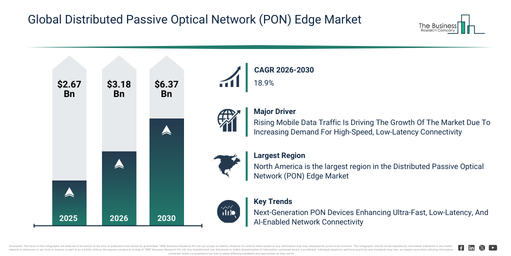
The distributed passive optical network (pon) edge market has experienced swift expansion in its size over recent years. This market is projected to expand from $2.67 billion in 2025 to reach $3.18 billion by 2026, demonstrating a compound annual growth rate (CAGR) of 19.3%. Historically, this expansion is linked to factors such as increasing need for rapid broadband, the rollout of gigabit PON networks, wider internet accessibility, the development of telecommunication infrastructure, and the implementation of optical line terminals and network units.
The distributed passive optical network (PON) edge market is projected to experience swift expansion in the upcoming years. It will grow to $6.37 billion in 2030 at a compound annual growth rate (CAGR) of 18.9%. This expansion during the forecast period is fueled by several factors, including the spread of next-generation PON2 technologies, rising uptake among enterprises and government entities, a need for ultra-low latency applications, the incorporation of sophisticated network management software, and the scaling of distributed PON edge deployments. Key trends anticipated for this period encompass edge-centric network rollouts, broadband services with minimal latency, efficient utilization of network resources, robust support for high-bandwidth applications, and the scalability inherent in distributed architectures.
Get A Free Sample Report With In-Depth Market Insights:
Distributed Passive Optical Network (PON) Edge Market Demand Drivers: What’s Powering Industry Growth?
The escalating mobile data traffic is anticipated to propel the growth of the distributed passive optical network (PON) edge market moving forward. Mobile data traffic encompasses the digital information exchanged across mobile networks by various devices such as smartphones, tablets, and IoT gadgets. This traffic is on the rise due to the growing demand for increased bandwidth and reduced latency from high-definition video streaming, cloud applications, and IoT connectivity, which prompts service providers to boost capacity and enhance performance. The distributed passive optical network (DPON) edge architecture is designed to tackle these data traffic issues by extending high-speed fiber closer to end users, thereby minimizing latency, easing network congestion, and facilitating more efficient data routing, which in turn enhances service quality during busy periods. As an illustration, Ericsson, a telecommunications firm based in Sweden, reported in June 2025 that 5G constituted 35% of worldwide mobile data traffic by the close of 2024, an increase from 26% in 2023, with projections indicating it will climb to 80% by 2030. Consequently, the increasing mobile data traffic creates advantageous conditions for the expansion of the distributed passive optical network (PON) edge market.
Distributed Passive Optical Network (PON) Edge Market Segmentation And Category Overview
The distributed passive optical network (pon) edge market covered in this report is segmented –
1) By Component: Hardware, Software, Services
2) By Technology: Gigabit Passive Optical Network, Ethernet Passive Optical Network, 10 Gigabit Symmetrical Passive Optical Network, Next-Generation Passive Optical Network 2, Other Technologies
3) By Deployment Mode: Centralized, Distributed
4) By End-User: Telecom Operators, Internet Service Providers, Enterprises, Government, Other End-Users
Subsegments:
1) By Hardware: Optical Line Terminal (OLT), Optical Network Unit (ONU), Optical Network Terminal (ONT), Splitters, Fiber Distribution Hub (FDH), Network Interface Devices (NID), Optical Transceivers
2) By Software: Network Management Software (NMS), Performance Monitoring Software (PMS), Fault Management Software (FMS), Configuration Management Software (CMS), Security And Access Control Software
3) By Services: Installation And Commissioning Services, Maintenance And Support Services, Consulting Services, Managed Services, Network Optimization Services
Distributed Passive Optical Network (PON) Edge Market Innovation Trends: What Developments Are Reshaping The Industry?
Leading companies within the distributed passive optical network (PON) edge market are concentrating on developing sophisticated offerings, such as next-generation passive optical network devices, to enable more dependable mobile and broadband data transfer across various networks. These next-generation passive optical network (PON) devices are innovative fiber-optic components that provide incredibly fast broadband and mobile connectivity, ensuring low-latency, scalable, and efficient data flow for homes, businesses, and enterprises. For example, in October 2024, Broadcom Inc., a US-based technology firm, introduced BCM68660 and BCM55050, which are the inaugural merchant silicon 50G Passive Optical Network Optical Line Terminal (OLT) and Optical Network Unit (ONU) devices. These units incorporate an embedded neural processing unit (NPU) to accelerate AI and machine learning tasks at the network edge, allowing telecom operators to provide broadband speeds 40 times faster with reduced latency compared to current gigabit solutions. The solution supports advanced uses like 5G small cells, autonomous driving connectivity, and network slicing for enterprises, while simultaneously enhancing energy efficiency and network security by processing AI/ML on-site instead of in the cloud, thereby improving privacy and lowering operational expenses.
Distributed Passive Optical Network (PON) Edge Market Competitive Analysis Of Leading Industry Participants
Major companies operating in the distributed passive optical network (pon) edge market are Huawei Technologies Co. Ltd, Cisco Systems Inc., Fujitsu Limited, Sumitomo Electric Industries Ltd., Nokia Corporation, NEC Corporation, ZTE Corporation, Prysmian Group, Corning Incorporated, Amphenol Corporation, Nexans S.A., Furukawa Electric Co. Ltd., Juniper Networks Inc., CommScope Holding Company Inc., FiberHome Technologies Group, ADTRAN Inc., Calix Inc., Alpha Networks Inc., Allied Telesis Holdings K.K., Dasan Zhone Solutions Inc.
View The Full Distributed Passive Optical Network (PON) Edge Market Report:
Distributed Passive Optical Network (PON) Edge Market Geographic Spread And Regional Opportunities
North America was the largest region in the distributed passive optical network (PON) edge market in 2025. Asia-Pacific is expected to be the fastest-growing region in the forecast period. The regions covered in the distributed passive optical network (pon) edge market report are Asia-Pacific, South East Asia, Western Europe, Eastern Europe, North America, South America, Middle East, Africa.
Reach Out To Our Team:
The Business Research Company: https://www.thebusinessresearchcompany.com/
Americas: +1 310-496-7795
Asia: +44 7882 955267 & +91 8897263534
Europe: +44 7882 955267
Email us at: marketing@tbrc.info
Follow us on:
LinkedIn: https://in.linkedin.com/company/the-business-research-company
YouTube: https://www.youtube.com/channel/UC24_fI0rV8cR5DxlCpgmyFQ
Global Market Model: https://www.thebusinessresearchcompany.com/global-market-model

Wasay has over a decade of experience in market research, data modelling, and analytics, with prior experience at GlobalData and Decision Tree Consulting Services. At The Business Research Company , he leads research operations across syndicated studies, customized consulting engagements, and the Global Market Model platform. His professional experience includes supporting organizations such as Boston Consulting Group, KPMG, and Ernst & Young. Wasay holds a degree in Electronics and Communications Engineering, postgraduate management qualifications from International Management Institute Belgium and Indian School of Business and Entrepreneurship, and completed the Integrated Program in Business Analytics from Indian Institute of Management Indore.