Featuring market attractiveness scoring, total addressable market sizing, company benchmarking matrices, interactive Excel dashboards, deeper supply chain intelligence, emerging startup tracking, and granular product-level insights, The Business Research Company’s 2026 market reports are built to deliver research that is both more actionable and more strategically valuable.
Edge Artificial Intelligence Accelerator Market Size And Revenue Outlook Through 2030
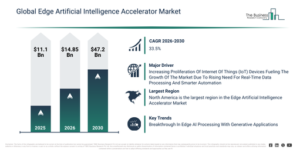
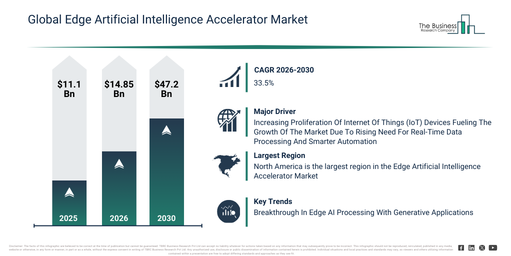
The edge artificial intelligence accelerator market has experienced rapid expansion in recent years. It is anticipated to grow from $11.1 billion in 2025 to $14.85 billion in 2026, at a compound annual growth rate (CAGR) of 33.8%. The historical growth can be attributed to the increased adoption of IoT devices, the expansion of smart manufacturing systems, a rising demand for real-time data processing, the development of autonomous technologies, and the growing deployment of connected sensors.
The edge artificial intelligence accelerator market is projected to experience substantial growth over the coming years. It is anticipated to reach $47.2 billion in 2030, demonstrating a compound annual growth rate (CAGR) of 33.5%. This growth during the forecast period is attributable to the expanding infrastructure of edge computing, the increasing adoption of autonomous machines, and industrial advancements. Key trends expected in the forecast period include low latency edge AI processing, the development of energy-efficient AI chips, on-device machine learning acceleration, the integration of real-time vision processing, and the design of compact edge AI hardware.
Get A Free Sample Report With In-Depth Market Insights:
Edge Artificial Intelligence Accelerator Market Growth Factors: What’s Supporting Expansion?
The expanding presence of internet of things (IoT) devices is projected to boost the edge artificial intelligence accelerator market’s growth in the future. internet of things (IoT) devices encompass an interconnected network of items like smartphones, sensors, wearables, smart home devices, and security cameras, which facilitate communication and data exchange via the internet automatically. The demand for internet of things (IoT) connected devices is rising, driven by the requirement for real-time data, as these devices improve efficiency, allow for remote oversight, and aid in more informed decision-making across various sectors. Edge artificial intelligence accelerators improve internet of things devices by facilitating real-time data processing directly on the device, thereby minimizing latency and lessening reliance on cloud infrastructure. These accelerators boost efficiency by providing quicker insights and more intelligent automation, which reinforces the overall efficacy of interconnected systems. As an illustration, in September 2024, IoT Analytics, a German research organization specializing in IoT market data, reported that connected IoT devices totaled 16.6 billion in 2023, marking a 15% rise from 14.4 billion in 2022. Consequently, the growing prevalence of internet of things (IoT) devices is fueling the expansion of the edge artificial intelligence accelerator market.
Edge Artificial Intelligence Accelerator Market Segmentation And Category Overview
The edge artificial intelligence accelerator market covered in this report is segmented –
1) By Component: Central Processing Unit (CPU), Graphics Processing Unit (GPU), Application-Specific Integrated Circuit (ASIC), Field-Programmable Gate Arrays (FPGAs)
2) By Device: Smartphones, Internet of Things (IoT) Devices, Robots, Cameras
3) By Function Outlook: Training, Interference
4) By End-User: Healthcare, Automotive, Retail, Manufacturing, Security and Surveillance, Other End-Users
Subsegments:
1) By Central Processing Unit (CPU): Multi-Core Central Processing Units, Single-Core Central Processing Units, Low-Power Central Processing Units, High-Performance Central Processing Units
2) By Graphics Processing Unit (GPU): Integrated Graphics Processing Units, Discrete Graphics Processing Units, Mobile Graphics Processing Units, Data Center Or Server Graphics Processing Units
3) By Application-Specific Integrated Circuit (ASIC): Artificial Intelligence Inference Application-Specific Integrated Circuits, Artificial Intelligence Training Application-Specific Integrated Circuits, Vision Processing Application-Specific Integrated Circuits, Neural Network Accelerator Application-Specific Integrated Circuits
4) By Field-Programmable Gate Arrays (FPGAs): High-End Field-Programmable Gate Arrays, Mid-Range Field-Programmable Gate Arrays, Low-Power Field-Programmable Gate Arrays, Embedded Field-Programmable Gate Arrays
Edge Artificial Intelligence Accelerator Market Industry Trends: What’s Reshaping Demand?
Major companies operating in the edge artificial intelligence accelerator market are focusing on developing advanced products, such as discrete AI accelerators, to enhance on-device AI processing and reduce latency. Discrete AI accelerators are standalone hardware components or chips dedicated solely to accelerating AI and machine learning workloads, separate from the central processing unit (CPU) or graphics processing unit (GPU). For instance, in July 2025, Hailo Technologies Ltd., an Israel-based AI technology company, launched Hailo-10H, a high-performance discrete artificial intelligence accelerator built to bring generative artificial intelligence capabilities to edge devices with enhanced efficiency and low latency. It enables edge devices to run complex generative artificial intelligence applications such as image creation, video processing, and natural language interactions directly on-device, eliminating reliance on cloud connectivity. The accelerator offers 40 tera operations per second (TOPS) of computing power, delivering high energy efficiency, faster response times, enhanced data privacy, and reliable performance for next-generation artificial intelligence-driven applications across consumer electronics, automotive, and industrial sectors.
Edge Artificial Intelligence Accelerator Market Competitive Analysis Of Leading Industry Participants
Major companies operating in the edge artificial intelligence accelerator market are Apple Inc., Tencent Corporation, Intel Corporation, IBM Corporation, Qualcomm Incorporated, NVIDIA Corporation, Advanced Micro Devices Inc., Infineon Technologies AG, Arm Holdings plc, Synaptics Incorporated, Ambarella Inc., Ceva Inc., EdgeCortix Pte. Ltd., Tenstorrent Inc., Geniatech Inc., Hailo Technologies Ltd., Axelera AI NV, Mythic Inc., Ambiq Micro Inc., DEEPX Co. Ltd.
View The Full Edge Artificial Intelligence Accelerator Market Report:
Edge Artificial Intelligence Accelerator Market Largest Region: Which Geography Holds The Biggest Share?
North America was the largest region in the edge artificial intelligence accelerator market in 2025. Asia-Pacific is expected to be the fastest-growing region in the forecast period. The regions covered in the edge artificial intelligence accelerator market report are Asia-Pacific, South East Asia, Western Europe, Eastern Europe, North America, South America, Middle East, Africa.
Reach Out To Our Team:
The Business Research Company: https://www.thebusinessresearchcompany.com/
Americas: +1 310-496-7795
Asia: +44 7882 955267 & +91 8897263534
Europe: +44 7882 955267
Email us at: marketing@tbrc.info
Follow us on:
LinkedIn: https://in.linkedin.com/company/the-business-research-company
YouTube: https://www.youtube.com/channel/UC24_fI0rV8cR5DxlCpgmyFQ
Global Market Model: https://www.thebusinessresearchcompany.com/global-market-model

Wasay has over a decade of experience in market research, data modelling, and analytics, with prior experience at GlobalData and Decision Tree Consulting Services. At The Business Research Company , he leads research operations across syndicated studies, customized consulting engagements, and the Global Market Model platform. His professional experience includes supporting organizations such as Boston Consulting Group, KPMG, and Ernst & Young. Wasay holds a degree in Electronics and Communications Engineering, postgraduate management qualifications from International Management Institute Belgium and Indian School of Business and Entrepreneurship, and completed the Integrated Program in Business Analytics from Indian Institute of Management Indore.