
Featuring market attractiveness scoring, total addressable market sizing, company benchmarking matrices, interactive Excel dashboards, deeper supply chain intelligence, emerging startup tracking, and granular product-level insights, The Business Research Company’s 2026 market reports are built to deliver research that is both more actionable and more strategically valuable.
Large Language Models (LLMs) In Robotics Market CAGR Outlook And Future Development
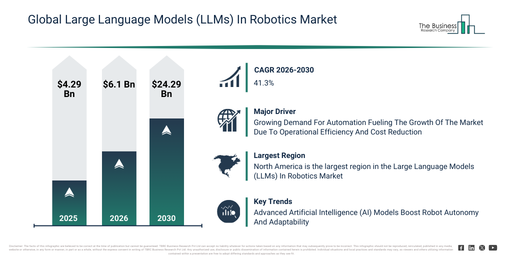
The market size for large language models (LLMs) in robotics has experienced rapid growth in recent years. It is anticipated to expand from $4.29 billion in 2025 to $6.1 billion in 2026, at a compound annual growth rate (CAGR) of 42.0%. The historical growth can be attributed to various factors, including the early adoption of robotics automation, advancements in machine learning models, the proliferation of industrial robotics, the increasing demand for intuitive robot interfaces, and the expansion of service robotics.
The market size for large language models (LLMs) in robotics is anticipated to experience substantial expansion over the upcoming years. This market is projected to reach a valuation of $24.29 billion by 2030, demonstrating a robust compound annual growth rate (CAGR) of 41.3%. This projected growth can be ascribed to several factors, including the integration of LLMs into autonomous systems, the increasing need for collaborative robots, breakthroughs in multimodal AI models, the expansion of humanoid and service robots, and escalating investment in intelligent automation. Key developments expected during this forecast period encompass natural language robot control, sophisticated cognitive robotics task planning, improved human-robot interaction, advanced multimodal perception and reasoning, and the emergence of adaptive robot learning systems.
Get A Free Sample Report With In-Depth Market Insights:
Large Language Models (LLMs) In Robotics Market Growth Factors: What’s Supporting Expansion?
The increasing need for automation is projected to boost the large language models (LLMs) in robotics market moving ahead. Automation, defined as using technology to perform tasks with minimal human intervention, enhances efficiency and accuracy. The demand for automation is growing due to the requirement for operational efficiency and cost savings, as it facilitates quicker task execution, reduces errors, and lessens reliance on manual labor. LLMs in robotics improve automation by providing intelligent language-based control, making them ideal for dynamic and complex environments. They minimize the need for manual programming by allowing robots to interpret and execute tasks from natural language commands, thus enhancing operational efficiency and flexibility. For instance, in September 2024, the International Federation of Robotics, a Germany-based non-profit organization, reported that 4,281,585 robotic units were operating in factories globally in 2023, marking a 10% increase from 3,904,000 units in 2022. Consequently, the rising demand for automation is driving the growth of the large language models (LLMs) in robotics market.
Large Language Models (LLMs) In Robotics Market Segment Outlook: Which Categories Are Growing Fastest?
The large language models (llms) in robotics market covered in this report is segmented –
1) By Functionality: Natural Language Understanding, Natural Language Generation, Speech Recognition And Synthesis, Computer Vision Integration, Multimodal Processing
2) By Deployment Mode: Cloud-Based Large Language Models (LLMs), On-Premises Large Language Models (LLMs)
3) By Enterprise Size: Large Enterprises, Small And Medium Enterprises
4) By Application: Industrial Robotics, Service Robotics, Autonomous Vehicles, Humanoid Robots, Drone Technology, Other Applications
5) By Industry: Healthcare, Manufacturing, Retail And E-Commerce, Banking, Financial Services, And Insurance, Defense And Security, Other Industries
Subsegments:
1) By Natural Language Understanding: Sentiment Analysis, Semantic Parsing, Named Entity Recognition (NER), Language Classification, Intent Recognition
2) By Natural Language Generation: Text Generation, Report Generation, Summarization, Dialogue Systems, Machine Translation
3) By Speech Recognition And Synthesis: Speech-To-Text, Speaker Identification, Text-To-Speech (TTS), Speech Emotion Recognition, Voice Command Systems
4) By Computer Vision Integration: Object Detection, Visual Simultaneous Localization And Mapping, Image Classification, Scene Understanding, Facial Recognition
5) By Multimodal Processing: Text-Image Integration, Multimodal Sentiment Analysis, Audio-Visual Processing, Video Understanding, Text-Speech Integration
Large Language Models (LLMs) In Robotics Market Industry Trends: What’s Reshaping Demand?
Major corporations operating in the large language models (LLMs) in robotics market are concentrating on developing pioneering solutions, specifically advanced artificial intelligence (AI) models, to enhance robot independence, improve human-robot interaction, and optimize the execution of tasks. An advanced AI model refers to highly developed machine learning or deep learning systems such as large language models, neural networks, or reinforcement learning algorithms that enable robots to independently analyze complex data, adapt to their surroundings, and carry out tasks with a high degree of flexibility and intelligence. For instance, in March 2025, DeepMind Technologies Limited, a UK-based software company, unveiled a Gemini Robotics AI model. This model integrates advanced vision-language-action (VLA) capabilities, allowing robots to perceive, adapt, and interact dynamically with their environment. Its advantages include generality for handling novel tasks, interactivity for real-time adaptability, and dexterity for precise manipulation, making it ideal for applications in dynamic environments like factories and homes.
Large Language Models (LLMs) In Robotics Market Leading Companies And Competitive Benchmarking
Major companies operating in the large language models (llms) in robotics market are Microsoft Corporation, Meta Platforms Inc., Amazon Web Services Inc., Tesla Inc., Hitachi Ltd., Midea Group, NVIDIA Corporation, UiPath Inc., Google DeepMind Technologies Limited, ?United Robotics Group, UBTech Robotics Corp Ltd., PAL Robotics S.L., Agility Robotics Inc., Figure AI Inc., Sanctuary Cognitive Systems Corporation, Xandex Inc., OrionStar Technology Co. Ltd, Sereact GmbH, Physical Intelligence Inc, Intrinsic Innovation LLC
View The Full Large Language Models (LLMs) In Robotics Market Report:
Large Language Models (LLMs) In Robotics Market Top Region By Revenue And Market Share
North America was the largest region in the large language models (LLMs) in robotics market in 2025. Asia-Pacific is expected to be the fastest-growing region in the forecast period. The regions covered in the large language models (llms) in robotics market report are Asia-Pacific, South East Asia, Western Europe, Eastern Europe, North America, South America, Middle East, Africa.
Reach Out To Our Team:
The Business Research Company: https://www.thebusinessresearchcompany.com/
Americas: +1 310-496-7795
Asia: +44 7882 955267 & +91 8897263534
Europe: +44 7882 955267
Email us at: marketing@tbrc.info
Follow us on:
LinkedIn: https://in.linkedin.com/company/the-business-research-company
YouTube: https://www.youtube.com/channel/UC24_fI0rV8cR5DxlCpgmyFQ
Global Market Model: https://www.thebusinessresearchcompany.com/global-market-model

Wasay has over a decade of experience in market research, data modelling, and analytics, with prior experience at GlobalData and Decision Tree Consulting Services. At The Business Research Company , he leads research operations across syndicated studies, customized consulting engagements, and the Global Market Model platform. His professional experience includes supporting organizations such as Boston Consulting Group, KPMG, and Ernst & Young. Wasay holds a degree in Electronics and Communications Engineering, postgraduate management qualifications from International Management Institute Belgium and Indian School of Business and Entrepreneurship, and completed the Integrated Program in Business Analytics from Indian Institute of Management Indore.

