Backed by market attractiveness analysis, total addressable market sizing, company benchmarking matrices, interactive Excel dashboards, wider supply chain intelligence, emerging startup coverage, and detailed product-level insights, The Business Research Company’s 2026 market reports are designed to offer research that is more actionable and strategically valuable than ever.
#Fabric Defect Detection Artificial Intelligence (AI) Market Size, Value And Growth Trajectory Through 2030#_x000D_
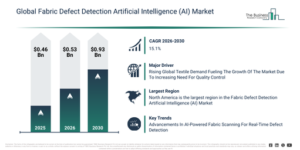
The fabric defect detection artificial intelligence (AI) market has experienced substantial expansion in recent years. This market is projected to expand from $0.46 billion in 2025 to $0.53 billion in 2026, exhibiting a compound annual growth rate (CAGR) of 15.4%. Historically, this market’s growth can be linked to factors such as increasing textile production volumes, the demand for elevated fabric quality standards, a scarcity of labor for manual inspection tasks, the growing implementation of machine vision technologies, and the necessity to reduce manufacturing waste._x000D_
_x000D_
The fabric defect detection artificial intelligence (AI) market is projected to undergo significant expansion over the next few years. This market is set to reach a value of $0.93 billion in 2030, demonstrating a compound annual growth rate (CAGR) of 15.1%. The anticipated growth during this period stems from several factors, including the increasing integration of smart factories in textiles, a rising need for premium fabrics devoid of defects, the advancement of edge computing in manufacturing, growing investments in automation within the apparel industry, and the proliferation of AI-based quality control solutions. Prominent trends for the forecast period encompass quality inspection powered by computer vision, automated real-time defect categorization, the implementation of edge AI in textile facilities, AI-driven optimization of processes for improved yield, and cloud-based systems for monitoring production lines._x000D_
_x000D_
#Get A Free Sample Report With In-Depth Market Insights:#_x000D_
_x000D_
#Fabric Defect Detection Artificial Intelligence (AI) Market Growth Drivers: What’s Behind The Acceleration?#_x000D_
The increasing demand for textiles is projected to drive the expansion of the fabric defect detection artificial intelligence (AI) market in the coming years. A textile is a material formed by weaving, knitting, or bonding fibers together to create fabric for apparel, furnishings, or other uses. The demand for textiles is escalating due to the expanding global population and urbanization, which heightens the need for clothing, home furnishings, and industrial fabrics to support evolving lifestyles and infrastructure. Fabric defect detection artificial intelligence (AI) offers benefits to the textile industry by ensuring consistent quality, as it swiftly identifies and rectifies defects, minimizes material waste, and guarantees products meet stringent consumer standards. For example, in October 2025, according to the World Trade Organization (WTO), a Switzerland-based international organization, the trade of textile products grew by 2% in 2024 compared to 2023, followed by a remarkable 7% increase in the first half of 2025 compared to the same period in 2024. Therefore, the growing textile demand is a key factor propelling the growth of the fabric defect detection artificial intelligence (AI) market._x000D_
_x000D_
#Fabric Defect Detection Artificial Intelligence (AI) Market Segment Trends And Revenue Contributors#_x000D_
The fabric defect detection artificial intelligence (AI) market covered in this report is segmented – _x000D_
_x000D_
1) By Component: Software, Hardware, Services_x000D_
2) By Deployment Mode: On-Premises, Cloud_x000D_
3) By Technology: Machine Learning, Deep Learning, Computer Vision, Other Technologies_x000D_
4) By End-User: Textile Industry, Apparel Industry, Home Furnishing, Automotive Textiles, Other End-Users_x000D_
_x000D_
Subsegments:_x000D_
1) By Software: Image Processing Software, Defect Analysis Software, Quality Control Management Software, Pattern Recognition Software, Machine Learning And AI Analytics Software_x000D_
2) By Hardware: Cameras And Imaging Sensors, Lighting Systems, Optical Scanners, Automated Inspection Machines, Edge Computing Devices_x000D_
3) By Services: Installation And Integration Services, Maintenance And Support Services, Consulting And Advisory Services, Training And Education Services, Cloud-Based Monitoring Services_x000D_
_x000D_
#Fabric Defect Detection Artificial Intelligence (AI) Market Trends: What’s Defining The Industry’s Next Phase?#_x000D_
Key companies operating within the fabric defect detection artificial intelligence (AI) market are concentrating on developing sophisticated solutions, such as fabric scanning technologies, to provide continuous real-time oversight. Fabric scanning technology involves using sensors or imaging systems to inspect textiles and automatically identify flaws or irregularities during manufacturing. For instance, in March 2024, Serkon Teknoloji Inc., a Turkey-based AI solutions provider, launched QBar.AI, an artificial intelligence fabric scanning technology capable of detecting defects on the fabric surface at the flow rate. QBar.AI captures high-resolution images of fabrics and processes them via an AI system that accurately identifies defects such as holes, stains, or weave inconsistencies across knitted, woven, and denim materials. When a defect is identified, it immediately notifies the operations team and can automatically stop the machine to prevent further production of faulty fabric. The system also marks the precise location of each imperfection, enabling quick corrective measures and reducing reliance on manual inspection. Compatible with existing production lines through Ethernet, COM port, Wi-Fi, or Bluetooth, QBar.AI exports data in multiple formats, thereby improving reporting efficiency, reducing waste, and maintaining consistent product quality._x000D_
_x000D_
#Fabric Defect Detection Artificial Intelligence (AI) Market Competitive Landscape: Which Companies Lead The Industry?#_x000D_
Major companies operating in the fabric defect detection artificial intelligence (AI) market are Keyence Corporation, Shenzhen Chaoqiang Technology Co. Ltd., BarcoVision, Zhejiang Cixing Co. Ltd., VITRONIC Machine Vision Ltd., Datacolor AG, Uster Technologies AG, Elbit Systems Ltd., Jiangsu Yingyou Textile Machinery Co. Ltd., VisionTex, Loepfe Brothers Ltd., TEXPA Maschinenbau GmbH & Co. KG, Inviya, TEXAID, Acsys Lasertechnik GmbH, Pixevia, Prowise Solutions Inc., Sensing Tex SL, Shenzhen Tailorwin Intelligent Technology Co. Ltd., Smartex. _x000D_
_x000D_
#View The Full Fabric Defect Detection Artificial Intelligence (AI) Market Report:#_x000D_
_x000D_
#Fabric Defect Detection Artificial Intelligence (AI) Market Top Region: Where Does Most Revenue Come From?#_x000D_
North America was the largest region in the fabric defect detection artificial intelligence (AI) market in 2025. Asia-Pacific is expected to be the fastest-growing region in the forecast period. The regions covered in the fabric defect detection artificial intelligence (AI) market report are Asia-Pacific, South East Asia, Western Europe, Eastern Europe, North America, South America, Middle East, Africa._x000D_
_x000D_
#Reach Out To Our Team:#_x000D_
_x000D_
The Business Research Company: https://www.thebusinessresearchcompany.com/_x000D_
Americas: +1 310-496-7795_x000D_
Asia: +44 7882 955267 & +91 8897263534_x000D_
Europe: +44 7882 955267_x000D_
Email us at: marketing@tbrc.info_x000D_
_x000D_
#Follow us on:#_x000D_
_x000D_
LinkedIn: https://in.linkedin.com/company/the-business-research-company_x000D_
YouTube: https://www.youtube.com/channel/UC24_fI0rV8cR5DxlCpgmyFQ_x000D_
Global Market Model: https://www.thebusinessresearchcompany.com/global-market-model

Wasay has over a decade of experience in market research, data modelling, and analytics, with prior experience at GlobalData and Decision Tree Consulting Services. At The Business Research Company , he leads research operations across syndicated studies, customized consulting engagements, and the Global Market Model platform. His professional experience includes supporting organizations such as Boston Consulting Group, KPMG, and Ernst & Young. Wasay holds a degree in Electronics and Communications Engineering, postgraduate management qualifications from International Management Institute Belgium and Indian School of Business and Entrepreneurship, and completed the Integrated Program in Business Analytics from Indian Institute of Management Indore.