Backed by market attractiveness analysis, total addressable market sizing, company benchmarking matrices, interactive Excel dashboards, wider supply chain intelligence, emerging startup coverage, and detailed product-level insights, The Business Research Company’s 2026 market reports are designed to offer research that is more actionable and strategically valuable than ever.
Security Automation Market Revenue Outlook: What CAGR Lies Ahead Through 2030?
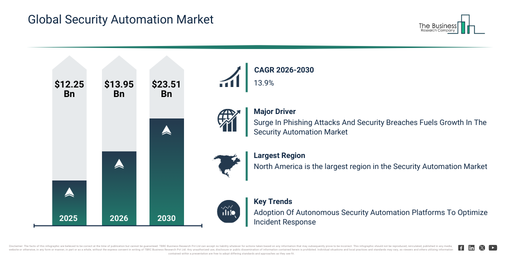
The security automation market has experienced rapid expansion recently. Projections indicate its expansion from $12.25 billion in 2025 to $13.95 billion in 2026, achieving a compound annual growth rate (CAGR) of 13.8%. Historically, this growth can be ascribed to factors such as the increasing complexity of cybersecurity workloads, the growing scarcity of proficient security personnel, the expansion of enterprise digital assets, the proliferation of security monitoring tools, and the early embrace of automation platforms.
The security automation market is poised for substantial growth over the next few years, with projections indicating it will reach $23.51 billion in 2030, driven by a compound annual growth rate (CAGR) of 13.9%. This expansion during the forecast period is fueled by increasing investments in security orchestration platforms, a rising demand for faster threat mitigation, the proliferation of autonomous security operations centers, a growing emphasis on compliance automation, and enhanced integration of security automation with DevSecOps. Prominent trends in this period include the wider adoption of automated incident response systems, increased utilization of AI-driven security orchestration, the growing integration of RPA in security operations, the expansion of continuous vulnerability management, and an enhanced focus on policy automation and compliance.
Get A Free Sample Report With In-Depth Market Insights:
Security Automation Market Growth Drivers: What’s Behind The Acceleration?
The increasing incidence of phishing attacks and security breaches is projected to drive the expansion of the security automation market in the future. Phishing attacks involve social engineering tactics often employed to obtain user data, including login information and credit card numbers. Data security breaches occur when confidential information is exposed to an insecure external setting, either for financial benefit or due to accidental errors. These incidents, encompassing both phishing and security breaches, are motivated by objectives such as financial gain, the stealing of data, identity theft, espionage, the disruption of systems, or the opportunistic leveraging of weaknesses. Security automation improves the ability to detect and respond, thereby effectively mitigating phishing attacks and managing security breaches. For example, in July 2024, the Identity Theft Resource Center, a US-based non-profit entity, documented 1,041,312,601 data breach victims in Q2 2024. This represented an astonishing 1,170 percent rise compared to Q2 2023, when there were 81,958,874 victims. Furthermore, the Information Commissioner’s Office, an independent regulatory body based in the UK, noted that phishing accounted for the largest number of victims in 2022, with 300,497 cases reported in total. Consequently, the escalating number of phishing attacks and security breaches is fueling the expansion of the security automation market.
Security Automation Market Segment Performance And Emerging Opportunities
The security automation market covered in this report is segmented –
1) By Type: Solution, Services
2) By Technology: Artificial Intelligence And Machine Learning, Predictive Analytics, Robotic Process Automation, User And Entity Behavior Analytics, Other Technologies
3) By Application: Network Security, Endpoint Security, Incident Response Management, Vulnerability Management
4) By Vertical: Banking Financial Services And Insurance, Manufacturing, Media And Entertainment, Healthcare And Life Sciences, Energy And Utilities, Government And Defense, Retail And Ecommerce, Other Verticals
Subsegments:
1) By Solution: Incident Response and Management Systems, Threat Intelligence Solutions, Security Monitoring Systems
2) By Services: Consulting Services, Installation and Integration Services, Managed Security Services, Training and Support Services, Maintenance and Upgrades
Security Automation Market Trends: What’s Defining The Industry’s Next Phase?
Major companies operating in the security automation market are focusing on developing technological advancements, such as autonomous SOAR platforms. These platforms aim for rapid threat detection and automated responses to enhance operational efficiency, reduce manual workload, and improve the security posture. An autonomous SOAR platform integrates AI-driven triage, risk-based orchestration, and codeless playbook automation, extending traditional SOAR solutions that primarily depended on manual rule creation and human-triggered playbooks. For instance, in April 2023, D3 Security, a Canada-based cybersecurity vendor, launched Smart SOAR, an innovative platform designed to streamline security operations. The product includes hundreds of prebuilt integrations, an AI-enabled event pipeline to normalize, deduplicate, and enrich alerts, codeless playbook creation, and a dedicated client portal for MSSPs to securely collaborate with clients, all aimed at closing detection gaps and enabling faster, more confident responses.
Security Automation Market Key Players: Which Companies Lead Industry Competition?
Major companies operating in the security automation market are Google LLC, Microsoft Corporation, International Business Machines Corporation, Cisco Systems Inc., VMware Inc., Palo Alto Networks Inc., Fortinet Inc., Splunk Inc., AkamAI Technologies Inc., CrowdStrike Holdings Inc., McAfee LLC, Check Point Software Technologies Ltd., Secureworks Inc., Darktrace PLC, Sumo Logic Inc., Devo Technology Inc., SentinelOne Inc., Tenable Inc., LogRhythm Inc., ManageEngine, Swimlane LLC, Anvilogic Inc., Torq Labs Inc.
View The Full Security Automation Market Report:
Security Automation Market Top Region: Where Does Most Revenue Come From?
North America was the largest region in the security automation market in 2025. The regions covered in the security automation market report are Asia-Pacific, South East Asia, Western Europe, Eastern Europe, North America, South America, Middle East, Africa.
Reach Out To Our Team:
The Business Research Company: https://www.thebusinessresearchcompany.com/
Americas: +1 310-496-7795
Asia: +44 7882 955267 & +91 8897263534
Europe: +44 7882 955267
Email us at: marketing@tbrc.info
Follow us on:
LinkedIn: https://in.linkedin.com/company/the-business-research-company
YouTube: https://www.youtube.com/channel/UC24_fI0rV8cR5DxlCpgmyFQ
Global Market Model: https://www.thebusinessresearchcompany.com/global-market-model

Wasay has over a decade of experience in market research, data modelling, and analytics, with prior experience at GlobalData and Decision Tree Consulting Services. At The Business Research Company , he leads research operations across syndicated studies, customized consulting engagements, and the Global Market Model platform. His professional experience includes supporting organizations such as Boston Consulting Group, KPMG, and Ernst & Young. Wasay holds a degree in Electronics and Communications Engineering, postgraduate management qualifications from International Management Institute Belgium and Indian School of Business and Entrepreneurship, and completed the Integrated Program in Business Analytics from Indian Institute of Management Indore.