Built to provide research that’s more actionable and strategically valuable, The Business Research Company’s 2026 market reports include market attractiveness analysis, total addressable market sizing, company benchmarking matrices, interactive Excel dashboards, broader supply chain intelligence, emerging startup tracking, and in-depth product insights.
Serverless Architecture Market Value Analysis: What Growth Lies Ahead Over The Forecast Period?
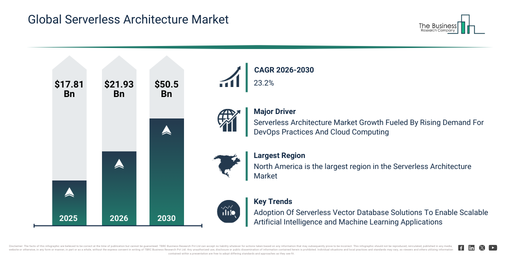
The serverless architecture market has seen substantial growth in recent years. Its value is anticipated to increase from $17.81 billion in 2025 to $21.93 billion in 2026, achieving a compound annual growth rate (CAGR) of 23.1%. This historical expansion can be attributed to several factors, including the rapid adoption of cloud computing, the spread of web and mobile applications, an increasing need for scalable infrastructure, the availability of managed cloud services, and the development of microservices architectures.
The serverless architecture market size is anticipated to experience significant expansion in the coming years. It is projected to reach $50.5 billion in 2030 at a compound annual growth rate (CAGR) of 23.2%. The increase foreseen in this period stems from factors such as the rising adoption of serverless frameworks, an increased emphasis on application modernization, the expanding requirements for real-time data processing, a growing need for agile development environments, and increased investments in cloud-native security. Key trends for the forecast period include the expanding acceptance of event-driven application models, a greater reliance on API-centric development, a burgeoning demand for scalable cloud-native applications, the broadening of IoT backend serverless deployments, and an enhanced focus on cost-optimized computing.
Get A Free Sample Report With In-Depth Market Insights:
Serverless Architecture Market Opportunity Drivers: What’s Unlocking New Revenue Potential?
The expanding demand for serverless computing within DevOps methodologies is anticipated to drive forward the serverless architecture market. Serverless computing represents a cloud paradigm where developers can build and deploy applications utilizing infrastructure managed externally, thereby removing worries related to capacity planning, configuration, management, maintenance, fault tolerance, or the scaling of containers, virtual machines (VMs), or physical servers. This approach significantly boosts DevOps practices through capabilities like automatic scaling, reduced operational intricacy, and accelerated deployment of microservices. For example, in January 2024, AAG IT, a UK-based IT services company, reported that Infrastructure as a Service (IaaS) revenues grew by 29.7%, reaching $120.3 billion in 2022. Additionally, more than 98% of organizations are currently using cloud services, including SaaS applications and fully cloud-native networks. Forecasts also show a 23% increase in cloud infrastructure spending for 2023. Consequently, the increasing requirement for serverless computing within DevOps practices is propelling the expansion of the serverless architecture market.
Serverless Architecture Market Segments: Where Is Growth Concentrated?
The serverless architecture market covered in this report is segmented –
1) By Service: Automation And Integration, Application Programming Interfaces (APIs) Management, Monitoring, Security, Support And Maintenance, Training And Consulting, Other Services
2) By Deployment Model: Public Cloud, Private Cloud, Hybrid Cloud
3) By Organization: Large Enterprise, Small And Medium-Sized Enterprises (SMEs)
4) By Application: Real-Time File And Stream Processing, Web Application Development, IoT Backend
5) By Vertical: Information Technology (IT) And Telecommunications, Banking, Financial Services And Insurance (BFSI), Retail, Healthcare, Government, Manufacturing, Media And Entertainment, Other Verticals
Subsegments:
1) By Automation And Integration: Workflow Automation, Event-Driven Automation
2) By Application Programming Interfaces (APIs) Management: API Gateway Services, API Lifecycle Management
3) By Monitoring: Performance Monitoring, Logging and Analytics
4) By Security: Access Control, Data Encryption
5) By Support And Maintenance: Technical Support, System Updates
6) By Training And Consulting: Implementation Consulting, Best Practices Training
7) By Other Services: Custom Development, Migration Services
Serverless Architecture Market Innovation Trends Shaping Future Development
Leading firms within the serverless architecture market are concentrating on creating innovative technologies, including serverless vector-database platforms, designed to support scalable, cost-effective, and real-time artificial intelligence and machine learning applications. Such platforms eliminate the need for server infrastructure management, covering aspects like provisioning, scaling, and upkeep, thereby allowing developers to dedicate their efforts solely to application logic and incur costs only for actual resource usage, a stark contrast to conventional server- or VM-based databases which demand hands-on capacity planning. An example of this trend is seen in January 2024, when Pinecone Systems Inc., a US-based vector-database company, introduced Pinecone Serverless, a new serverless vector-database platform. This offering enhances cost efficiency by decoupling compute and storage, facilitates extensive vector clustering and rapid data retrieval, offers a multi-tenant design, and ensures compatibility with artificial intelligence and machine learning tools such as LangChain, Anthropic, and Cohere, thereby empowering developers to accelerate the creation of knowledge-centric applications and lower operational expenses.
Serverless Architecture Market Key Participants And Competitive Landscape
Major companies operating in the serverless architecture market are Google LLC, Microsoft Corporation, Amazon Web Services Inc., International Business Machines Corporation, Cisco Systems Inc., Oracle Corporation, Broadcom Inc., Salesforce.com Inc, NTT Data Corporation, VMware Inc, Alibaba Cloud, Palo Alto Networks Inc, Twilio Inc, Red Hat Inc, Rackspace Technology Inc, Tibco Software, Cloudflare Inc, Dynatrace Inc., Auth0 Inc, Joyent Inc, Spotinst Ltd, Fiorano Software Inc., Platform9 Systems Inc, PubNub Inc, Iron.io Inc, Nimbella Corporation, Stackery Inc, OpenLegacy Inc
View The Full Serverless Architecture Market Report:
Serverless Architecture Market Largest Region: Which Geography Holds The Biggest Share?
North America was the largest region in the serverless architecture market in 2025. Asia-Pacific is expected to be the fastest-growing region in the forecast period. The regions covered in the serverless architecture market report are Asia-Pacific, South East Asia, Western Europe, Eastern Europe, North America, South America, Middle East, Africa.
Reach Out To Our Team:
The Business Research Company: https://www.thebusinessresearchcompany.com/
Americas: +1 310-496-7795
Asia: +44 7882 955267 & +91 8897263534
Europe: +44 7882 955267
Email us at: marketing@tbrc.info
Follow us on:
LinkedIn: https://in.linkedin.com/company/the-business-research-company
YouTube: https://www.youtube.com/channel/UC24_fI0rV8cR5DxlCpgmyFQ
Global Market Model: https://www.thebusinessresearchcompany.com/global-market-model

Wasay has over a decade of experience in market research, data modelling, and analytics, with prior experience at GlobalData and Decision Tree Consulting Services. At The Business Research Company , he leads research operations across syndicated studies, customized consulting engagements, and the Global Market Model platform. His professional experience includes supporting organizations such as Boston Consulting Group, KPMG, and Ernst & Young. Wasay holds a degree in Electronics and Communications Engineering, postgraduate management qualifications from International Management Institute Belgium and Indian School of Business and Entrepreneurship, and completed the Integrated Program in Business Analytics from Indian Institute of Management Indore.