Backed by market attractiveness analysis, total addressable market sizing, company benchmarking matrices, interactive Excel dashboards, wider supply chain intelligence, emerging startup coverage, and detailed product-level insights, The Business Research Company’s 2026 market reports are designed to offer research that is more actionable and strategically valuable than ever.
Software Development AI Market Growth Analysis: How Will Revenue Trend Over The Forecast Period?
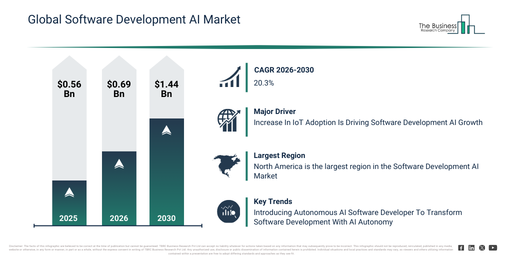
The market size for software development AI has seen substantial growth in recent times. Projections indicate it will expand from $0.56 billion in 2025 to $0.69 billion in 2026, achieving a compound annual growth rate (CAGR) of 24.1%. Historically, this growth has stemmed from factors such as the increasing intricacy of software applications, a broader embrace of agile development methods, the proliferation of cloud-native application development, a heightened dependence on automation in software testing, and the escalating need for quicker development cycles.
The software development AI market is anticipated to experience significant growth in the upcoming years, with its size projected to reach $1.44 billion in 2030, demonstrating a compound annual growth rate (CAGR) of 20.3%. This expansion over the forecast period is primarily fueled by the increasing embrace of generative AI models, augmented investments in AI-driven DevOps platforms, the broadening of low-code and no-code development environments, an intensified focus on intelligent software lifecycle management, and the rising demand for scalable AI development tools. Key trends expected during this timeframe include the heightened adoption of AI-assisted code generation, increased utilization of automated bug detection systems, expanding integration of AI in project management tools, the broadening of predictive software quality analytics, and a strengthened emphasis on optimizing developer productivity.
Get A Free Sample Report With In-Depth Market Insights:
Software Development AI Market Growth Drivers: What’s Behind The Acceleration?
The increasing integration of the Internet of Things (IoT) is anticipated to stimulate the expansion of the software development AI market in the future. The Internet of Things (IoT) defines a vast network of physical objects and various items embedded with sensors, software, and other advanced technologies, allowing them to connect and share data with other devices and systems via the Internet. The rapid increase in IoT adoption can be attributed to its capability to boost operational efficiency, elevate user convenience, and facilitate data-driven strategic choices across numerous industries. IoT significantly bolsters software development by enabling immediate data collection and subsequent analysis, thereby fostering the creation of more intelligent and responsive applications. Concurrently, AI enhances software development processes by automating routine tasks, refining algorithms, and improving decision-making capabilities, which collectively drive greater efficiency and innovation. For example, in September 2023, a report published by Telefonaktiebolaget LM Ericsson, a telecommunications company based in Sweden, revealed that global IoT connections had reached 15.7 billion connections in 2023 and are forecast to increase by 16% to 38.9 billion connections by 2029. Thus, the escalating adoption of the Internet of Things (IoT) is actively propelling the growth of the software development AI market.
Software Development AI Market Segments: Where Is Growth Concentrated?
The software development AI market covered in this report is segmented –
1) By Programming Languages: Python, R, Lisp, Prolog, Java, Other Programming Languages
2) By Approaches: Natural Language Processing Techniques, Neural Networks, Fuzzy Logic, Ant Colony Optimization (ACO), General Algorithm, Tabu Search, Bee Colony, Data Mining, Other Approaches
3) By Development Phases: Planning, Knowledge Acquisition And Analysis, System Evaluation
4) By Application: Expert System, Project Management, Other Applications
Subsegments:
1) By Python: AI Libraries (TensorFlow, PyTorch, Keras), Machine Learning Frameworks, Deep Learning Models
2) By R: Statistical Computing Libraries, Data Analysis Tools, Machine Learning And Predictive Modeling Libraries
3) By Lisp: Symbolic AI Applications, Expert Systems, AI Algorithms
4) By Prolog: Logic Programming For AI, Knowledge Representation Systems, Rule-Based Systems
5) By Java: AI And Machine Learning Libraries (Deeplearning4j, Weka), Natural Language Processing (NLP) Tools, Predictive Analytics Models
6) By Other Programming Languages: C++ For AI (Computer Vision), JavaScript For AI (TensorFlow.js), Julia For High-Performance AI, MATLAB For Data Science And AI
Software Development AI Market Trends: What’s Defining The Industry’s Next Phase?
Major companies in the software development AI market are concentrating on developing innovative solutions, such as autonomous AI software developers, to gain a competitive edge. An autonomous AI software developer is a software tool or system that uses artificial intelligence (AI) and machine learning (ML) technologies to automate the creation, design, or development of other AI-based software applications or solutions. For instance, in March 2024, Microsoft Corporation, a US-based technology company, launched AutoDev, an autonomous AI-driven software development framework that integrates artificial intelligence (AI) into various tasks like code generation, testing, and version control operations. It offers customizable prompts, automates test case generation, enhances code quality, and fosters collaboration among AI agents. AutoDev aims to streamline software development processes, ensure security through Docker container encapsulation, and achieve high success rates in automating software engineering tasks.
Software Development AI Market Key Participants And Competitive Landscape
Major companies operating in the software development AI market are Amazon.com Inc., Apple Inc., Alphabet Inc., Microsoft Corporation, Meta Platforms Inc., Intel Corporation, International Business Machines Corporation, SAP SE, NVIDIA Corporation, Salesforce.com Inc., Talentica Solutions Pvt. Ltd, LeewayHertz Technologies Pvt. Ltd, eSparkBiz Technologies Pvt. Ltd, InData Labs LLC, AIBrain Inc., Markovate Inc., Azumo LLC, Nettyfy Technologies Pvt. Ltd, Div-idy, Lovable, Qodo, Tech JDI, Softlabs Group, Appinventiv, Simform
View The Full Software Development AI Market Report:
Software Development AI Market Regional Analysis: Which Geography Leads On Revenue?
North America was the largest region in the software development AI market in 2025. Asia-Pacific is expected to be the fastest-growing region in the forecast period. The regions covered in the software development AI market report are Asia-Pacific, South East Asia, Western Europe, Eastern Europe, North America, South America, Middle East, Africa.
Reach Out To Our Team:
The Business Research Company: https://www.thebusinessresearchcompany.com/
Americas: +1 310-496-7795
Asia: +44 7882 955267 & +91 8897263534
Europe: +44 7882 955267
Email us at: marketing@tbrc.info
Follow us on:
LinkedIn: https://in.linkedin.com/company/the-business-research-company
YouTube: https://www.youtube.com/channel/UC24_fI0rV8cR5DxlCpgmyFQ
Global Market Model: https://www.thebusinessresearchcompany.com/global-market-model

Wasay has over a decade of experience in market research, data modelling, and analytics, with prior experience at GlobalData and Decision Tree Consulting Services. At The Business Research Company , he leads research operations across syndicated studies, customized consulting engagements, and the Global Market Model platform. His professional experience includes supporting organizations such as Boston Consulting Group, KPMG, and Ernst & Young. Wasay holds a degree in Electronics and Communications Engineering, postgraduate management qualifications from International Management Institute Belgium and Indian School of Business and Entrepreneurship, and completed the Integrated Program in Business Analytics from Indian Institute of Management Indore.