Backed by market attractiveness analysis, total addressable market sizing, company benchmarking matrices, interactive Excel dashboards, wider supply chain intelligence, emerging startup coverage, and detailed product-level insights, The Business Research Company’s 2026 market reports are designed to offer research that is more actionable and strategically valuable than ever.
Optical Wireless Backhaul Market Forecast: Value Set To Climb From $1.58 Billion To $3.13 Billion
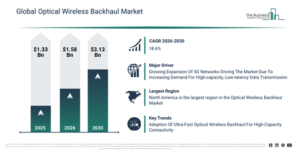
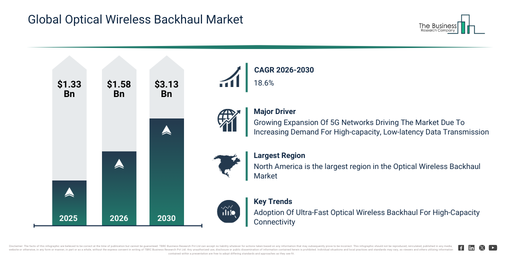
The optical wireless backhaul market has witnessed significant expansion in recent years. It is anticipated to grow from $1.33 billion in 2025 to $1.58 billion in 2026, exhibiting a compound annual growth rate (CAGR) of 18.7%. The historical development of this market is linked to challenges in deploying fiber in congested urban environments, the increasing volume of mobile data traffic, the necessity for quick network implementation, the considerable expenses of trenching and securing right-of-way approvals, and the integration of free-space optics for business connections.
The optical wireless backhaul market is projected to experience substantial expansion in the coming years. Its valuation is anticipated to reach $3.13 billion by 2030, demonstrating a compound annual growth rate (CAGR) of 18.6%. This anticipated expansion over the forecast period is driven by factors such as the proliferation of 5G and upcoming 6G networks, the rising need for ultra-high-capacity backhaul solutions, the development of smart cities and interconnected infrastructure, implementation in remote and underprivileged areas, and breakthroughs in optical beam tracking technologies. Key developments expected during this timeframe encompass the swift rollout of fiber-like backhaul, high-capacity line-of-sight connections, flexible beam steering and alignment mechanisms, optical wireless links resilient to adverse weather, and adaptable last-mile backhaul options.
Get A Free Sample Report With In-Depth Market Insights:
Optical Wireless Backhaul Market Growth Drivers: What’s Behind The Acceleration?
The increasing proliferation of 5G networks is anticipated to boost the expansion of the optical wireless backhaul market in the future. 5G networks, the fifth generation of wireless cellular technology, are engineered to provide substantially quicker data rates, reduced latency, and improved connectivity for numerous devices concurrently. This growth in 5G network deployment largely stems from the sharp rise in mobile data usage, fueled by popular activities such as video streaming, cloud gaming, and various mobile applications that require greater speeds and bandwidth. Optical wireless backhaul facilitates this expansion through its capability for high-capacity, low-latency data transmission, which is crucial for fulfilling the dense and high-speed demands inherent in 5G networks. As an illustration, in September 2023, data from 5G Americas, a US-based industry trade organization, revealed that the 5G penetration rate in North America had hit 40%, exhibiting a growth rate of 25.5% during the first half of 2023. Forecasts suggest that 5G connections across North America will amount to 669 million by 2028. Consequently, the increasing rollout of 5G networks is projected to significantly contribute to the development of the optical wireless backhaul market.
Optical Wireless Backhaul Market Segments: Where Is Growth Concentrated?
The optical wireless backhaul market covered in this report is segmented –
1) By Component: Transmitter, Receiver, Modulator, Demodulator, Other Components
2) By Transmission Type: Free Space Optics, Visible Light Communication, Infrared Communication, Other Transmission Types
3) By Deployment: Urban, Suburban, Rural
4) By Application: Telecommunications, Enterprise, Government, Defense, Other Applications
Subsegments:
1) By Transmitter: Laser Diode, Light Emitting Diode (LED), Optical Amplifier, Beam Steering Unit
2) By Receiver: Photodiode, Optical Filter, Optical Amplifier, Signal Conditioning Circuit
3) By Modulator: Electro-Optic Modulator, Acousto-Optic Modulator, Mach–Zehnder Modulator, Phase Or Intensity Modulator
4) By Demodulator: Coherent Demodulator, Direct Detection Demodulator, Heterodyne Demodulator, Digital Signal Processing (DSP) Unit
5) By Other Components: Optical Fiber Patch Or Connector, Beam Alignment And Tracking System, Cooling And Thermal Management Unit, Power Supply And Control Electronics
Optical Wireless Backhaul Market Trends: What’s Defining The Industry’s Next Phase?
Leading firms within the optical wireless backhaul market are concentrating on technological innovations, such as advanced high-capacity optical wireless links, to boost data transmission capabilities, minimize interference, and provide effective backhaul solutions for congested network settings. High-capacity optical wireless links are defined as direct communication pathways that transmit data through open air using lasers or LEDs, achieving speeds comparable to fiber optics without requiring physical cables, though their efficiency is dependent on maintaining an unobstructed line-of-sight. For example, in June 2024, Lumeova Inc., a US-based photonics company, introduced WiRays, engineered to deliver wireless data rates up to 100 gigabits per second, facilitating low-latency point-to-point connections and seamless integration of compact photonic hardware. This product enhances network deployment possibilities by offering resilient transmission against interference and efficient backhaul for both urban and private networks, although consideration of environmental factors and line-of-sight requirements is necessary for optimal functioning. WiRays further improves installation versatility through its lightweight, modular architecture, enabling relatively swift setup across appropriate site conditions.
Optical Wireless Backhaul Market Key Participants And Competitive Landscape
Major companies operating in the optical wireless backhaul market are Huawei Technologies Company Limited, Mitsubishi Electric Corporation, Fujitsu Limited, Telefonaktiebolaget LM Ericsson, NEC Corporation, ZTE Corporation, Aviat Networks Inc., Ceragon Networks Limited, Intracom Telecom Holdings S.A., Radwin Ltd., SIAE Microelettronica S.p.A., Cambium Networks Ltd., Skyloom Inc., Plaintree Systems Inc., CableFree Ltd., Mostcom Ltd., Transcelestial Pte. Ltd., Attochron Inc., Taara Corporation, KORUZA Ltd.
View The Full Optical Wireless Backhaul Market Report:
Optical Wireless Backhaul Market Geographic Analysis: Where Is Demand Rising Fastest?
North America was the largest region in the optical wireless backhaul market in 2025. Asia-Pacific is expected to be the fastest-growing region in the forecast period. The regions covered in the optical wireless backhaul market report are Asia-Pacific, South East Asia, Western Europe, Eastern Europe, North America, South America, Middle East, Africa.
Reach Out To Our Team:
The Business Research Company: https://www.thebusinessresearchcompany.com/
Americas: +1 310-496-7795
Asia: +44 7882 955267 & +91 8897263534
Europe: +44 7882 955267
Email us at: marketing@tbrc.info
Follow us on:
LinkedIn: https://in.linkedin.com/company/the-business-research-company
YouTube: https://www.youtube.com/channel/UC24_fI0rV8cR5DxlCpgmyFQ
Global Market Model: https://www.thebusinessresearchcompany.com/global-market-model

Wasay has over a decade of experience in market research, data modelling, and analytics, with prior experience at GlobalData and Decision Tree Consulting Services. At The Business Research Company , he leads research operations across syndicated studies, customized consulting engagements, and the Global Market Model platform. His professional experience includes supporting organizations such as Boston Consulting Group, KPMG, and Ernst & Young. Wasay holds a degree in Electronics and Communications Engineering, postgraduate management qualifications from International Management Institute Belgium and Indian School of Business and Entrepreneurship, and completed the Integrated Program in Business Analytics from Indian Institute of Management Indore.