Backed by market attractiveness analysis, total addressable market sizing, company benchmarking matrices, interactive Excel dashboards, wider supply chain intelligence, emerging startup coverage, and detailed product-level insights, The Business Research Company’s 2026 market reports are designed to offer research that is more actionable and strategically valuable than ever.
Second Generation Biofuels Market Size Outlook: How Quickly Will Revenue Expand Through 2030?
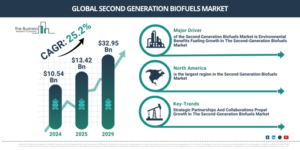
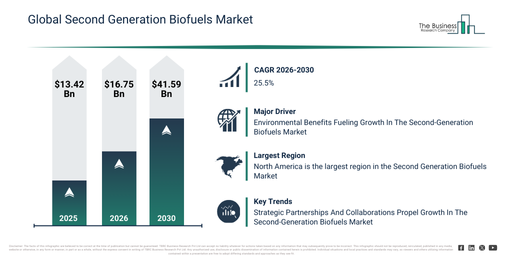
The second generation biofuels market has shown significant expansion in recent years. Its size is projected to increase from $13.42 billion in 2025 to $16.75 billion in 2026, demonstrating a compound annual growth rate (CAGR) of 24.8%. Historically, this market growth has been propelled by factors including concerns regarding food-based biofuels, the implementation of environmental regulations, government mandates for biofuel use, the availability of agricultural residues, and ongoing research in biofuel technologies.
The second generation biofuels market size is projected to experience substantial growth in the coming years. It is expected to expand to $41.59 billion by 2030, achieving a compound annual growth rate (CAGR) of 25.5%. This growth during the forecast period is primarily fueled by net zero emission targets, the rising demand for sustainable fuels, advancements in conversion efficiency, the expansion of renewable energy policies, and increased investments in bio-refineries. Significant trends anticipated for this period include the growing use of non-food feedstocks, an increase in cellulosic ethanol production, the proliferation of advanced biodiesel technologies, a heightened focus on low carbon fuels, and the scaling up of thermochemical conversion processes.
Get A Free Sample Report With In-Depth Market Insights:
Second Generation Biofuels Market Demand Drivers Opening New Revenue Streams
The increased consumption of biofuels, driven by their environmental advantages, is projected to stimulate the expansion of the second-generation biofuels market. Biofuel is defined as any liquid fuel produced from biological materials, including trees, agricultural residue, various crops, or grasses. The uptake of biofuels is growing due to their substantial capacity to reduce greenhouse gas emissions when compared to fossil fuels, thereby assisting governments and industries in meeting climate change mitigation and carbon reduction targets more effectively. Second-generation biofuels, derived from non-food biomass like agricultural residues, forestry waste, and dedicated energy crops, facilitate broader biofuel adoption by minimizing competition with food resources, reducing greenhouse gas emissions, and presenting a more sustainable and scalable option compared to first-generation biofuels. For instance, in October 2025, according to U.S. Energy Information Administration (EIA), US-based government agency, renewable diesel and other biofuels production capacity increased just 391 million gallons per year (gal/y) in 2024. Thus, the extensive utilization of biofuels for their ecological benefits is driving the growth of the second-generation biofuels market.
Second Generation Biofuels Market Segment Outlook: Which Categories Are Growing Fastest?
The second generation biofuels market covered in this report is segmented –
1) By Type: Cellulosic Ethanol, Biodiesel, Bio Butanol, Bio Dimethylether (DME), Other Types
2) By Process: Biochemical Process, Thermochemical Process
3) By Feedstock: Simple Lignocellulose, Complex Lignocellulose, Syngas, Algae, Other Feedstocks
4) By Application: Transportation, Power Generation, Other Applications
Subsegments:
1) By Cellulosic Ethanol: Acid Hydrolysis Ethanol, Enzymatic Hydrolysis Ethanol
2) By Biodiesel: Transesterification Biodiesel, Non-Transesterified Biodiesel
3) By Bio Butanol: ABE (Acetone-Butanol-Ethanol) Fermentation, Other Production Methods
4) By Bio Dimethylether (DME): Methanol-Derived DME, Gasification-Derived DME
5) By Other Types: Renewable Jet Fuel, Biogas, Algal Biofuels
Second Generation Biofuels Market Trends Powering Strategic Industry Growth
Key entities active within the second-generation biofuels market are prioritizing strategic partnerships and collaborations to bolster their market standing and propel sustainable fuel production. Such strategic alliances and joint ventures involve agreements between companies to combine their expertise, resources, and technology, thereby facilitating the expedited development and implementation of second-generation biofuels. An illustrative instance is in April 2023, when Compañía Española de Petróleos S.A. (CEPSA), a Spain-based oil and gas company, joined forces with Bio-Oils Huelva S.L.U., a Spain-based biodiesel manufacturer. This partnership resulted in a joint venture focused on advancing second-generation biofuels through the construction of the largest 2G biofuel production plant in southern Europe, which will feature extensive processing capacity, utilize non-food feedstocks, and achieve significantly reduced lifecycle carbon emissions.
Second Generation Biofuels Market Competitive Landscape: Which Companies Lead The Industry?
Major companies operating in the second generation biofuels market are TotalEnergies SE, Reliance Industries Limited, INEOS Group Limited, The Andersons Inc., International Flavors & Fragrances Inc., Darling Ingredients Inc, DuPont Nutrition Biosciences ApS, Green Plains Inc, Flint Hills Resources LLC, Gevo Inc., Abengoa S.A., POET LLC, ICM Inc., Enerkem Inc., Advanced Enzyme Technologies Limited, Fulcrum BioEnergy Inc., LanzaTech Inc, Virent Energy Systems Inc., GranBio LLC, Algenol Biofuels Inc., Novamont S.p.A., Edeniq Inc., Mascoma Corporation, BlueFire Renewables Inc, Fiberight LLC., Clariant AG, Raizen S.A., Copersucar SA, Beta Renewables S.p.A., EcoCeres Inc.
View The Full Second Generation Biofuels Market Report:
Second Generation Biofuels Market Regional Breakdown: Where Is Demand Concentrated?
North America was the largest region in the second-generation biofuels market in 2025. Asia-Pacific is expected to be the fastest-growing region in the forecast period. The regions covered in the second generation biofuels market report are Asia-Pacific, South East Asia, Western Europe, Eastern Europe, North America, South America, Middle East, Africa.
Reach Out To Our Team:
The Business Research Company: https://www.thebusinessresearchcompany.com/
Americas: +1 310-496-7795
Asia: +44 7882 955267 & +91 8897263534
Europe: +44 7882 955267
Email us at: marketing@tbrc.info
Follow us on:
LinkedIn: https://in.linkedin.com/company/the-business-research-company
YouTube: https://www.youtube.com/channel/UC24_fI0rV8cR5DxlCpgmyFQ
Global Market Model: https://www.thebusinessresearchcompany.com/global-market-model

Wasay has over a decade of experience in market research, data modelling, and analytics, with prior experience at GlobalData and Decision Tree Consulting Services. At The Business Research Company , he leads research operations across syndicated studies, customized consulting engagements, and the Global Market Model platform. His professional experience includes supporting organizations such as Boston Consulting Group, KPMG, and Ernst & Young. Wasay holds a degree in Electronics and Communications Engineering, postgraduate management qualifications from International Management Institute Belgium and Indian School of Business and Entrepreneurship, and completed the Integrated Program in Business Analytics from Indian Institute of Management Indore.