
Backed by market attractiveness analysis, total addressable market sizing, company benchmarking matrices, interactive Excel dashboards, wider supply chain intelligence, emerging startup coverage, and detailed product-level insights, The Business Research Company’s 2026 market reports are designed to offer research that is more actionable and strategically valuable than ever.
Second-Hand Product Market Value Analysis: What Growth Lies Ahead Over The Forecast Period?
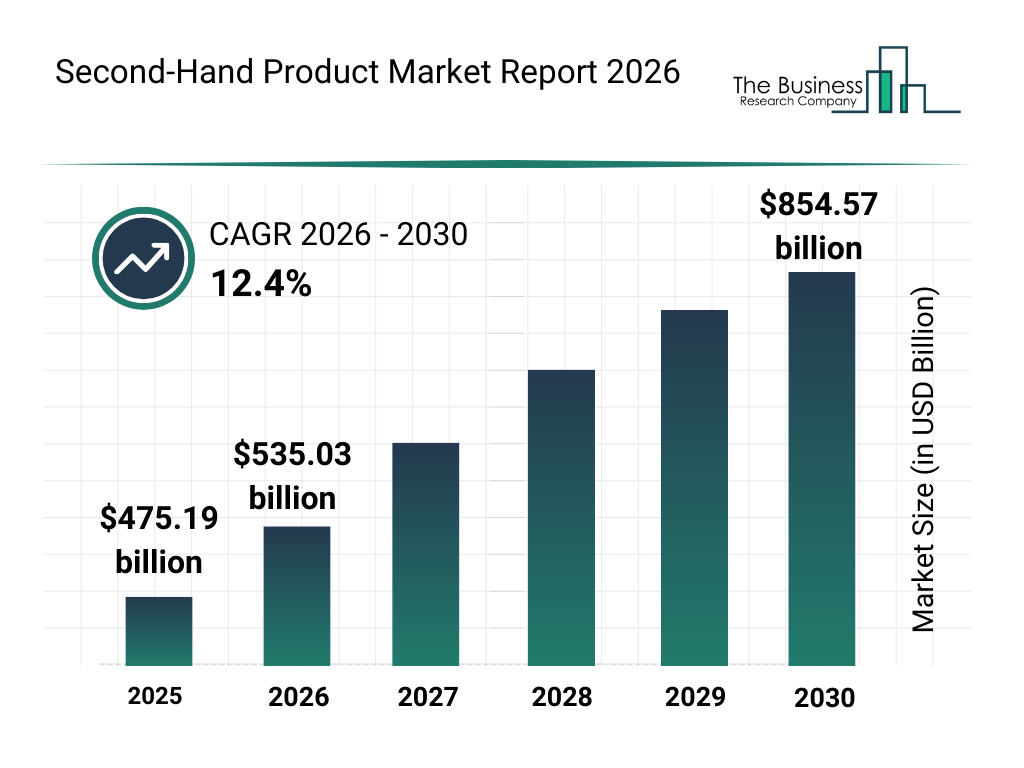
The second-hand product market size has seen rapid expansion in recent years. It is projected to grow from $475.19 billion in 2025 to $535.03 billion in 2026, demonstrating a compound annual growth rate (CAGR) of 12.6%. Historically, this growth can be attributed to factors such as a developing thrift culture, limited e-commerce penetration, the high cost of new products, increased urbanization, and the absence of organized resale platforms.
The second-hand product market is anticipated to experience substantial growth over the next few years. It is projected to achieve a value of $854.57 billion by 2030, demonstrating a compound annual growth rate (CAGR) of 12.4%. This expansion during the forecast period can be attributed to factors like increased internet and smartphone penetration, growing awareness regarding sustainability, the rise of mobile commerce, advancements in product authentication technology, and the broadening of logistics and delivery networks. Prominent trends for this period include the emergence of peer-to-peer marketplaces, an increase in product refurbishment services, heightened consumer awareness of eco-friendly selections, the expansion of online resale platforms, and the integration of mobile payment solutions.
Get A Free Sample Report With In-Depth Market Insights:
Second-Hand Product Market Demand Drivers: What’s Powering Industry Growth?
The expanding presence of e-commerce platforms is anticipated to stimulate the future expansion of the second-hand product market. These platforms serve as internet-based systems, allowing both businesses and customers to engage in buying and selling goods or services online, thereby streamlining transactions and managing virtual shops. The wider availability of e-commerce platforms stems from technological progress, which simplifies the process for companies to access international customers and for shoppers to purchase items with ease online. Specifically for second-hand products, e-commerce enables consumers to effortlessly trade pre-owned goods online, enhancing accessibility to economical products and fostering sustainable practices. For example, data released in February 2024 by the US-based government department, the Census Bureau of the Department of Commerce, indicated that e-commerce sales saw a significant rise of 7.5% in the fourth quarter of 2023 when juxtaposed with the corresponding period in 2022. Consequently, the growing prevalence of e-commerce platforms is a key factor propelling the expansion of the second-hand product market.
Second-Hand Product Market Segment Outlook: Which Categories Are Growing Fastest?
The second-hand product market covered in this report is segmented –
1) By Product: Furniture, Clothing, Vehicles, Electronics, Sporting Goods, Other Products
2) By Price: Mid-Range Segment, High-End Segment
3) By Distribution Channel: Online, Offline
4) By Application: Commercial, Recreational, Residential, Other Applications
5) By End Users: Individuals, Businesses, Institutions
Subsegments:
1) By Furniture: Living Room Furniture, Bedroom Furniture, Office Furniture, Outdoor Furniture
2) By Clothing: Men’s Apparel, Women’s Apparel, Children’s Clothing, Footwear, Accessories
3) By Vehicles: Cars, Motorcycles, Bicycles, Commercial Vehicles
4) By Electronics: Smartphones And Tablets, Laptops And Computers, Home Appliances, Audio And Video Equipment, Wearable Technology
5) By Sporting Goods: Fitness Equipment, Bicycles And Accessories, Sports Apparel, Outdoor Recreation Gear
6) By Other Products: Books, Toys And Games, Musical Instruments, Home Décor And Kitchenware
Second-Hand Product Market Innovation Trends: What Developments Are Reshaping The Industry?
Leading businesses in the second-hand product market are concentrating on developing innovative services, such as platforms for used clothing, to attract eco-conscious shoppers and meet the growing demand for sustainable fashion options. Second-hand clothing platforms are digital or physical venues where individuals can acquire and offload pre-owned garments. For example, in September 2023, Zara, a fast fashion company based in Spain, rolled out its pre-owned platform in France. This initiative allows customers to sell, mend, or contribute second-hand clothing through Zara’s physical outlets, website, and mobile application. The platform, branded Zara Pre-Owned, builds upon the success of its debut in the UK and aims to encourage circular fashion practices by extending the longevity of clothing items and lessening waste. Customers are provided with a clothing repair service, an online marketplace for buying and selling previously owned Zara products, and a home collection service for donating apparel.
Second-Hand Product Market Leading Companies And Competitive Benchmarking
Major companies operating in the second-hand product market are Amazon.com Inc., Apple Inc., Samsung Electronics Co Ltd, Microsoft Corporation, Robert Bosch GmbH, HP Inc., Audi AG, Inter IKEA Systems B.V., Adidas AG, eBay Inc., Rolex Watch U.S.A. Inc., Levi Strauss & Co., Tiffany & Co., Eileen Fisher Inc., Nudie Jeans, Patagonia Inc., Breitling, Mud Jeans, Luxclusif, Madewel
View The Full Second-Hand Product Market Report:
Second-Hand Product Market Largest Region By Revenue And Market Share
North America was the largest region in the second-hand product market in 2025. Asia-Pacific is expected to be the fastest-growing region in the forecast period. The regions covered in the second-hand product market report are Asia-Pacific, South East Asia, Western Europe, Eastern Europe, North America, South America, Middle East and Africa.
Reach Out To Our Team:
The Business Research Company: https://www.thebusinessresearchcompany.com/
Americas: +1 310-496-7795
Asia: +44 7882 955267 & +91 8897263534
Europe: +44 7882 955267
Email us at: marketing@tbrc.info
Follow us on:
LinkedIn: https://in.linkedin.com/company/the-business-research-company
YouTube: https://www.youtube.com/channel/UC24_fI0rV8cR5DxlCpgmyFQ
Global Market Model: https://www.thebusinessresearchcompany.com/global-market-model

Wasay has over a decade of experience in market research, data modelling, and analytics, with prior experience at GlobalData and Decision Tree Consulting Services. At The Business Research Company , he leads research operations across syndicated studies, customized consulting engagements, and the Global Market Model platform. His professional experience includes supporting organizations such as Boston Consulting Group, KPMG, and Ernst & Young. Wasay holds a degree in Electronics and Communications Engineering, postgraduate management qualifications from International Management Institute Belgium and Indian School of Business and Entrepreneurship, and completed the Integrated Program in Business Analytics from Indian Institute of Management Indore.