Featuring market attractiveness scoring, total addressable market sizing, company benchmarking matrices, interactive Excel dashboards, deeper supply chain intelligence, emerging startup tracking, and granular product-level insights, The Business Research Company’s 2026 market reports are built to deliver research that is both more actionable and more strategically valuable.
Fire Resistant Fabrics Market Revenue Outlook: What CAGR Lies Ahead Through 2030?
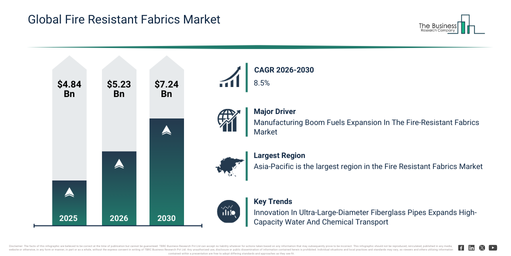
The market for fire resistant fabrics has shown robust growth over the past few years. Projections indicate that its size will increase from $4.84 billion in 2025 to $5.23 billion in 2026, demonstrating a compound annual growth rate (CAGR) of 8.1%. Historically, this growth has been driven by factors such as stricter industrial safety regulations, the expansion of firefighting and emergency services, a rise in the use of fire-resistant materials within the construction sector, increased expenditures in defense and public safety, and advancements in textile manufacturing technologies.
The fire resistant fabrics market is projected for substantial expansion in the coming years. This market is anticipated to reach $7.24 billion in 2030, achieving a compound annual growth rate (CAGR) of 8.5%. Key factors contributing to this growth during the forecast period include the escalating demand for lightweight yet durable protective fabrics, a surge in investments towards smart and multifunctional textiles, the broader implementation of fire safety standards across various sectors, the increasing uptake of sustainable fire-resistant materials, and the expanded application of advanced fiber processing techniques. Significant trends anticipated in this period encompass a heightened demand for sophisticated protective apparel materials, an uptick in the adoption of aramid and other high-performance fibers, the expanding application of fire-resistant textiles within industrial environments, a wider reach of flame-retardant solutions for home furnishing, and a sharpened emphasis on adherence to fire safety regulations.
Get A Free Sample Report With In-Depth Market Insights:
Fire Resistant Fabrics Market Opportunity Drivers: What’s Unlocking New Revenue Potential?
An anticipated expansion in manufacturing operations is projected to drive the future growth of the fire-resistant fabrics market. Manufacturing involves the conversion of raw materials or components into finished products through the application of tools, human effort, machinery, and chemical procedures. A rise in manufacturing can support the production of flame-resistant materials, increasing their accessibility and reducing their price. Such textiles find applications across diverse sectors, including military operations, electrical works, the petroleum industry, chemical production, and emergency services. Enhancing the output of these materials offers improved protection against fire hazards for personnel in these fields. Moreover, incorporating flame-resistant materials has the potential to boost both the efficiency and safety of workers. For example, reports from the United Nations Industrial Development Organization (UNIDO), an Austria-based UN agency focused on economic and industrial development, indicated that in March 2023, the global manufacturing output sustained a consistent annual growth rate of 3–4%. Additionally, the India Brand Equity Foundation, an India-based trust under the Department of Commerce, Ministry of Commerce and Industry, Government of India, reported that by April 2023, India’s manufacturing exports for FY22 had hit a record high of $418 billion, marking an increase of over 40% compared to the $290 billion recorded in FY21. Consequently, the expanding scope of manufacturing activities is propelling the development of the fire-resistant fabrics market.
Fire Resistant Fabrics Market Segmentation And Category Overview
The fire resistant fabrics market covered in this report is segmented –
1) By Type: Apparel, Non-Apparel
2) By Materials: Cotton, Nylon, Aramid, Polyesters, Other Materials
3) By Processing: Woven, Non-Woven, Knitted
4) By Application: Protective Wear, Upholstery, Tents And Coverings, Curtains And Drapes, Other Applications
5) By End-User: Industrial, Defense And Public Safety Services, Transport
Subsegments:
1) By Apparel: Flame-Resistant Clothing, Firefighter Gear, Industrial Workwear, Arc-Flash Protective Clothing, Military Uniforms
2) By Non-Apparel: Upholstery Fabrics, Curtains And Drapes, Tents And Tarps, Industrial Curtains, Protective Covers And Blankets
Fire Resistant Fabrics Market Innovation Trends Shaping Future Development
Major companies in the fire resistant fabrics market are concentrating on devising innovative solutions, like inherently flame-resistant stretch textiles, to enhance wearer mobility, comfort, and sustained protective performance. Inherently flame-resistant stretch fabrics incorporate flame resistance directly into their fiber blend instead of it being a surface application, with engineered stretch yarns contributing multi-directional flexibility and high shape recovery. For instance, in May 2023, TenCate Protective Fabrics, a US-based manufacturer of protective textiles, unveiled Tecasafe 360+, an inherently flame-resistant stretch fabric specifically engineered for industrial workwear. This fabric integrates proprietary inherent flame-resistant fibers with engineered stretch filaments to provide two-way stretch with nearly complete recovery and includes mechanical reinforcement to prevent sagging. Tecasafe 360+ maintains its protective properties and stretch even after repeated industrial laundering, complies with standards such as CAT 2 and NFPA 2112, and supports improved fit, mobility, and wearer acceptance across industries including oil and gas and utilities.
Fire Resistant Fabrics Market Leading Companies And Competitive Benchmarking
Major companies operating in the fire resistant fabrics market are E.I. DuPont De Nemours and Company, Kaneka Corporation, PBI Performance Products Inc., Royal TenCate N.V. Teijin Ltd., Gun EI Chemical Industry Co. Ltd., Huntsman Corporation, Solvay S.A., Milliken & Company, Evonik Industries AG, Toyobo Co. Ltd., W. L. Gore Associates Inc., Indorama Corporation, Norfab Corporation, Safety Components Fabric Technologies Inc., Teijin Ltd., Westex, AMERICAN & EFIRD LLC, Apex Mills Corporation, AUBURN MANUFACTURING INC., BGF INDUSTRIES INC., Emtexglobal USA, Forceprotector Gear LLC, Rivertex Technical Fabrics Group, Precision Fabrics Group Inc., Carrington Textiles Ltd., Arvind Limited, Mount Vernon Mills Inc., Burlington Industries LLC, Glen Raven Technical Fabrics LLC, Newtex Industries Inc., SSM Industries Inc., Tex Tech Industries Inc.
View The Full Fire Resistant Fabrics Market Report:
Fire Resistant Fabrics Market Largest Region By Revenue And Market Share
Asia-Pacific was the largest region in the fire-resistant fabric market in 2025. It is expected to be the fastest growing region in the global fire-resistant fabric market during the forecast period. The regions covered in the fire resistant fabrics market report are Asia-Pacific, South East Asia, Western Europe, Eastern Europe, North America, South America, Middle East, Africa.
Reach Out To Our Team:
The Business Research Company: https://www.thebusinessresearchcompany.com/
Americas: +1 310-496-7795
Asia: +44 7882 955267 & +91 8897263534
Europe: +44 7882 955267
Email us at: marketing@tbrc.info
Follow us on:
LinkedIn: https://in.linkedin.com/company/the-business-research-company
YouTube: https://www.youtube.com/channel/UC24_fI0rV8cR5DxlCpgmyFQ
Global Market Model: https://www.thebusinessresearchcompany.com/global-market-model

Wasay has over a decade of experience in market research, data modelling, and analytics, with prior experience at GlobalData and Decision Tree Consulting Services. At The Business Research Company , he leads research operations across syndicated studies, customized consulting engagements, and the Global Market Model platform. His professional experience includes supporting organizations such as Boston Consulting Group, KPMG, and Ernst & Young. Wasay holds a degree in Electronics and Communications Engineering, postgraduate management qualifications from International Management Institute Belgium and Indian School of Business and Entrepreneurship, and completed the Integrated Program in Business Analytics from Indian Institute of Management Indore.