
Built to provide research that’s more actionable and strategically valuable, The Business Research Company’s 2026 market reports include market attractiveness analysis, total addressable market sizing, company benchmarking matrices, interactive Excel dashboards, broader supply chain intelligence, emerging startup tracking, and in-depth product insights.
Metal Products Market Size And Revenue Outlook Through 2030
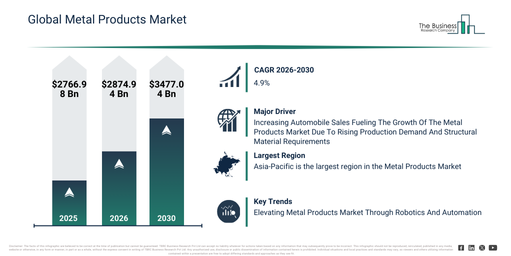
The metal products market has experienced consistent growth in its size over recent years. It is projected to expand from $2766.98 billion in 2025 to $2874.94 billion by 2026, at a compound annual growth rate (CAGR) of 3.9%. Historically, this growth has been influenced by factors such as the expansion of the construction industry, the increasing size of the manufacturing sector, a greater need for fasteners and hardware, the wider use of structural metals, and the growth in the production of industrial machinery and equipment.
The metal products market is projected to experience consistent expansion over the upcoming years. This market is set to reach $3477.04 billion by 2030, exhibiting a compound annual growth rate (CAGR) of 4.9%. This anticipated growth during the forecast timeframe stems from a surge in infrastructure development initiatives, escalating demand for bespoke metal fabrications, the proliferation of renewable energy setups, the broadening scope of precision engineering uses, and the integration of cutting-edge manufacturing techniques. Key developments anticipated in the forecast period encompass an increasing need for forged and stamped metal items, a greater reliance on precision machined and CNC components, the broadening of architectural and structural metal functionalities, the rising incorporation of metal hardware and fasteners, and an emphasis on specialized metal products and tailored fabrications.
Get A Free Sample Report With In-Depth Market Insights:
Metal Products Market Demand Drivers Opening New Revenue Streams
The expanding sales of automobiles are projected to stimulate the advancement of the metal products market moving forward. Vehicles necessitate significant application of metal constituents, including steel and aluminum, in elements such as vehicle bodies, chassis, frames, and structural components, making the automotive sector one of the primary global consumers of metal products. A surge in vehicle demand results in elevated manufacturing activities, which, in turn, intensifies the requirement for metal fabrication, processing, and component production. Additionally, the industry’s shift toward larger SUVs, trucks, and technologically advanced vehicles further increases metal usage due to their expanded dimensions and enhanced structural and safety specifications. For instance, in March 2025, according to the European Automobile Manufacturers’ Association (ACEA), a Europe-based Automobile Association, global car sales in 2024 reached 74.6 million units, marking a 2.5% increase compared to 2023. Therefore, the escalating demand for automobiles is a key factor propelling the growth of the metal products market.
Metal Products Market Segmentation: How Does The Market Break Down By Category?
The metal products market covered in this report is segmented –
1) By Type: Forged and Stamped Goods, Cutlery and Hand Tools, Architectural And Structural Metals, Boiler, Tank, And Shipping Container, Hardware, Spring And Wire Products, Machine Shops, Turned Product, Screw, Nut And Bolt, Other Types
2) By Metal Type: Copper, Other Metal Types, Zinc, Nickel, Lead
3) By End User: Construction, Manufacturing, Other End Users
Subsegments:
1) By Forged And Stamped Goods: Forged Components, Stamped Parts, Cold Formed Parts, Hot Forged Parts
2) By Cutlery And Hand Tools: Kitchen Cutlery, Hand Tools, Garden Tools, Professional Tools
3) By Architectural And Structural Metals: Steel Beams And Columns, Metal Decking, Roofing And Siding Panels, Metal Framing Systems
4) By Boiler, Tank, And Shipping Container: Pressure Vessels, Storage Tanks, Shipping Containers, Boiler Components
5) By Hardware: Fasteners, Door And Window Hardware, Furniture Hardware, Builders’ Hardware
6) By Spring And Wire Products: Compression Springs, Extension Springs, Wire Forms, Specialty Springs
7) By Machine Shops: Precision Machined Components, Custom Machining Services, CNC Machined Parts, Tooling And Fixture Manufacturing
8) By Turned Products: Turned Metal Parts, CNC Turned Components, Precision Turned Parts
9) By Screw, Nut, And Bolt: Standard Fasteners, Specialty Fasteners, Custom Fastener Manufacturing
10) By Other Types: Powder Coated Products, Anodized Metal Parts, Engraved Components, Heat-Treated Steel Parts, Gate Valves, Ball Valves, Check Valves, Control Valves, Metal Fabrications, Assemblies And Subassemblies, Specialty Metal Products
Metal Products Market Trends Powering Strategic Industry Growth
Numerous metal products manufacturers are adopting robotics and automation to enhance the efficiency and productivity of their facilities. Robotics represents an interdisciplinary field of technology and engineering concerned with the design, construction, operation, and utilization of robots. Automation, conversely, involves using technology to lessen human intervention in processes by predetermining decision criteria, relationships between subprocesses, and associated actions, then embodying these determinations within machines. Automation contributes to consistent quality in metal products. Robots possess the capability to weld, cut, and fabricate metal with remarkable accuracy, thereby minimizing defects and the need for rework. This ultimately yields higher-quality metal products that meet or exceed established industry standards. For instance, in September 2023, the International Federation of Robotics (IFR), a professional non-profit organization based in Germany, released its latest World Robotics report, which indicated that 553,052 industrial robots were installed globally in 2022, marking a 5% year-on-year growth. Out of this total, 73% were deployed in Asia, 15% in Europe, and 10% in the Americas. Companies such as FANUC, KUKA, ABB, and Motoman are prominent examples of those supplying industrial robots to metals companies.
Metal Products Market Industry Leaders And Competitive Landscape
Major companies operating in the metal products market report are Stanley Black & Decker, Inc, Illinois Tool Works Inc, Techtronic Industries Co. Ltd., Schaeffler Technologies AG & Co. KG, Assa Abloy AB, Apex Tool Group, Channellock, Inc, Snap-on, Kennametal Inc, Flowserve Corporation, Ball Corporation, China International Marine Containers (Group) Ltd., Bekaert SA, Gibraltar Industries, Consolidated Steel Industries Ltd, AL Shafar Steel Engineering, Ajmal Steel Tubes & Pipes Industries LLC, Fenster Aluminum Ltd, Dynamic Structures, Ningbo BST Metal Products Co., Ltd, Mueller Industries, Suzuki Garphyttan AB
View The Full Metal Products Market Report:
Metal Products Market Regional Analysis And Leading Geography
Asia-Pacific was the largest region in the metal products market in 2025. Western Europe was the second-largest region in the metal products market. The regions covered in the metal products market are Asia-Pacific, South East Asia, Western Europe, Eastern Europe, North America, South America, Middle East, Africa.
Reach Out To Our Team:
The Business Research Company: https://www.thebusinessresearchcompany.com/
Americas: +1 310-496-7795
Asia: +44 7882 955267 & +91 8897263534
Europe: +44 7882 955267
Email us at: marketing@tbrc.info
Follow us on:
LinkedIn: https://in.linkedin.com/company/the-business-research-company
YouTube: https://www.youtube.com/channel/UC24_fI0rV8cR5DxlCpgmyFQ
Global Market Model: https://www.thebusinessresearchcompany.com/global-market-model

Wasay has over a decade of experience in market research, data modelling, and analytics, with prior experience at GlobalData and Decision Tree Consulting Services. At The Business Research Company , he leads research operations across syndicated studies, customized consulting engagements, and the Global Market Model platform. His professional experience includes supporting organizations such as Boston Consulting Group, KPMG, and Ernst & Young. Wasay holds a degree in Electronics and Communications Engineering, postgraduate management qualifications from International Management Institute Belgium and Indian School of Business and Entrepreneurship, and completed the Integrated Program in Business Analytics from Indian Institute of Management Indore.