
Built to provide research that’s more actionable and strategically valuable, The Business Research Company’s 2026 market reports include market attractiveness analysis, total addressable market sizing, company benchmarking matrices, interactive Excel dashboards, broader supply chain intelligence, emerging startup tracking, and in-depth product insights.
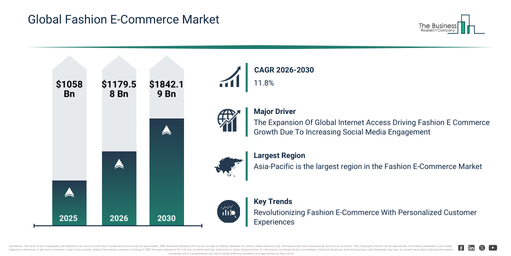
#Fashion E-Commerce Market Poised To Hit $1842.19 Billion By 2030 With A 11.8% CAGR#_x000D_
The fashion e-commerce market has observed substantial growth in recent years. It is expected to expand from $1058 billion in 2025 to $1179.58 billion in 2026, marking a compound annual growth rate (CAGR) of 11.5%. This market’s historical development can be attributed to factors like increasing internet penetration, widespread smartphone adoption, the proliferation of online payment systems, an expanding middle-class population, and the globalization of fashion brands._x000D_
_x000D_
The fashion e-commerce market is projected to experience substantial expansion in the coming years, anticipated to reach a valuation of $1842.19 billion by 2030, demonstrating a compound annual growth rate (CAGR) of 11.8%. Key factors contributing to this growth during the forecast period include the increasing adoption of AI-driven fashion recommendation systems, a growing consumer preference for sustainable fashion, the expansion of social media marketing within the fashion sector, technological advancements in virtual fitting rooms, and the broader expansion of cross-border e-commerce activities. Prominent trends expected over the forecast period encompass the escalating prevalence of mobile commerce in fashion, the emphasis on personalized shopping experiences, the swift development of fast fashion e-commerce, the widening reach of social commerce channels, and an increasing consumer demand for omnichannel retail solutions._x000D_
_x000D_
#Get A Free Sample Report With In-Depth Market Insights:#_x000D_
_x000D_
#Fashion E-Commerce Market Growth Drivers: What’s Behind The Acceleration?#_x000D_
The swift expansion of worldwide Internet availability is anticipated to stimulate the growth of the fashion e commerce market going forward. Internet access refers to individuals’ capability to connect to and use the Internet through devices such as smartphones, computers, and tablets, facilitating engagement with online content, platforms, and services. The wider spread of Internet connectivity expands the potential audience for social media platforms, enabling more consumers to discover fashion trends, interact with influencers, and make purchases directly through social apps. For instance, in November 2024, according to the International Telecommunication Union (ITU), a specialized agency of the United Nations based in Switzerland, a total of 5.5 billion people were online in 2024, representing 68% of the world’s population, which is up from 65% one year earlier. Therefore, the broadening of global Internet access is propelling the growth of the fashion e commerce market._x000D_
_x000D_
#Fashion E-Commerce Market Segment Trends And Revenue Contributors#_x000D_
The fashion e-commerce market covered in this report is segmented – _x000D_
_x000D_
1) By Product: Apparel Or Clothing, Accessories, Footwear, Cosmetics, Other Products_x000D_
2) By Model Type: Business to Business (B2B), Business to Consumer (B2C)_x000D_
3) By End User: Men, Women, Children _x000D_
_x000D_
Subsegments:_x000D_
1) By Apparel Or Clothing: Women’s Clothing, Men’s Clothing, Children’s Clothing, Activewear, Swimwear, Outerwear _x000D_
2) By Accessories: Bags and Purses, Jewelry, Watches, Belts, Sunglasses, Scarves and Hats _x000D_
3) By Footwear: Athletic Shoes, Casual Shoes, Formal Shoes, Sandals and Slippers, Boots _x000D_
4) By Cosmetics: Skincare Products, Makeup Products, Fragrances, Hair Care Products, Nail Products _x000D_
5) By Other Products: Fashion Tech (smartwatches, fitness trackers), Lingerie and Sleepwear, Underwear, Active Accessories (gym bags, yoga mats), Home and Lifestyle Fashion Products _x000D_
_x000D_
#Fashion E-Commerce Market Trends: What’s Defining The Industry’s Next Phase?#_x000D_
Leading companies in the fashion e-commerce market are concentrating on developing solutions such as AI-powered style recommendation systems to enhance personalized fashion discovery and improve customer engagement. An AI-powered style recommendation system is a technology-driven solution that harnesses artificial intelligence, machine learning, and data analytics to analyze user preferences, behaviors, and trends, subsequently offering personalized fashion and styling suggestions to elevate the shopping experience and interaction. For instance, in May 2023, Myntra, an India-based fashion e-commerce company, launched My Stylist, an innovative fashion feature on its app. This feature employs AI algorithms, deep learning models, and computer vision to recommend complete, personalized outfits from its extensive fashion catalog. My Stylist helps existing customers discover and shop for full looks based on their recent app purchases, browsed products, or popular platform outfits with high user engagement, while new customers can upload images of their offline wardrobe items for outfit pairing ideas, thereby offering a seamless shopping experience._x000D_
_x000D_
#Fashion E-Commerce Market Key Players Shaping Industry Direction#_x000D_
Major companies operating in the fashion e-commerce market are Zalando SE, ASOS plc, Boohoo Group plc, Stitch Fix Inc, Global Fashion Group SA, Amazon.com Inc, eBay Inc, Alibaba Group Holding Limited, JD.com Inc, Hennes and Mauritz AB, Nike Inc, Adidas AG, Lululemon Athletica Inc, Under Armour Inc, Fast Retailing Co Ltd, Next plc, Macys Inc, Nordstrom Inc, Snapdeal Limited, Noon, Shein Group, Wildberries, Lamoda, Americanas, Magalu, Netshoes, Revolve Group, Net a Porter, Sivvi _x000D_
_x000D_
#View The Full Fashion E-Commerce Market Report:#_x000D_
_x000D_
#Fashion E-Commerce Market Regional Analysis: Which Geography Leads On Revenue?#_x000D_
Asia-Pacific was the largest region in the fashion e-commerce market in 2025. Western Europe was the second largest region in the global fashion e-commerce market share. The regions covered in the fashion e-commerce market report are Asia-Pacific, South East Asia, Western Europe, Eastern Europe, North America, South America, Middle East and Africa._x000D_
_x000D_
#Reach Out To Our Team:#_x000D_
_x000D_
The Business Research Company: https://www.thebusinessresearchcompany.com/_x000D_
Americas: +1 310-496-7795_x000D_
Asia: +44 7882 955267 & +91 8897263534_x000D_
Europe: +44 7882 955267_x000D_
Email us at: marketing@tbrc.info_x000D_
_x000D_
#Follow us on:#_x000D_
_x000D_
LinkedIn: https://in.linkedin.com/company/the-business-research-company_x000D_
YouTube: https://www.youtube.com/channel/UC24_fI0rV8cR5DxlCpgmyFQ_x000D_
Global Market Model: https://www.thebusinessresearchcompany.com/global-market-model

Wasay has over a decade of experience in market research, data modelling, and analytics, with prior experience at GlobalData and Decision Tree Consulting Services. At The Business Research Company , he leads research operations across syndicated studies, customized consulting engagements, and the Global Market Model platform. His professional experience includes supporting organizations such as Boston Consulting Group, KPMG, and Ernst & Young. Wasay holds a degree in Electronics and Communications Engineering, postgraduate management qualifications from International Management Institute Belgium and Indian School of Business and Entrepreneurship, and completed the Integrated Program in Business Analytics from Indian Institute of Management Indore.