
Built to provide research that’s more actionable and strategically valuable, The Business Research Company’s 2026 market reports include market attractiveness analysis, total addressable market sizing, company benchmarking matrices, interactive Excel dashboards, broader supply chain intelligence, emerging startup tracking, and in-depth product insights.
Corporate E-learning Market Size, Value And Growth Trajectory Through 2030
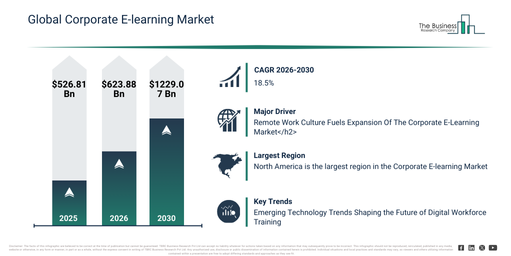
The corporate e-learning market size has experienced rapid growth in recent years. This market is forecasted to increase from $526.81 billion in 2025 to $623.88 billion in 2026, exhibiting a compound annual growth rate (CAGR) of 18.4%. The historical period’s expansion can be linked to the rise of digital workforce training initiatives, a growing demand for standardized employee skill development, the adoption of online training platforms, the growth of global enterprises, and an increased focus on employee productivity.
The corporate e-learning market is anticipated to experience substantial growth in the foreseeable future. This market is projected to reach a valuation of $1229.07 billion by 2030, exhibiting a compound annual growth rate (CAGR) of 18.5%. This expansion throughout the forecast period stems from factors such as enhanced adoption of AI-driven adaptive learning, increasing demand for immersive training technologies, the growth in enabling remote workforces, a heightened emphasis on reskilling and upskilling initiatives, and greater investments in scalable learning platforms. Key trends anticipated during this period encompass the wider adoption of personalized digital learning platforms, a surge in the integration of AI-based learning analytics, an expanding utilization of microlearning and mobile training modules, the broadening of immersive virtual training content, and an intensified focus on ongoing skill development.
Get A Free Sample Report With In-Depth Market Insights:
Corporate E-learning Market Growth Momentum: What Factors Are Shaping Demand?
The expanding remote work culture is projected to boost the growth of the corporate e-learning market in the future. This culture signifies a shift in organizational norms and practices, allowing employees to perform their duties away from conventional office environments, often from home or other distant places. Its increasing prevalence can be attributed to advancements in digital technology, a demand for greater flexibility, and the imperative for uninterrupted business operations. Corporate e-learning supports this remote work trend by offering adaptable and easily accessible training, thereby facilitating ongoing skill enhancement and knowledge building for a scattered workforce. For example, data from February 2023, shared by the Office for National Statistics, a UK-based non-ministerial department, indicated that from April 27 and May 8, 2022, following the removal of work-from-home recommendations in Great Britain, about 38% of employed adults reported having worked remotely. More recently, between January 25 to February 5, 2023, roughly 40% of working adults reported working from home at least once within the preceding week. Consequently, the expanding remote work culture is a significant factor propelling the growth of the corporate e-learning market.
Corporate E-learning Market Segment Outlook: Which Categories Are Growing Fastest?
The corporate e-learning market covered in this report is segmented –
1) By Technology: Learning Management System (LMS), Online E-learning, Mobile E-learning, Virtual Classroom, Rapid E-learning, Other Technologies
2) By Deployment: Cloud-Based, On-premises
3) By Organization Size: Small And Medium-Sized Enterprises, Large Enterprises
4) By Provider: Instructor Led And Text Based, Outsourced
Subsegments:
1) By Learning Management System (LMS): Cloud-Based LMS, On-Premises LMS, Open-Source LMS, Corporate LMS Platforms
2) By Online E-Learning: Instructor-Led Online Training, Self-Paced Online Courses, Webinars And Virtual Workshops
3) By Mobile E-Learning: Mobile Apps For E-Learning, Mobile-Optimized Content, Microlearning Via Mobile Devices
4) By Virtual Classroom: Video Conferencing Tools, Real-Time Collaboration Platforms, Virtual Training Rooms
5) By Rapid E-Learning: Authoring Tools For Quick Content Creation, Template-Based Learning Modules, Adaptive Learning Solutions
6) By Other Technologies: Gamification in E-Learning, Augmented Reality (AR) Or Virtual Reality (VR), Artificial Intelligence (AI) and Machine Learning (ML) in Learning, Social Learning Platforms
Corporate E-learning Market Trends Redefining Industry Growth
Leading companies in the corporate e learning market are prioritizing the development of sophisticated solutions like AI powered authoring technology to boost training effectiveness and improve workforce capabilities. This AI powered authoring technology utilizes automated content creation features, enabling organizations to rapidly construct tailored training materials, which in turn supports quicker onboarding and enhanced employee performance. For example, in August 2025, Paradiso Solutions Corporation, a US-based e-learning technology firm, unveiled Paradiso Free LMS, which includes an AI powered e learning authoring tool designed to help businesses create and manage engaging training content. This offering supports up to one hundred users and provides full access to core LMS features, assisting small and medium teams in streamlining their learning activities. The platform features an extensive course catalog, delivering professional and certification-ready content intended to upgrade workforce skills. It also provides advanced analytics and reporting tools, allowing organizations to monitor performance and make informed decisions. Its mobile-ready design ensures training is accessible anytime on iOS and Android, and the system supports customized learning paths, alongside gamification and certifications, all contributing to increased engagement and stronger employee development.
Corporate E-learning Market Top Companies Driving Competitive Growth
Major companies operating in the corporate e-learning market areThe International Business Machines Corporation, Oracle Corporation, SAP SE, Adobe Inc., LinkedIn Corporation, Cornerstone OnDemand Inc., Blackboard Inc., Learning Technologies Group plc, Skillsoft Corporation, Cegos Group, Docebo Inc., D2L Corporation, SumTotal Systems LLC, IgniteTech, HIVE Blockchain Technologies Ltd., Coveo Solutions Inc., Learning Pool Limited, CrossKnowledge Group, Kallidus Ltd., Media Zoo, Mind Tools, iSpring Solutions Inc., GeoMetrix Data Systems Inc., CERTPOINT Systems, Moodle Pty Ltd.
View The Full Corporate E-learning Market Report:
Corporate E-learning Market Global Footprint: Which Region Leads The Industry?
North America was the largest region in the corporate e-learning market in 2025.Asia-Pacific is expected to be the fastest-growing region in the forecast period. The regions covered in the corporate e-learning market report are Asia-Pacific, South East Asia, Western Europe, Eastern Europe, North America, South America, Middle East, Africa.
Reach Out To Our Team:
The Business Research Company: https://www.thebusinessresearchcompany.com/
Americas: +1 310-496-7795
Asia: +44 7882 955267 & +91 8897263534
Europe: +44 7882 955267
Email us at: marketing@tbrc.info
Follow us on:
LinkedIn: https://in.linkedin.com/company/the-business-research-company
YouTube: https://www.youtube.com/channel/UC24_fI0rV8cR5DxlCpgmyFQ
Global Market Model: https://www.thebusinessresearchcompany.com/global-market-model

Wasay has over a decade of experience in market research, data modelling, and analytics, with prior experience at GlobalData and Decision Tree Consulting Services. At The Business Research Company , he leads research operations across syndicated studies, customized consulting engagements, and the Global Market Model platform. His professional experience includes supporting organizations such as Boston Consulting Group, KPMG, and Ernst & Young. Wasay holds a degree in Electronics and Communications Engineering, postgraduate management qualifications from International Management Institute Belgium and Indian School of Business and Entrepreneurship, and completed the Integrated Program in Business Analytics from Indian Institute of Management Indore.