Featuring market attractiveness scoring, total addressable market sizing, company benchmarking matrices, interactive Excel dashboards, deeper supply chain intelligence, emerging startup tracking, and granular product-level insights, The Business Research Company’s 2026 market reports are built to deliver research that is both more actionable and more strategically valuable.
Industrial Fabric Market Revenue Outlook: What CAGR Lies Ahead Through 2030?
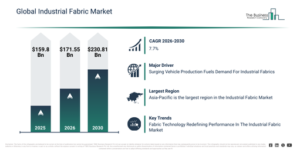
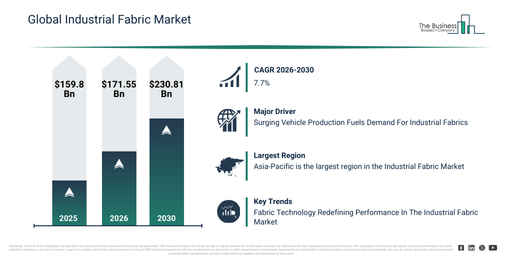
The industrial fabric market has demonstrated significant expansion in recent years. This market is anticipated to increase from $159.8 billion in 2025 to $171.55 billion in 2026, advancing at a compound annual growth rate (CAGR) of 7.4%. Historically, this growth can be ascribed to elements such as the expansion of manufacturing activities and industrial safety demands, the proliferation of conveyor belt installations, the growing utilization of protective apparel, a surge in the need for automotive interior textiles, and the accessibility of advanced synthetic fibers.
The industrial fabric market is projected to experience substantial expansion in the coming years, reaching a valuation of $230.81 billion by 2030, propelled by a compound annual growth rate (CAGR) of 7.7%. This anticipated growth during the forecast period is fueled by several factors, including the escalating demand for sustainable industrial fabrics, the increasing integration of aramid and composite fibers, the growth in electric vehicle manufacturing, the expanding application of industrial fabrics in infrastructure initiatives, and developments in fiber engineering technologies. Key trends anticipated within the forecast timeframe involve the greater utilization of high-strength industrial textiles, a rising preference for flame-resistant fabrics, an increasing need for lightweight composite fabrics, the broader application of industrial fabrics in the automotive sector, and a heightened emphasis on both durability and load-bearing performance.
Get A Free Sample Report With In-Depth Market Insights:
Industrial Fabric Market Growth Catalysts And Demand Drivers
The rising need for vehicle manufacturing is anticipated to boost the expansion of the industrial fabric market in the future. The process of vehicle production involves the manufacturing of motorized transport, including automobiles, lorries, motorbikes, and various other vehicle categories. Industrial fabrics, specifically polyester and nylon, find application in vehicle production. Polyester fiber, in particular, serves numerous purposes within the automotive industry, appearing in knitted, woven, and nonwoven forms, notably as needle punch and stitch bond fabrics for face materials, and as woven materials for airbags and seat belts. For example, data from June 2023, provided by the European Automobile Manufacturers Association – a Belgium-based organization advocating for European automobile manufacturers – indicates that about 13 million Europeans are employed within the automotive industry, accounting for 7% of all EU jobs. This sector makes up 11.5% of manufacturing employment in the EU, encompassing around 3.4 million roles. Annually, the EU manufactures 13.1 million cars, vans, trucks, and buses, establishing it as a crucial industry. The automotive sector in Europe holds a leading position globally, achieving a €101.9 billion trade surplus through its premium Made in Europe goods. Consequently, the escalating demand for vehicle manufacturing is fueling the expansion of the industrial fabric market.
Industrial Fabric Market Segmentation: How Does The Market Break Down By Category?
The industrial fabric market covered in this report is segmented –
1) By Fiber Type: Aramid, Polyester, Polyamide, Fiberglass, Composite, Other Fiber Types
2) By Application: Conveyor Belt, Automotive Carpet, Flame Resistance Apparel, Transmission Belt, Protective Apparel, Other Applications
3) By End-User: Industrial, Automotive, Construction, Defense, Filtration
Subsegments:
1) By Aramid: Para-Aramid, Meta-Aramid
2) By Polyester: PET (Polyethylene Terephthalate), PBT (Polybutylene Terephthalate)
3) By Polyamide: Nylon 6, Nylon 66
4) By Fiberglass: E-Glass, S-Glass
5) By Composite: Carbon Fiber Composites, Glass Fiber Composites
6) By Other Fiber Types: Natural Fibers, Specialty Synthetic Fibers
Industrial Fabric Market Trends Shaping Long-Term Demand
Leading companies active in the industrial fabric market are incorporating inventive technologies, such as fabric technology, to offer dependable services to customers. Fabric technology refers to the expansive domain of innovations and progress in textile materials and their manufacturing procedures. For instance, in January 2023, Reliance Industries Limited, an India-based multinational conglomerate company, introduced a novel fabric technology named HEXaREL, specifically designed for clothing and home textiles. This is a transformative fabric technology that presents an unparalleled blend of exceptional characteristics previously absent in a single fabric or garment. HEXaREL fabrics skillfully regulate your body temperature, keeping you cool during warm weather and warm during cold conditions. This effect is accomplished through a distinct fiber structure and phase-change materials that absorb and release heat as required.
Industrial Fabric Market Top Companies Driving Competitive Growth
Major companies operating in the industrial fabric market are Saint-Gobain S.A., Bridgestone Corporation, Kimberly-Clark Corporation, Toray Industries Inc., Berry Global Inc., DuPont de Nemours Inc., Ahlstrom-Munksjö Oyj, Donaldson Company Inc., Milliken & Company, Lenzing AG, Freudenberg Performance Materials SE & Co KG, Forbo International SA, Albany International Corp., Johns Manville Corp, Hollingsworth & Vose Co, Fitesa SA, Scott Bader Co Ltd., GSE Environmental, Habasit AG, Leigh Fibers, Jason Mills LLC, Herculite Products Inc., Apex Mills Corp, Cerex Advanced Fabrics Inc., Barnet GmbH & Co KG, TVF Carmel
View The Full Industrial Fabric Market Report:
Industrial Fabric Market Global Footprint: Which Region Leads The Industry?
Asia-Pacific was the largest region in the industrial fabric market in 2025, and is expected to be the fastest-growing region in the forecast period. The regions covered in the industrial fabric market report are Asia-Pacific, South East Asia, Western Europe, Eastern Europe, North America, South America, Middle East, Africa.
Reach Out To Our Team:
The Business Research Company: https://www.thebusinessresearchcompany.com/
Americas: +1 310-496-7795
Asia: +44 7882 955267 & +91 8897263534
Europe: +44 7882 955267
Email us at: marketing@tbrc.info
Follow us on:
LinkedIn: https://in.linkedin.com/company/the-business-research-company
YouTube: https://www.youtube.com/channel/UC24_fI0rV8cR5DxlCpgmyFQ
Global Market Model: https://www.thebusinessresearchcompany.com/global-market-model

Wasay has over a decade of experience in market research, data modelling, and analytics, with prior experience at GlobalData and Decision Tree Consulting Services. At The Business Research Company , he leads research operations across syndicated studies, customized consulting engagements, and the Global Market Model platform. His professional experience includes supporting organizations such as Boston Consulting Group, KPMG, and Ernst & Young. Wasay holds a degree in Electronics and Communications Engineering, postgraduate management qualifications from International Management Institute Belgium and Indian School of Business and Entrepreneurship, and completed the Integrated Program in Business Analytics from Indian Institute of Management Indore.