Built to provide research that’s more actionable and strategically valuable, The Business Research Company’s 2026 market reports include market attractiveness analysis, total addressable market sizing, company benchmarking matrices, interactive Excel dashboards, broader supply chain intelligence, emerging startup tracking, and in-depth product insights.
Lyocell Fiber Market Forecast: Value Set To Climb From $1.72 Billion To $2.45 Billion
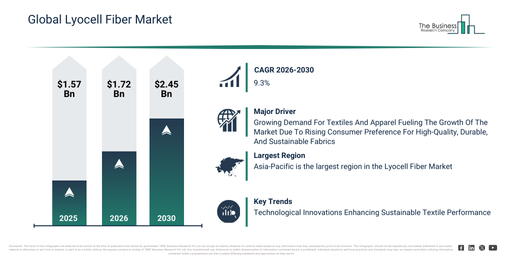
The lyocell fiber market has experienced substantial growth in recent years. It is projected to expand from $1.57 billion in 2025 to $1.72 billion in 2026, achieving a compound annual growth rate (CAGR) of 9.6%. Historically, this growth can be attributed to factors such as increasing consumer demand for eco-friendly textiles, the expansion of apparel manufacturing, greater adoption of cellulosic fibers, advancements in fiber production technology, and the accessibility of certified wood pulp sources.
The lyocell fiber market is projected to experience substantial expansion over the upcoming years. This market is forecast to reach $2.45 billion by 2030, exhibiting a compound annual growth rate (CAGR) of 9.3%. Factors driving this growth during the projected period include a surging demand for eco-friendly fashion fabrics, greater integration of lyocell in technical textile uses, an increase in hygiene and medical textile applications, rising capital expenditure in circular textile manufacturing, and advancements in fiber blending technologies. Prominent trends anticipated within this forecast timeframe encompass an expanding utilization of sustainable and biodegradable fibers, an escalating need for lyocell in clothing, the development of diverse blended lyocell textile items, heightened implementation in medical and hygiene sectors, and a sharpened emphasis on closed-loop production methods.
Get A Free Sample Report With In-Depth Market Insights:
Lyocell Fiber Market Development Factors: What’s Supporting Demand?
The increasing need for textiles and apparel is anticipated to boost the expansion of the lyocell fiber market in the future. This sector, known as textiles and apparel, covers the extensive industry involved in producing, designing, and distributing materials, garments, and accompanying items for individual, business, or industrial applications. The rising demand within textiles and apparel stems from consumers’ growing inclination towards superior, resilient, and cutting-edge fabric options, as they look for garments that are lasting, pleasant, fashionable, and provide enhanced functionality and environmental responsibility. Lyocell fiber elevates textile and apparel items by providing materials that are soft, allow air circulation, and are robust, positioning it as an excellent choice for attire, household fabrics, and sportswear. It contributes to better comfort and effective moisture handling, simultaneously backing sustainability efforts through environmentally sound manufacturing methods. As an illustration, in June 2024, data from the International Trade Administration, a US-based government entity, indicated that the imports of textiles and apparel for the year-to-date period concluding in April 2024 amounted to 30, 095.1 million square meter equivalents (MSME), signifying a 9.5% rise when juxtaposed with the corresponding period in 2023. Consequently, the increasing need for textiles and apparel is propelling the expansion of the lyocell fiber market.
Lyocell Fiber Market Segment Outlook: Which Categories Are Growing Fastest?
The lyocell fiber market covered in this report is segmented –
1) By Fiber Type: Lyocell Staple Fiber, Lyocell Filament Fiber, Blended Lyocell Fiber
2) By Product Type: Staple Fiber, Filament Fiber
3) By Distribution Channel: Online Retail, Offline Retail, Direct Sales, Wholesale Distributors
4) By Application: Apparel, Home Textiles, Medical And Hygiene, Automotive Filters, Other Applications
5) By End User: Textile Industry, Healthcare, Automotive, Other End-Users
Subsegments:
1) By Lyocell Staple Fiber: Short Fibers Used In Spinning Yarns, Fibers For Nonwoven Fabrics, Fibers For Blended Textiles
2) By Lyocell Filament Fiber: Continuous Filament Yarns, High-Strength Textile Applications, Technical Textiles
3) By Blended Lyocell Fiber: Cotton-Lyocell Blends, Wool-Lyocell Blends, Synthetic-Lyocell Blends
Lyocell Fiber Market Transformation Trends: What Innovations Are Driving Change?
Major companies operating in the lyocell fiber market are focusing on developing innovative products, such as fiber crimps, to enhance fabric texture, improve durability, and expand applications in sustainable textiles. Fiber crimps describe the natural or engineered waviness or bends in a fiber that increase its bulk, elasticity, and ability to trap air, thereby improving fabric softness, resilience, and insulation properties. For instance, in January 2024, Lenzing AG, an Australia-based chemical industry company, launched advancements in its Tencel Lyocell fibers, emphasizing innovation in natural aesthetics and sustainability. It offers a natural, textured appearance inspired by nature, combining deliberate staple length variations with a matte finish for authentic fabric aesthetics. It provides sustainable benefits with at least 50% less water and carbon footprint than generic lyocell, while delivering softness, moisture management, excellent durability and enhanced fabric bulk and resilience due to the crimped fibers. This innovation expands creative textile possibilities, especially for premium denim and apparel, meeting the growing demand for eco-friendly and high-quality fabrics.
Lyocell Fiber Market Top Companies Driving Competitive Growth
Major companies operating in the lyocell fiber market are Lenzing AG, Aditya Birla Group, Sateri, Acelon Chemicals & Fiber Corporation, Smartfiber AG, Qingdao Textiles Group Fiber Technology Co Ltd, Baoding Swan Fiber Co Ltd, Great Duksan, Zhejiang Yibin Grace Group Co Ltd, Tangshan Sanyou Group Xingda Chemical Fibre Co Ltd, Shandong Yingli Industrial Co Ltd, Nien Foun Fiber Co Ltd, Acegreen Eco-Material Technology Co Ltd, Chonbang Co Ltd, Hubang Lyocell, Grecell, Hi-Tech Fiber Group Corporation, Chengdu Huaming Cellulose Co Ltd, Xinxiang Bailu Chemical Fiber Co Ltd, Shandong Silver Hawk Chemical Fibre Co Ltd
View The Full Lyocell Fiber Market Report:
Lyocell Fiber Market Global Footprint: Which Region Leads The Industry?
Asia-Pacific was the largest region in the lyocell fiber market in 2025. Asia-Pacific is expected to be the fastest-growing region in the forecast period. The regions covered in the lyocell fiber market report are Asia-Pacific, South East Asia, Western Europe, Eastern Europe, North America, South America, Middle East, Africa.
Reach Out To Our Team:
The Business Research Company: https://www.thebusinessresearchcompany.com/
Americas: +1 310-496-7795
Asia: +44 7882 955267 & +91 8897263534
Europe: +44 7882 955267
Email us at: marketing@tbrc.info
Follow us on:
LinkedIn: https://in.linkedin.com/company/the-business-research-company
YouTube: https://www.youtube.com/channel/UC24_fI0rV8cR5DxlCpgmyFQ
Global Market Model: https://www.thebusinessresearchcompany.com/global-market-model

Wasay has over a decade of experience in market research, data modelling, and analytics, with prior experience at GlobalData and Decision Tree Consulting Services. At The Business Research Company , he leads research operations across syndicated studies, customized consulting engagements, and the Global Market Model platform. His professional experience includes supporting organizations such as Boston Consulting Group, KPMG, and Ernst & Young. Wasay holds a degree in Electronics and Communications Engineering, postgraduate management qualifications from International Management Institute Belgium and Indian School of Business and Entrepreneurship, and completed the Integrated Program in Business Analytics from Indian Institute of Management Indore.