
Enhanced with market attractiveness analysis, total addressable market evaluation, company benchmarking matrices, interactive Excel dashboards, expanded supply chain intelligence, emerging startup coverage, and detailed product insights, The Business Research Company’s 2026 market reports deliver more actionable and strategically valuable research.
#Military Deployable Infrastructure Market Size And Revenue Forecast Through 2030
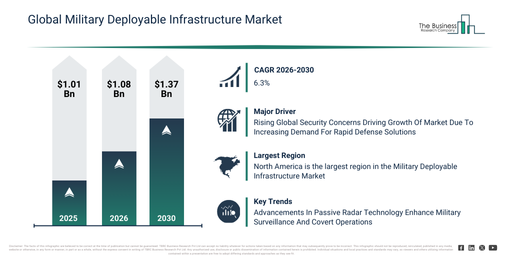
The military deployable infrastructure market size has experienced strong growth in recent years. It is forecast to increase from $1.01 billion in 2025 to $1.08 billion in 2026, exhibiting a compound annual growth rate (CAGR) of 6.4%. The expansion observed historically can be attributed to several factors: increasing global military operations and expeditionary missions, a rising demand for rapid deployment and modular infrastructure, advancements in lightweight and transportable construction materials, growing investment in disaster relief and emergency response capabilities, and the expansion of mobile communication and power generation units for field operations.
The military deployable infrastructure market is projected to experience substantial expansion over the coming years, with its value anticipated to reach $1.37 billion by 2030, demonstrating a compound annual growth rate (CAGR) of 6.3%. This projected growth is driven by several factors, including the creation of intelligent and interconnected deployable infrastructure featuring integrated monitoring, a growing uptake of energy-efficient and sustainable modular components, and the expanded deployment of prefabricated and quickly deployable medical and command structures. Additionally, the expansion of nascent defense markets undertaking modernization efforts and the incorporation of AI and IoT technologies for improved operational efficiency and remote oversight contribute significantly. Key trends anticipated during this period encompass an escalating requirement for modular and swiftly deployable military base configurations, increased utilization of mobile medical and command units for expeditionary deployments, and a greater application of deployable shelters in disaster relief and humanitarian efforts. Furthermore, there’s a noticeable shift towards infrastructure materials that are lightweight, durable, and resilient to varying climates, alongside a rising necessity for scalable, mission-specific deployable systems suitable for diverse geographical conditions.
Download A Free Sample Report For Comprehensive Market Insights:
Military Deployable Infrastructure Market Expansion Supported By Key Demand Factors
Escalating concerns regarding worldwide security are anticipated to drive the expansion of the military deployable infrastructure market moving ahead. Global security encompasses the approaches and tactics employed to safeguard countries, communities, and people against dangers like conflicts, acts of terrorism, and ecological issues. Currently, global security worries are heightened, stemming from increasing geopolitical instability, cyber threats, and sophisticated warfare technologies, which contribute to greater worldwide unpredictability and hazards. Military deployable infrastructure offers swift and adaptable assistance for military personnel, allowing for efficient countermeasures against worldwide security dangers. As an illustration, in February 2024, data from the Global Terrorism Index, a publication by the Institute for Economics & Peace (an Australia-based research and education think tank), revealed that terrorism-related fatalities climbed to 8,352 in 2023, representing a 22% rise compared to the preceding year. Furthermore, the fatality rate of attacks also grew, with an average of 2.5 deaths per incident, up from 1.6 in 2022. Consequently, the increasing anxieties surrounding global security are fueling the expansion of the military deployable infrastructure market.
#Military Deployable Infrastructure Market Segment Landscape And Growth Potential
The military deployable infrastructure market covered in this report is segmented –
1) By Deployment Type: Rapid Deployment Systems, Permanent Deployable Solutions, Mobile Deployment Units
2) By Technology Used: Modular Construction Technologies, Renewable Energy Solutions, Advanced Communication Systems, Smart Logistics Technologies
3) By Application Area: Combat Operations, Peacekeeping Missions, Humanitarian Assistance, Disaster Relief Operations
Subsegments:
1) By Rapid Deployment Systems: Pre-Fabricated Shelters, Temporary Accommodation Units, Rapid Assembly Medical Facilities, Quick-Deploy Command Centers
2) By Permanent Deployable Solutions: Modular Barracks, Long-Term Medical Facilities, Fixed Command And Control Structures, Logistics And Storage Units
3) By Mobile Deployment Units: Mobile Hospitals, Mobile Communication Centers, Mobile Kitchen And Dining Units, Mobile Power And Water Supply Units
Military Deployable Infrastructure Market Growth Trends Influencing Competitive Dynamics
Major companies operating within the military deployable infrastructure market are increasingly focusing on integrating advanced technologies, such as passive radar, to improve covert surveillance, enhance threat detection, enable autonomous operations, and strengthen real-time battlefield intelligence and defense capabilities. Passive radar technology serves as a surveillance system that identifies and tracks targets by analyzing signals reflected from existing third-party transmitters without emitting its own. As an illustration, in August 2023, Hensoldt AG, a Germany-based aerospace company, unveiled the Twinvis Military Sheltered, a deployable variant of its passive radar system tailored for military applications. This system comes fully integrated into a shelter and can be readily deployed on military vehicles by just two personnel. It significantly enhances surveillance capabilities through covert operations and is capable of detecting stealth targets. The Twinvis system functions autonomously, relying on reflected signals from third-party transmitters for target detection.
Military Deployable Infrastructure Market Competitive Landscape: Who Are The Leading Companies?
Major companies operating in the military deployable infrastructure market are General Dynamics Corporation, Rheinmetall AG, AAR Corp., Kratos Defense & Security Solutions Inc., Marshall Land Systems Ltd., HDT Global Inc., C3 Systems S.L., Losberger De Boer Group, Rubb Military (Rubb Buildings Ltd.), Alaska Structures LLC, Weatherhaven Global Resources Ltd., EPE International Pty Ltd, Zodiac Milpro International, HTS Tentiq GmbH, Utilis S.A.S., Big Top Manufacturing Inc., Nordic Shelter AS, M. Schall GmbH & Co. KG, FORTS USA LLC, Gillard Shelters Ltd., Inflatable Structures Ltd.
Access The Complete Military Deployable Infrastructure Market Report:
Military Deployable Infrastructure Market Largest Region By Revenue And Market Share
North America was the largest region in the military deployable infrastructure market in 2025. Asia-Pacific is expected to be the fastest-growing region in the forecast period. The regions covered in the military deployable infrastructure market report are Asia-Pacific, South East Asia, Western Europe, Eastern Europe, North America, South America, Middle East, Africa.
Access a Customized Military Deployable Infrastructure Market Report for Deeper Competitive Insights
https://www.thebusinessresearchcompany.com/customise?id=22058&type=smp
The Business Research Company: https://www.thebusinessresearchcompany.com/
Americas: +1 310-496-7795
Asia: +44 7882 955267 & +91 8897263534
Europe: +44 7882 955267
Email us at: marketing@tbrc.info
Follow us on:
LinkedIn: https://in.linkedin.com/company/the-business-research-company
YouTube: https://www.youtube.com/channel/UC24_fI0rV8cR5DxlCpgmyFQ
Global Market Model: https://www.thebusinessresearchcompany.com/global-market-model

Wasay has over a decade of experience in market research, data modelling, and analytics, with prior experience at GlobalData and Decision Tree Consulting Services. At The Business Research Company , he leads research operations across syndicated studies, customized consulting engagements, and the Global Market Model platform. His professional experience includes supporting organizations such as Boston Consulting Group, KPMG, and Ernst & Young. Wasay holds a degree in Electronics and Communications Engineering, postgraduate management qualifications from International Management Institute Belgium and Indian School of Business and Entrepreneurship, and completed the Integrated Program in Business Analytics from Indian Institute of Management Indore.
